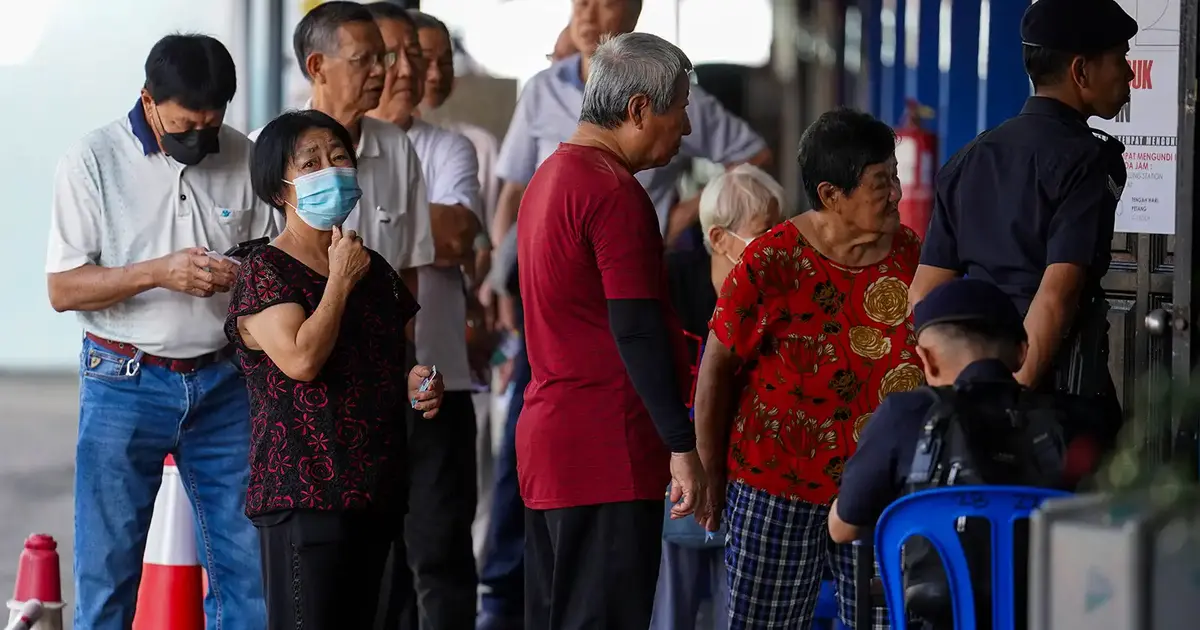
Pakatan Harapan's disappointing performance in the recent Johor state election resulted primarily from a collapse in Chinese voter participation rather than a significant realignment toward Barisan Nasional, according to Ong Teng Cheong, the former member of parliament for Bangi. The analysis contradicts assumptions that the coalition haemorrhaged support among ethnic Chinese, one of its traditionally receptive demographics, instead pointing to a mobilisation problem that may have broader implications for opposition strategy in the state.
Ong's assessment suggests that the machinery required to turn out Chinese voters—typically a core constituency for Pakatan Harapan—fundamentally broke down during the election campaign. Rather than voters actively choosing to support BN, many stayed at home, creating a relative advantage for the ruling coalition without necessarily winning fresh converts. This distinction carries significant weight in understanding the election's outcome and what remedial steps may be necessary ahead of future contests.
The voter turnout explanation offers a different narrative from the immediate post-election commentary, which had focused on whether Johor's Chinese community was abandoning the opposition due to policy disappointments, economic concerns, or shifting demographic preferences. If Ong's interpretation holds merit, it suggests the problem lies not with fundamental shifts in voter sentiment but rather with tactical and organisational shortcomings on Pakatan Harapan's part. Poor turnout among any demographic group typically reflects either ineffective ground campaigning, failure to communicate a compelling reason to vote, or broader disengagement from the political process.
The findings carry implications well beyond Johor's borders, as Chinese voter participation has become increasingly volatile across Malaysia following the 2018 general election. In urban centres and semi-urban areas of Selangor, Kuala Lumpur, and Penang, Chinese constituencies have historically pivoted between supporting reform-minded opposition coalitions and establishment parties depending on economic conditions, governance perceptions, and community concerns. Any structural weakness in mobilising this group threatens Pakatan Harapan's broader electoral prospects in the peninsula's most economically significant regions.
Ong's distinction between low turnout and voter defection also speaks to the different remedies available to political parties. If voters have permanently switched allegiance, reversing such losses requires fundamental repositioning on policy and leadership. Conversely, if the problem stems from failure to motivate existing sympathisers to cast ballots, the solution involves strengthened campaign organisation, clearer messaging, and renewed grassroots engagement. The latter presents a more tractable problem, though it demands significant investment in party machinery and volunteer mobilisation.
The low-turnout explanation becomes more plausible when considering the broader political context in Johor during the election period. The state has experienced considerable political turbulence, including leadership transitions, allegations of governance lapses, and ongoing tensions within both the ruling coalition and opposition ranks. Such volatility can generate voter fatigue and cynicism, particularly among demographics that possess alternative employment and personal priorities to voting. Chinese voters, concentrated in urban and commercial areas, may have experienced higher opportunity costs in taking time to vote compared to rural constituencies where polling may be more central to community life.
Packatan Harapan's campaign machinery in Johor has faced acknowledged weaknesses in recent years, stemming from internal disputes, resource constraints, and the challenge of competing in a state where Barisan Nasional maintains deep institutional roots and traditional support networks. If the coalition failed to mount effective voter outreach in predominantly Chinese areas, many sympathetic voters might simply have remained home rather than actively switching support. This scenario aligns with Ong's analysis and suggests that organisational revival could meaningfully alter the electoral landscape.
The implications for Chinese voter engagement extend to broader questions about opposition sustainability in Malaysia. The coalition's performance depends significantly on turn-out among younger and more educated voters, groups disproportionately concentrated in Chinese communities. If these voters become progressively disengaged—viewing politics as repetitive or offering insufficient incentive to participate—the opposition faces a long-term structural headwind independent of policy positions or leadership quality. Addressing this requires not only better campaign tactics but also renewed efforts to articulate why political participation matters beyond individual grievances.
Ong's argument also implicitly challenges simplistic readings of Malaysian electoral patterns that attribute all opposition losses to shifting voter preferences. Malaysia's election results reflect complex interactions between turnout rates, campaign effectiveness, demographic composition, and genuine shifts in political opinion. Disentangling these factors remains essential for political analysts and strategists seeking to understand what happened and predict future contests. In Johor's case, accepting the low-turnout explanation means that recovery for Pakatan Harapan remains feasible through renewed organisation and engagement rather than requiring fundamental repositioning to recapture lost supporters.
Moving forward, both Pakatan Harapan and observers of Malaysian politics would benefit from deeper analysis of which specific Chinese-majority constituencies experienced turnout collapse and what factors drove voter non-participation. Such granular examination could reveal whether the problem was uniform across Johor's Chinese areas or concentrated in particular regions, and whether it stemmed from campaign failures, voter cynicism, or external circumstances. This evidence would prove invaluable in designing strategies for the next election cycle and for assessing whether Chinese voter disengagement represents a temporary phenomenon or a more enduring challenge to opposition prospects in the state.

