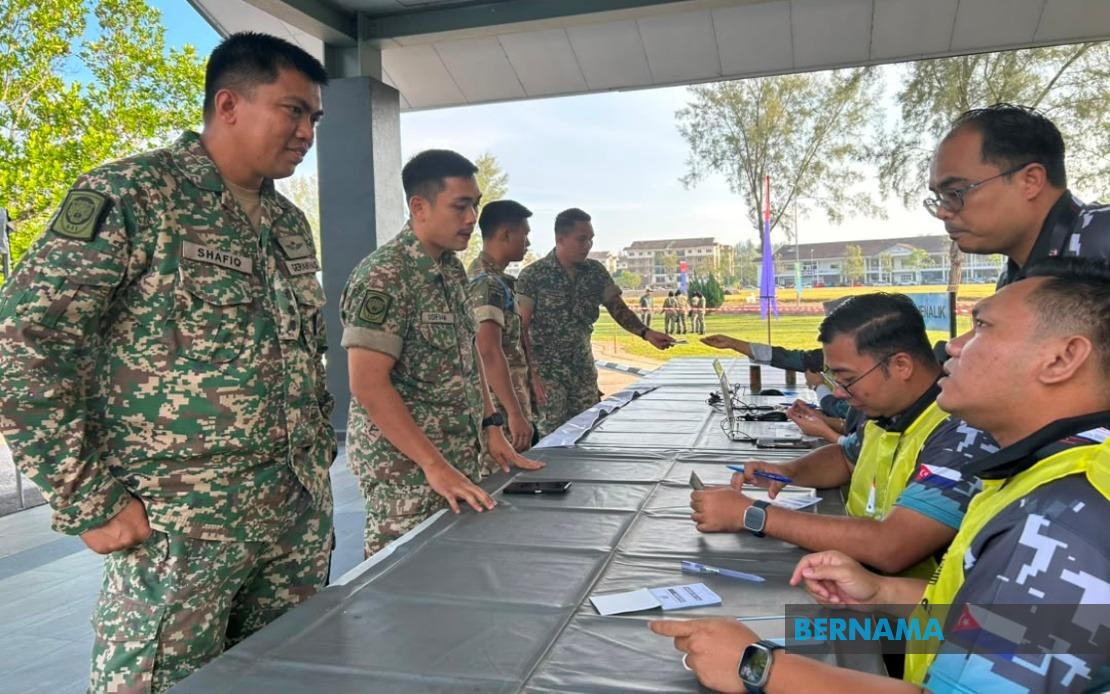
The Johor state election entered its early voting phase on July 7 with smooth operations at polling centres across the state, as security forces turned out from the morning hours to participate in the democratic process. Personnel began arriving at 7.30 am, ahead of the official 8 am opening time, taking advantage of clear weather conditions that facilitated their movement and the administrative work of Election Commission staff preparing the venues. The timely arrival of voters and officials set a positive tone for the day's proceedings, with no reported complications at any of the designated polling locations.
A network of 64 early voting centres had been established to handle the initial phase of Johor's 16th state election, designed specifically to accommodate 24,751 registered voters who fall within categories designated for advanced balloting. The composition of this early electorate reflected the security apparatus of the nation, comprising 12,041 personnel from the Malaysian Armed Forces alongside their spouses, and 12,710 representatives from the Royal Malaysia Police and General Operations Force with their families. This arrangement acknowledges the operational demands placed on security personnel and grants them flexibility in exercising their constitutional right to vote, a provision that has become standard practice in Malaysian electoral cycles.
Field observations at multiple polling venues, including the 5th Battalion GOF Camp in Simpang Renggam, the Johor Contingent Police Headquarters, and Mahkota Kluang Camp, confirmed that voting procedures unfolded without disruption or irregularities. Election Commission personnel had completed comprehensive preparatory checks prior to the opening of facilities, ensuring that ballot materials, voter registers, and security protocols were properly positioned. This meticulous preparation contributed to an orderly flow of voters throughout the morning and early afternoon hours, with staff managing queues efficiently and maintaining the integrity of the voting environment.
Weather conditions played a supporting role in the smooth execution of early polling operations. The Malaysian Meteorological Department had issued forecasts indicating clear skies during the morning and midday hours, which proved accurate and allowed voters to move between registration areas, polling booths, and exit points without weather-related obstacles. However, meteorological authorities issued warnings that afternoon thunderstorms were expected across Johor later in the day, prompting some contingency planning by election officials managing the logistics of transporting materials and personnel. The threat of inclement weather did not materialise during the critical morning voting period, providing an uninterrupted window for security personnel to complete their balloting.
The staggered closure of polling centres, scheduled to occur in phases between noon and 6 pm depending on individual centre locations and voter registration numbers, reflected the operational flexibility required to manage diverse voting locations across a geographically dispersed state. This graduated shutdown schedule prevented the simultaneous closure of all centres and allowed election officials to allocate resources efficiently while ensuring that all registered early voters had adequate opportunity to cast their ballots. The arrangement also facilitated the secure transportation and tallying of ballot boxes from remote locations, a logistical consideration that assumes greater importance in a state as large and administratively complex as Johor.
The broader electoral landscape into which this early voting phase fits encompasses a state election of considerable scale and political significance. A total of 2,727,926 registered voters across Johor are eligible to participate in the election proper, set for Saturday of that week, spreading across 1,140 polling centres throughout the state. This substantial electorate will determine the representation of 56 state assembly seats, with 172 candidates from various political parties contesting those positions. The sheer logistical magnitude of managing polling operations across such a dispersed and populous state underscores why early voting provisions for security personnel serve a practical function beyond mere convenience.
Johor's position as Malaysia's second-largest state by population and its economic importance to the nation's southern region have long made its state elections a barometer of political sentiment and potential shifts in electoral alignments. The machinery deployed for the 16th state election reflects the Election Commission's commitment to maintaining electoral integrity and accessibility, principles that extend from early voting arrangements to the main polling day operations. The smooth commencement of the early voting phase provides an encouraging signal regarding the administrative preparedness for the main voting exercise scheduled days later, when the broader electorate would descend upon polling stations across the state.
Security personnel's participation in electoral processes carries particular significance within Malaysia's democratic framework, as these uniformed services are constitutionally protected in their voting rights despite the demands of their operational duties. By facilitating early voting arrangements, the Election Commission acknowledges both the operational necessities that may prevent regular attendance at scheduled polling hours and the principle that no citizen should be effectively disenfranchised due to employment circumstances. The smooth execution of early voting for this cohort on July 7 validated the institutional arrangements that enable this participation while maintaining procedural standards equivalent to those applied during general polling.
The absence of reported irregularities during early voting, combined with the favourable weather and efficient administrative management, established conditions that enabled the main polling exercise to proceed with demonstrated institutional capability and voter confidence. Election officials' pre-opening preparations and the observed smoothness of operations across multiple venues indicated that the Election Commission had adequately resourced the early voting phase and trained poll workers to manage the procedures correctly. Such operational competence during the preliminary voting phase typically translates into similar standards during main polling day, a factor that influences broader public confidence in the electoral process and its outcomes.
As the Johor state election progressed toward its Saturday polling day, the successful commencement of early voting served multiple functions simultaneously: it provided security personnel with their constitutionally guaranteed opportunity to vote, it allowed the Election Commission to test and refine its operational procedures under actual conditions, and it generated early momentum and public interest in the electoral process itself. The clear skies that marked the opening of early voting centres on July 7 were matched, in symbolic terms, by the clarity of administrative purpose and operational execution that characterised the day's proceedings, setting expectations for the larger democratic exercise that would follow.

