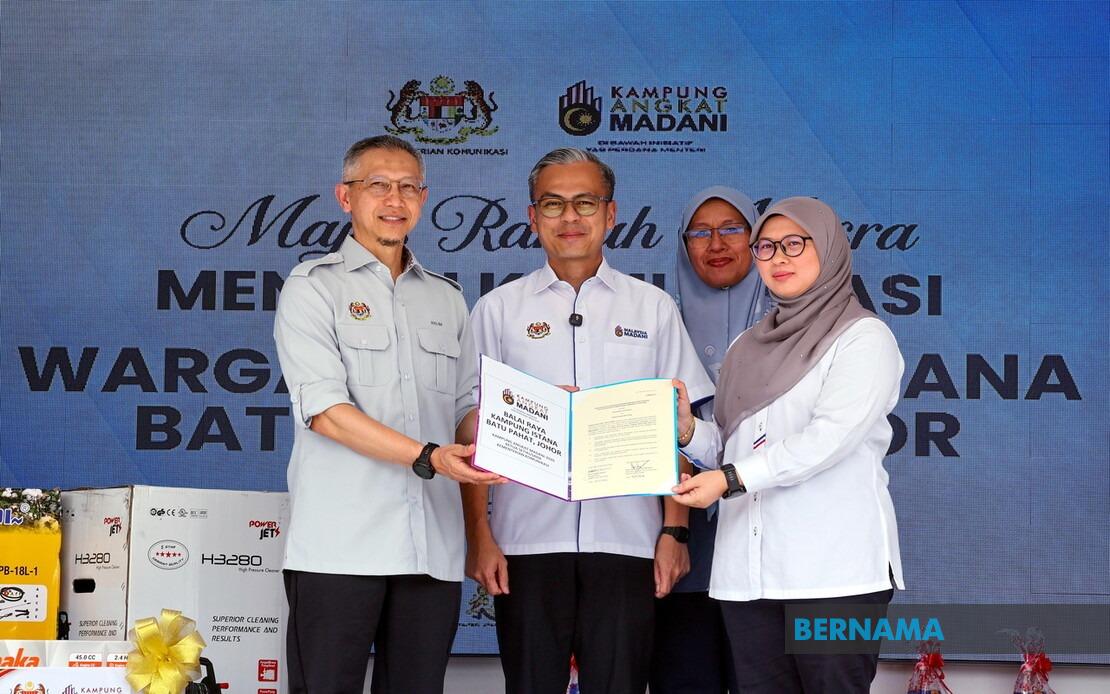
The 16th Johor State Election represents a critical juncture for voters seeking to elect leaders capable of advancing the state's development agenda, according to Pakatan Harapan Communications Director Datuk Fahmi Fadzil, who pushed back against narratives framing the contest as a personal endorsement exercise. Speaking to reporters during a campaign engagement in Batu Pahat on July 4, Fahmi expressed concern over attempts to connect a potential Barisan Nasional victory with public backing for a former prime minister, characterising such framings as distractions from substantive governance issues.
Fahmi's remarks came in response to statements by Datuk Nazifuddin Mohd Najib, who suggested that a BN triumph in the Johor race would demonstrate voter support for his father, Datuk Seri Najib Razak, to receive a pardon. The PH communications chief view such linkages as counterproductive to meaningful democratic discourse, arguing instead that electoral choices should centre on competence, vision, and capacity to deliver tangible improvements to ordinary citizens' lives. His intervention signals PH's broader strategy of steering campaign messaging away from personalised politics toward institutional and policy-focused arguments.
The minister emphasised that political support cannot and should not be treated as automatically assured, regardless of historical voting patterns or community demographics. He argued that every political formation must continuously work to earn and maintain public confidence rather than assume voter loyalty remains constant. This reflects growing recognition across Malaysia's political landscape that traditional bases of support are becoming increasingly volatile, as demographic shifts, economic pressures, and changing media consumption alter how citizens form electoral preferences. For Johor specifically, this observation carries particular weight given the state's historical role as a BN stronghold where significant political realignment would represent a notable reversal.
Fahmi highlighted the coalition's expanding appeal by pointing to endorsements from individuals previously associated with opposing political movements. The public backing extended by former Rengit assemblyman Datuk Dr Mohd Puad Zarkashi toward PH candidates signalled that UMNO and BN could no longer assume automatic loyalty from historically aligned figures or communities. Such defections, though individually modest, accumulate into evidence of broader erosion in established political allegiances. The strategy of surfacing these crossovers serves multiple purposes for PH: demonstrating internal fractures within rival coalitions, signalling momentum and inevitability, and providing permission structures for undecided voters or soft supporters of other parties to consider switching.
Beyond individual endorsements, PH identified emerging support from members of Bersatu, the smaller coalition partner, for PH candidates contesting specific seats including Sri Medan. These demonstrations of inter-party cooperation and support migration suggest that the unified front presented by Pakatan Harapan candidates extends beyond formal alliance structures into grassroots enthusiasm. Such organic backing patterns, when publicly documented and amplified, function as soft advertising that appeals particularly to voters seeking reassurance that a particular candidate or coalition possesses broader legitimacy than their nominal party affiliation might suggest.
Fahmi's characterisation of the election as fundamentally about Johor's future development trajectory rather than individual vindication reflected PH's tactical positioning heading toward the July 11 polling date. By framing voters' choices as consequential for state-level governance outcomes—economic development, service delivery, investment attraction—rather than as personal endorsements of any political figure, the coalition sought to elevate campaign discourse and shift voter focus toward competency-based evaluation. This positioning proves particularly valuable in contexts where anti-incumbency sentiment exists or where voters harbour concerns about the personal conduct or record of prominent political figures associated with competing camps.
The minister also addressed DAP's apparent erosion of stable support among non-Malay voters, a demographic traditionally considered a reliable base for the party. Fahmi acknowledged that no political party should presume permanent voter loyalty and stressed that all formations must actively cultivate, earn, and strengthen their relationships with constituents through performance and responsiveness. This candid admission reflected broader recognition within PH that complacency represents a genuine threat, particularly as economic headwinds and service delivery challenges create openings for opposition messaging. His framing of voter commitment as something requiring continuous renewal rather than passive maintenance aligned with PH's mobilisation strategy throughout the campaign period.
The 56-seat Johor state election will see 172 candidates competing, with early voting scheduled for July 7 and main polling day set for July 11. The scale of the contest and its timing—occurring within Malaysia's broader political calendar—carries implications beyond Johor's borders. State-level electoral outcomes frequently function as indicators of national sentiment, influencing coalition dynamics at the federal level and shaping narrative momentum heading toward potential federal elections. For that reason, political actors across the spectrum have invested considerable effort and resources into the Johor campaign, with both BN and PH treating the contest as consequential for their respective strategic positions.
Fahmi's campaign-trail message emphasised that Johor voters possessed agency to reshape their state's trajectory by selecting leadership genuinely focused on development and service delivery. By explicitly rejecting framings that reduce electoral choice to personal or factional calculations, he sought to position PH as the party of governance competence and forward-looking vision. Whether such messaging resonates with the diverse voter base across Johor's urban, suburban, and rural constituencies will become evident through the election outcome, with implications reverberating across Malaysia's broader political landscape.

