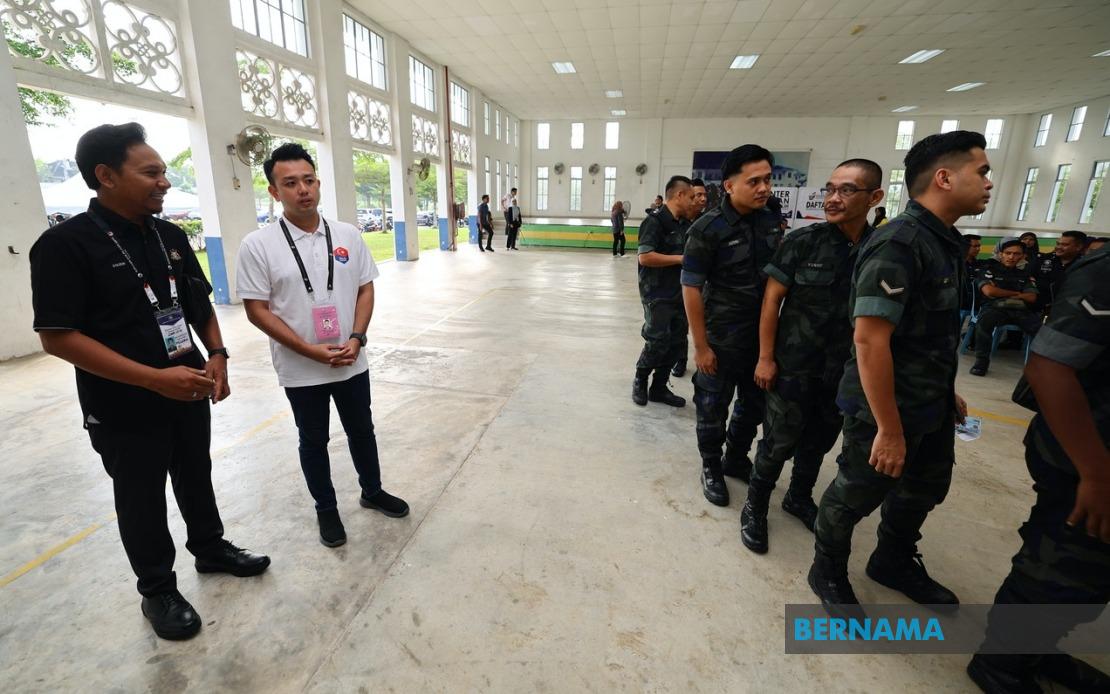
The countdown to Johor's state election entered its final stretch on Thursday as candidates from the three major political coalitions set aside their campaign activities to witness the early voting mechanism designed for the armed forces and police personnel. The observation exercise underscored the transparency demanded in Malaysia's electoral process, with representatives from competing camps present to ensure procedural integrity ahead of Saturday's vote.
At the 5th Battalion General Operations Force camp in Simpang Renggam, all three candidates vying for the Layang-Layang seat made their presence felt throughout the day. Guna Balakrishnan of the opposition Pakatan Harapan alliance, Chua Jian Boon representing the ruling Barisan Nasional, and Abd Mutalip Abd Rahim from the Perikatan Nasional coalition stood as observers while uniformed personnel exercised their constitutional right. This multiparty observation has become standard practice in contemporary Malaysian elections, serving as a confidence-building mechanism that reassures all stakeholders of the Election Commission's impartiality.
The Tenggaroh seat in Mersing witnessed a similar display of cross-party unity in the democratic process. Muhamad Amerul Muhamad of Perikatan Nasional, Mohd Youzaimi Yusof from Barisan Nasional, and Md Yusof Dawam representing Pakatan Harapan congregated at the Iskandar Camp early voting centre to observe proceedings. Such coordinated attendance, despite the intense political competition these candidates face on the campaign trail, reflects an underlying consensus about electoral propriety that transcends partisan divisions in Malaysian democracy.
Scattered across multiple constituencies, other candidates similarly fulfilled this observation responsibility. Lim Chin Eng, the oldest candidate contesting in the Johor election representing Perikatan Nasional, monitored voting at the Johor Contingent Police Headquarters. Muhammad Faezuddin Mohd Puad of Pakatan Harapan observed operations at the Kempas Police Station, while Barisan Nasional's Datuk Jafni Md Shukor attended proceedings at the Kulai District Police Headquarters. This distributed presence ensured that virtually every early voting venue had eyes from the competitive political realm watching over the process.
Security forces themselves demonstrated commitment to the democratic exercise. Army Chief General Tan Sri Azhan Md Othman and 21st Special Service Group commander Major General Datuk Ahmad Shuhaimi Mat Wajab visited the Iskandar Camp venue in Mersing, emphasizing the military's institutional respect for civilian electoral processes. Meanwhile, Johor's police chief Datuk Ab Rahaman Arsad exercised his own voting rights at Dewan Dato Onn within the Johor police headquarters complex, symbolically affirming that security personnel operate within the same democratic framework as ordinary citizens.
The logistics of early voting proved remarkably efficient despite challenging weather conditions. Starting at 8 am across 64 designated centres, the process accommodated a total of 20,607 registered voters comprising 8,544 members of the Malaysian Armed Forces along with their eligible spouses, plus 12,063 police officers and their family members. This early voting mechanism, staggered across multiple locations and closing times between noon and 6 pm depending on demand, reflects the Electoral Commission's acknowledgement that security personnel cannot always vote on standard election day due to duty commitments.
Brief rainfall at certain locations posed minimal disruption to the orderly flow of personnel arriving in organized stages to fulfil their voting responsibilities. Election Commission officers maintained strict adherence to established procedures, ensuring that despite the unconventional timing and security-focused demographics, the fundamental principles governing Malaysian elections remained inviolate. The systematic approach demonstrated institutional capacity to accommodate special electoral needs without compromising the integrity of the process.
The Johor state election represents one of Malaysia's most consequential regional contests, with 172 candidates competing fiercely for 56 seats in the State Legislative Assembly. The early voting exercise on Thursday served as the first major test of the Electoral Commission's preparations for the full election day on Saturday. For observers of Malaysian politics, the multiparty participation in monitoring proceedings offered reassurance that despite heightened political temperatures during campaign season, a shared commitment to democratic norms continues to undergird the system.
The significance of this election extends beyond Johor's boundaries. Results will influence the broader political dynamics affecting the federal government and could reshape state-level governance equations across Malaysia. For candidates and supporters alike, early voting represents the official commencement of actual ballot casting, transforming abstract campaign promises into concrete democratic participation. The presence of rival candidates at these early voting centres, rather than staging parallel campaign events, sends a message to voters that electoral competition can coexist with institutional respect.

