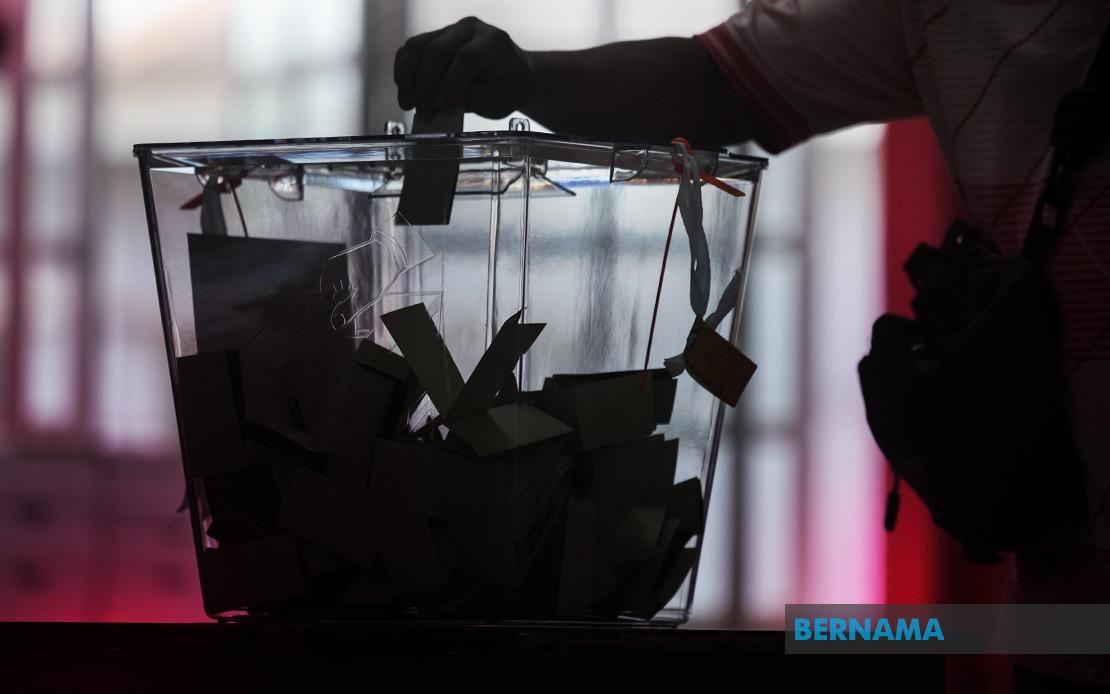
The upcoming 16th Johor state election stands at a critical juncture where the mechanics of voter participation may prove as decisive as policy positions themselves. According to political analyst Associate Professor Dr Mazlan Ali from Universiti Teknologi Malaysia, elevated voter turnout this Saturday could substantially benefit Pakatan Harapan, especially across the state's urban and semi-urban constituencies where outstation workers, younger demographics, and persuadable voters constitute a significant share of the electoral base.
Dr Mazlan's assessment rests on a straightforward but powerful observation about Malaysian voter behaviour: federal political stability, coupled with visible improvements in economic performance and targeted government assistance programmes, creates conditions that motivate opposition-leaning supporters to undertake the practical effort of returning home to vote. The stability of the current federal administration, alongside subsidies for fuel and the broader social safety net, appear to resonate with voters who fear disruption of these gains. This sentiment translates into concrete incentive—especially for those residing beyond Johor—to participate in this state-level contest, viewing it as an extension of their interest in maintaining continuity at the national level.
The contrast with the 2022 Johor state election provides instructive context for understanding what turnout levels mean in this particular state. That contest recorded a voter participation rate marginally above 50 percent, a figure substantially depressed by lingering COVID-19 pandemic constraints that deterred outstation voters from returning home to cast ballots. This artificially low turnout worked decisively in Barisan Nasional's favour, enabling the coalition to secure 40 state assembly seats. BN's organisational advantage lies precisely in the strength of its standing among local, permanent residents of Johor who maintain stable voting patterns regardless of participation levels. When only local voters show up in significant numbers, BN's entrenched support base becomes proportionally more influential.
Yet the trajectory shifted dramatically just months later during the 15th General Election held later in 2022. Participation rates climbed to approximately 75 percent—a jump reflecting post-pandemic normalisation and perhaps growing public engagement with national-level contests. The difference proved transformative for Pakatan Harapan's electoral mathematics. The coalition's raw vote count in Johor surged from roughly 350,000 votes in the state election to approximately 830,000 votes during the general election—more than doubling within a matter of months. This phenomenon reflects a crucial composition shift: the voters who showed up for the general election but skipped the state election were disproportionately supportive of PH.
Translating this general election performance to a state-level framework produces a logical inference that warrants serious consideration. If the same 75-percent turnout materialises and if the composition of that turnout mirrors the general election pattern, PH would reasonably expect to convert its substantially higher vote share into considerably more assembly seats than the single-digit representation it holds following 2022. The mathematics becomes clearer when one considers that state assembly seats are necessarily smaller constituencies than parliamentary constituencies, meaning that concentrated vote increases in specific geographical areas compound into seat gains more readily.
This year's Johor election unfolds under fundamentally altered conditions. Pandemic-related restrictions have evaporated entirely, removing the logistical barriers that previously discouraged outstation voting. More significantly, observable trends suggest that such voters have increasingly normalised their participation in electoral contests, viewing it as standard democratic practice rather than an exceptional undertaking. The psychological and practical hurdles that depressed 2022 turnout no longer operate with the same force.
Dr Mazlan identifies urban and semi-urban constituencies as the probable battleground where turnout effects will prove most consequential. These areas host voter populations notably different in composition from Johor's rural strongholds. Urban voters demonstrate greater responsiveness to contemporary governance issues, economic policy performance, and social justice framings—the core elements of PH's political narrative. They tend to be younger, more educationally credentialed, and more active in digital media spaces where PH messaging circulates vigorously. These characteristics align with constituencies where floating and outstation voters concentrate.
The coalition's typical supporter profile has crystallised into a distinctive demographic constellation. Outstation residents, undecided voters, younger citizens, and those with higher education levels predominantly constitute PH's base. Their political motivations centre on narratives emphasising fairness, justice, and responsive governance rather than appeals to primordial ethnic or religious identity. Conversely, voters responding primarily to ethnic and religious messaging tend to gravitate toward BN's positioning. This polarisation by voter type and geographic location means that when outstation voters return home and participate at scale, the electoral geography shifts toward constituencies with greater PH appeal.
The catalytic effect of returning outstation voters in determining specific seat outcomes cannot be overstated. Turnout mobilisation concentrates in particular constituencies rather than distributing uniformly across all seats. Several marginal state assembly constituencies likely hinge on whether the outstation voter component exceeds certain thresholds. A strong turnout surge among registered Johor voters living elsewhere could plausibly determine outcomes in a dozen or more individual races, potentially remaking the assembly's composition.
However, Dr Mazlan emphasises that mobilisation represents only half the equation. PH's organisational challenge involves converting potential support into actual votes. The coalition must ensure that its supporters—particularly those scattered across the country in temporary residence—actually undertake the journey home and complete the voting act. Organisational capacity, effective communication targeting outstation voters, and overcoming apathy or competing commitments on election day all remain substantial hurdles. Historical experience demonstrates that potential sympathisers frequently fail to participate, especially when logistical requirements demand special effort.
The Johor state election thus crystallises a broader dynamic within Malaysian electoral politics. Turnout acts not as a neutral mechanism but as a partisan filter, benefiting competing coalitions unequally depending on the composition of voters who participate. In Johor's case, a majority-participation turnout landscape favours coalitions capable of mobilising dispersed, mobile, and educationally diverse voter populations. BN maintains organisational depth and local strength, but that advantage diminishes as participation rates approach broader population levels. Understanding this dynamic—that participating voters differ meaningfully from abstainers—provides the foundation for interpreting how Saturday's results may reshape Johor's political trajectory.

