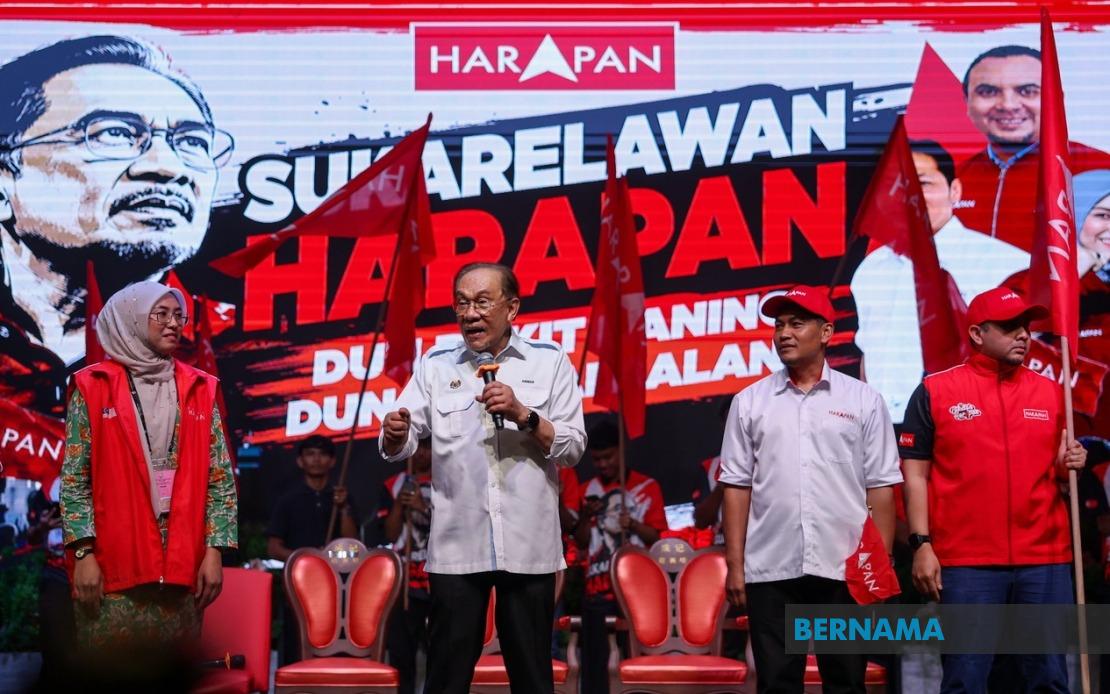
The upcoming Johor state election represents a critical moment for Malaysia's younger generation to reshape political discourse away from divisive racial narratives, Prime Minister Datuk Seri Anwar Ibrahim declared during campaigning in Muar on July 5. Speaking as Pakatan Harapan chairman, Anwar positioned the contest as an opportunity for youth voters to demonstrate their ability to select leaders based on substantive policy platforms rather than communal appeals, fundamentally challenging the political approach that has long dominated Malaysian elections.
Anwar centred his message on practical governance priorities that directly influence young people's daily lives and long-term prospects. Education quality, employment pathways, and accelerated state development emerged as the metrics by which voters should evaluate candidates, he argued, rather than allowing themselves to be manipulated through fear-mongering or ethnic resentment. This framing represents a deliberate attempt to reorient campaign discourse toward issues of bread-and-butter concern—areas where policy competence and administrative track records matter more than identity politics.
The Prime Minister delivered a pointed critique of established political actors who, he suggested, deliberately manufacture inter-communal tensions while enriching themselves behind the scenes. His observation that ordinary citizens fight amongst themselves while elites accumulate wealth reflects a broader anti-establishment sentiment that has gained traction among younger Malaysian voters increasingly sceptical of traditional party machinery. By naming the specific tactics—stoking fears about Chinese Malaysians, generating resentment toward Indian Malaysians, and exacerbating Malay-Chinese divisions—Anwar called out the playbook while inviting listeners to recognise and reject its application.
Addressing youth across Johor's ethnic communities directly, Anwar framed the election as a decisive moment requiring collective responsibility. His explicit appeals to young Malays, Chinese, and Indian voters simultaneously acknowledged Malaysia's multicultural reality while suggesting that younger generations possess both the insight and agency to transcend inherited communal voting patterns. The rhetoric positioned generational identity—being young and forward-thinking—as potentially superseding ethnic identity in voting behaviour, a significant assertion within Malaysian political discourse.
The scale of youth participation at the volunteer programme launch in Bukit Naning visibly emboldened Anwar's optimism about generational change. He characterised the turnout as extraordinary compared to his decade-long campaigning history, interpreting widespread young attendance as evidence of deepening civic consciousness and appetite for transformation. This framing leverages genuine enthusiasm as both a data point validating his political message and momentum for the wider campaign effort across 56 contested seats.
Anwar strategically positioned racial divisiveness as fundamentally incompatible with Malaysia's post-colonial standing as an independent nation. By arguing that such politics represent relics of an earlier era unsuitable for modern, developed Malaysia, he implicitly questioned the legitimacy of competitors who employ communal rhetoric. His reference to Malaysia's peaceful coexistence across its Malay, Chinese, Indian, and Orang Asli populations served as both historical reminder and aspirational vision, grounding inclusive politics in lived national experience rather than utopian theory.
The Prime Minister's invocation of religious language—thanking Allah for Malaysia's continued peace—added a moral and spiritual dimension to his secular governance argument. This rhetorical move potentially bridges appeals to religiously observant voters who might otherwise favour communal politics, suggesting that faith-based values actually support inclusive, multi-ethnic conduct rather than divisive practices. Such framing addresses potential tensions between religious identity and pluralistic citizenship that have periodically surface in Malaysian politics.
Anwar's exhortation that young people move beyond passive spectatorship to active responsibility carries implications for political mobilisation strategy. Rather than simply asking youth to vote for Pakatan Harapan candidates, he challenged them to become agents of change by canvassing villages, neighbourhoods, and districts with coherent messaging about transformational possibility. This invocation of grassroots activism aligns with broader global trends of younger voters expecting participatory roles rather than merely consuming top-down political messaging.
The Johor contest itself provides tangible context for these appeals. With 172 candidates competing for 56 state seats, the election features sufficient competitive density to genuinely allow voters meaningful choice. Polling scheduled for July 11, with early voting on July 7, creates a narrow timeline during which such messaging must penetrate target audiences, particularly among younger demographics with less established voting routines than older cohorts. The specific identification of Bukit Naning and Simpang Jeram constituencies with PH candidates Md Ysahrudin Kusni and Nazri Abd Rahman grounds Anwar's broader arguments in concrete local contests.
For Malaysian and Southeast Asian observers, Anwar's campaign rhetoric illuminates ongoing contestation over how rapidly and fundamentally Malaysia can restructure its political operating system. The appeal to youth suggests confidence that generational succession offers genuine opportunity for political transformation, though it remains unclear whether sentiment translates into voting behaviour sufficiently robust to overcome entrenched organisational advantages held by competitors comfortable with traditional communal appeals. The Johor result will provide measurable indication of whether younger voters in Malaysia are indeed moving decisively beyond race-based politics or whether such aspirations remain confined to urban, English-educated constituencies with distinct priorities from broader rural and working-class electorates.
Anwar's emphasis on inclusive governance and merit-based leadership evaluation resonates within Southeast Asia's broader struggles to balance multicultural demography with political demands for communal representation. Malaysia's specific history of constitutional provisions protecting particular communities creates particular complexity absent in some neighbouring contexts, potentially limiting how far political discourse can shift away from identity-based framing. Nonetheless, his explicit challenge to divisive narratives represents significant positioning within Malaysian political space, where such forthright criticism of communal politics remains relatively uncommon at senior leadership levels.

