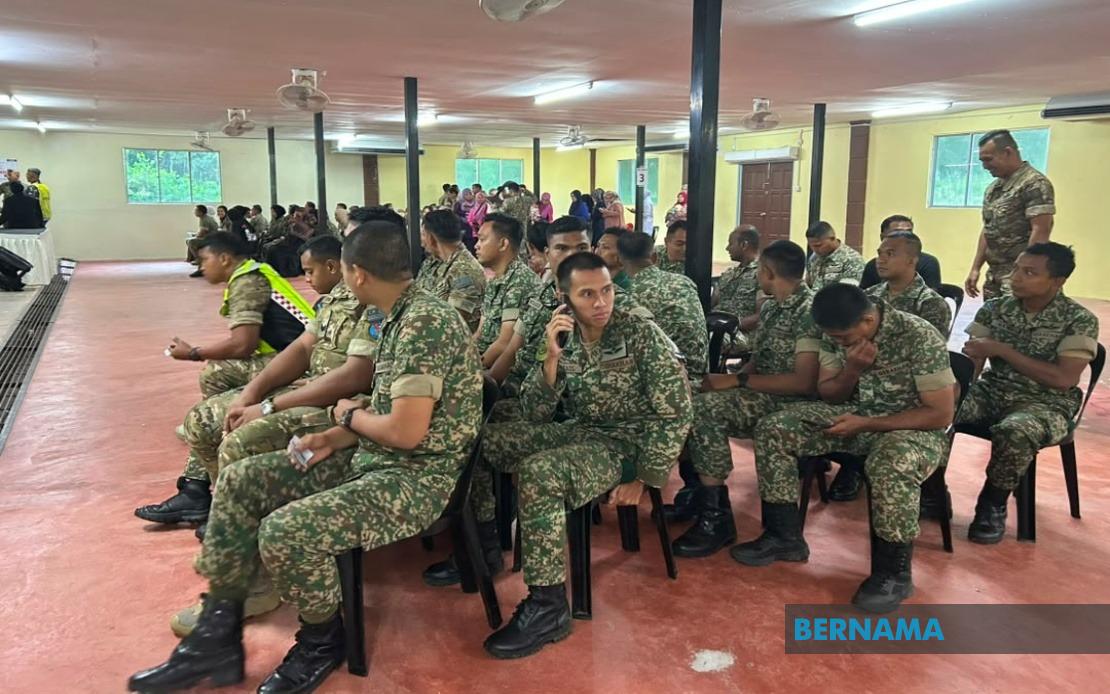
Senior government figures have called upon Malaysia's security forces to approach their ballots with a strong sense of civic responsibility as early voting got underway across Johor today. Home Minister Datuk Seri Saifuddin Nasution Ismail and Defence Minister Datuk Seri Mohamed Khaled Nordin made separate appeals to military and police personnel who participated in the first phase of polling for the 16th Johor State Election, emphasizing that their participation would set the tone for the democratic process.
The push to encourage early casting of votes reflects broader efforts by Malaysian authorities to deepen civic engagement and ensure orderly elections. Among the 24,751 individuals eligible to vote today were 12,041 members of the Malaysian Armed Forces alongside their spouses, and 12,710 police officers with their families. By extending voting rights to security sector employees ahead of the main polling day, the electoral commission sought to accommodate the operational demands of these institutions while preserving democratic principles.
Saifuddin Nasution, who holds the additional role of Pakatan Harapan secretary-general, took to social media to convey his message, framing the exercise as more than a procedural requirement. His appeal centered on voting "with full responsibility and in the spirit of democracy," language that underscores how Malaysian political leaders view elections as moments requiring heightened ethical consciousness from all participants. The framing suggests awareness that security personnel, occupying positions of trust within the state apparatus, carry particular symbolic weight in how elections are conducted and perceived by the public.
The Defence Minister's intervention carried a notably different emphasis, pivoting the discussion toward Johor's developmental trajectory. Mohamed Khaled urged early voters to recognize their responsibility as custodians of the state's continued progress, linking their ballot choices directly to questions of stability and prosperity. This messaging aligns with broader patterns in Malaysian electoral campaigns, where development achievements and promises feature prominently in appeals to voters across demographic groups.
State leadership also weighed in on the significance of the early voting phase. Menteri Besar Datuk Onn Hafiz Ghazi, representing the Barisan Nasional coalition, appealed to the same cohort of security personnel to place confidence in BN candidates. His statement framed the election as fundamentally about consolidating "stability, development and public welfare," positioning the governing coalition's continuity as essential to Johor's wellbeing. The appeals from both coalition leaders suggest a competitive environment where securing the backing of this disciplined and organized voter segment carries strategic importance.
The logistical framework for early voting reflected careful planning to accommodate the needs of military and police voters while maintaining electoral integrity. Sixty-four dedicated voting centers opened at 8 am, with staggered closing times between noon and 6 pm depending on each location's voter registration numbers. This arrangement allowed the Electoral Commission to process votes efficiently without creating bottlenecks that might compromise the orderly conduct that officials emphasized repeatedly.
The 16th Johor State Election represents a significant political moment in Southeast Asia's largest democracy, with both Pakatan Harapan and Barisan Nasional fielding candidates across all 56 state seats. The competition involves 172 candidates total, indicating a contested political landscape where no outcome appears predetermined. Early voting patterns, particularly among disciplined voter cohorts like security personnel, frequently provide reliable indicators of broader election trends that analysts monitor closely.
Malaysian electoral observers have noted that early voting mechanisms serve multiple purposes beyond mere administrative convenience. They distribute voting pressure across several days, reducing strain on the electoral machinery and allowing officials to conduct quality control checks on processes before the main polling day arrives. For voters in security positions, the arrangement recognizes legitimate operational constraints while maintaining their fundamental democratic prerogative.
The appeals made by Saifuddin Nasution, Mohamed Khaled, and Onn Hafiz reflect how Malaysian political culture increasingly emphasizes ethical dimensions of voting behavior. Beyond simply recording preferences, the messaging encourages voters to view their ballots as expressions of commitment to democratic norms and national wellbeing. This rhetorical approach has become standard in Malaysian elections, where leaders across the political spectrum invoke responsibility, maturity, and civic virtue as frameworks for understanding electoral participation.
For the Pakatan Harapan machinery, Saifuddin Nasution's statement also contained tactical guidance, urging the coalition's campaign organization to maintain engagement with voters through the final campaign period while preserving what he termed "mature" campaigning. This language suggests concern about maintaining campaign standards during the competitive phase before Saturday's main polling day, potentially reflecting lessons learned from previous electoral cycles regarding campaign conduct.
The early voting arrangements and accompanying appeals highlight how Malaysian authorities balance multiple imperatives: facilitating democratic participation, managing operational security requirements, maintaining electoral integrity, and ensuring orderly conduct. For Malaysia and Southeast Asia more broadly, these mechanisms and the rhetoric surrounding them demonstrate how established democracies in the region continue refining electoral processes to accommodate diverse voter needs while upholding democratic standards.
Saturday's main polling day will determine whether the early voting patterns among security personnel proved indicative of broader electoral sentiment across Johor's general population. The focus placed on these security sector votes by multiple political leaders underscores their perceived significance as potential bellwethers for understanding the state's electoral direction and the competitive balance between Pakatan Harapan and Barisan Nasional.

