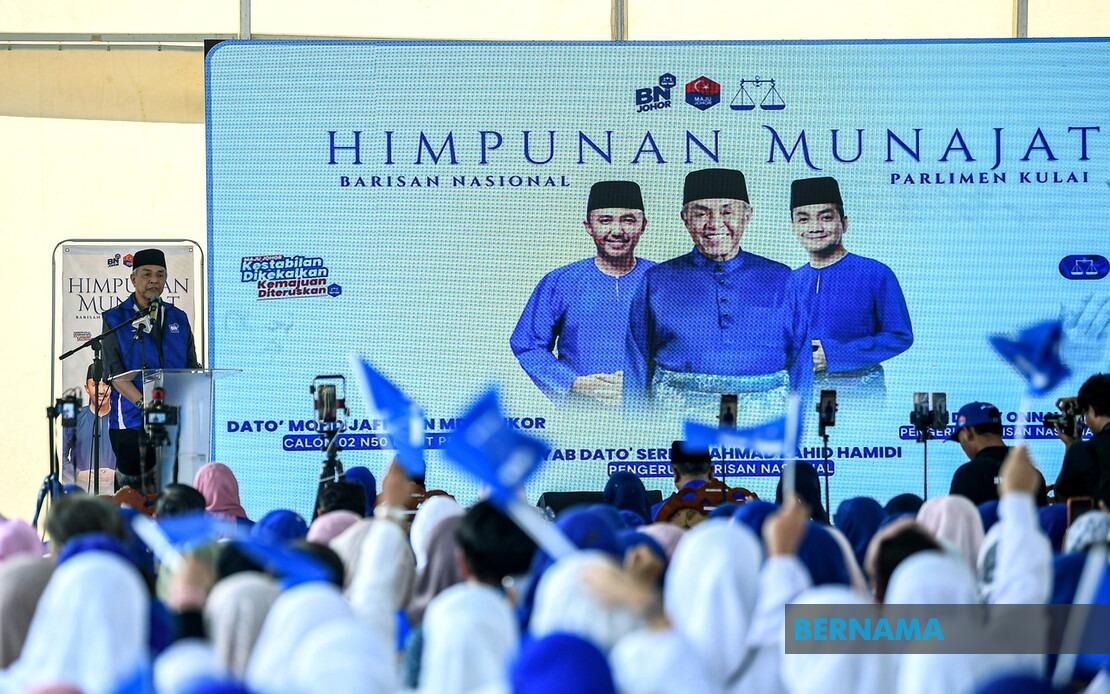
Malaysia's ruling Barisan Nasional coalition has moved to reassure stakeholders that the intensifying political contest in Johor will remain contained within state-level competition, with no spillover effects on the stability of the federal administration. Speaking in Kulai ahead of the 16th Johor State Election, coalition chairman Datuk Seri Dr Ahmad Zahid Hamidi stressed that ministerial cooperation and the professional functioning of government machinery would remain unaffected regardless of which party gains ground in tomorrow's polling.
The Deputy Prime Minister's intervention reflects concerns that have periodically surfaced in Malaysian politics about electoral contests at the state level creating tensions within federal coalitions, particularly when ruling parties contest against each other. By publicly committing to compartmentalise the Johor campaign from national governance, Ahmad Zahid is signalling that BN intends to maintain the delicate balance that has underpinned the current federal government structure since 2023.
Ahmad Zahid, who also holds the Rural and Regional Development portfolio, emphasised that the Cabinet has demonstrated consistent professionalism throughout the state election campaign period. He pointed to the absence of disruption in inter-ministerial operations as evidence that political leaders have successfully separated their campaign strategies from their governance responsibilities. This distinction is crucial in Malaysia's context, where federal coalitions frequently comprise parties with competing interests across different states.
The remarks acquire particular significance because Johor represents a major electoral battleground in Malaysian politics, with both BN and Pakatan Harapan fielding candidates across all 56 state assembly seats. The winner of tomorrow's election will govern Malaysia's second-largest economy and a state with substantial political influence nationally. Such high stakes typically generate intense partisan activity that can strain coalition relationships when coalition partners compete against each other in the same contests.
Ahmad Zahid acknowledged that divergent campaign messaging and political positioning in Johor are inevitable and acceptable. He argued, however, that these surface-level differences need not translate into institutional dysfunction at the federal level. Ministers and deputy ministers from different parties could legitimately advocate for their own candidates while maintaining professionalism during Cabinet deliberations, he suggested. This framing allows coalition partners to compete vigorously without compromising the appearance of unified national governance.
The coalition chairman also extended his appeal beyond the ministerial level, calling on party grassroots and supporters from both BN and Pakatan Harapan to exercise restraint once election results are announced. Post-election emotions, particularly in tightly contested races, frequently generate inflammatory rhetoric that can damage inter-party relationships and weaken governance coalitions. By invoking the example of top leadership maturity, Ahmad Zahid was implicitly asking rank-and-file members to emulate the professional conduct he attributed to senior figures.
For Malaysian observers, the statement encapsulates an ongoing challenge facing Southeast Asia's longest-serving democracy. The institutional separation between federal and state politics remains theoretically sound but practically difficult to maintain when coalition partners harbour genuine electoral ambitions in particular states. The federal government model increasingly relies on party leaders' personal restraint rather than structural safeguards against tension transmission between different tiers of governance.
The Johor election also carries implications for how Malaysia manages coalition politics during periods of substantial political fluidity. Since the 2023 general election, federal coalitions have become more fragile, with MPs from different parties maintaining tenuous working relationships. State elections serve as important tests of coalition durability. A result perceived as damaging to coalition partners' interests could provide a pretext for disgruntled factions to challenge the federal arrangement.
Ahmad Zahid's reassurances should be understood within this broader context of maintaining coalition stability rather than mere campaign rhetoric. By consistently restating that electoral competition and federal cooperation operate on separate tracks, he attempts to establish a norm that insulates federal governance from state-level electoral dynamics. Whether this norm holds will depend substantially on the Johor outcome and the genuine satisfaction or disappointment it generates among coalition partners.
The timing of these remarks—made just hours before polling day—suggests that BN leadership anticipates a closely contested result that could leave some coalition components feeling disadvantaged. Pre-emptive statements about federal stability serve to contain potential fallout and establish expectations about acceptable post-election behaviour. This diplomatic manoeuvre reflects the increasing sophistication with which Malaysian political leaders manage coalition tensions, even if the underlying fragility of such arrangements remains a structural reality of contemporary Malaysian politics.

