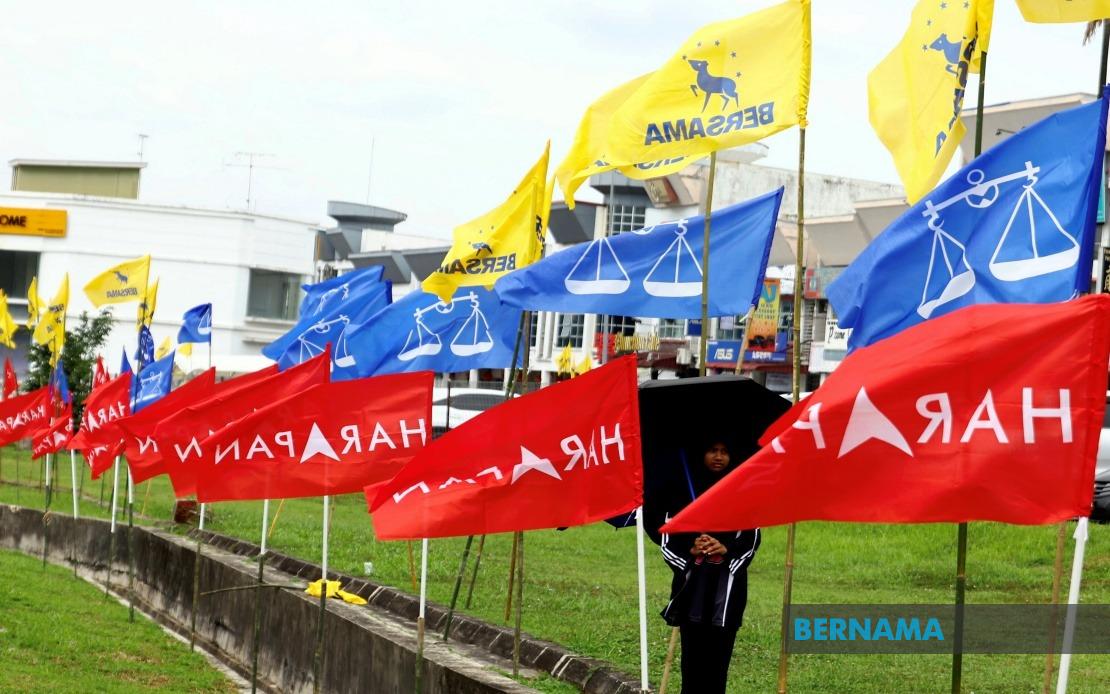
Johor's political landscape faces a transformative moment as voters prepare to cast their ballots tomorrow, marking the culmination of an energetic two-week campaign season that concludes officially at 11.59 pm tonight. The race for control of the state will be settled through a day-long electoral exercise beginning at 8 am, when polling stations across 1,076 centres open their doors to the electorate. The outcome will reshape Johor's governance structure for the next five years, determining not only which coalition commands the state legislature but also which policy direction the region pursues on pressing economic and social issues.
The election features a notably concentrated field of candidates compared to previous contests. Only 172 individuals are vying for the 56 available seats, a significant reduction from 239 candidates in the last state election. This leaner ballot reflects strategic consolidation among political actors and arguably clearer voter choice matrices, though it also suggests intensified competition within each major contender grouping. The Election Commission has mobilised substantial administrative resources to process results efficiently, with officials expecting full electoral outcomes to be published as early as 10 pm tomorrow evening—a timeline that underscores the commission's operational sophistication and the public appetite for rapid clarity.
Voting eligibility encompasses 2.7 million registered voters, though the actual turnout rate remains uncertain and carries substantial analytical weight. Political observers regard participation levels as a crucial barometer of campaign momentum and grassroots engagement. Early voting procedures already took place last Tuesday, when 20,607 members of the Malaysian Armed Forces, Royal Malaysia Police, General Operations Force and their spouses cast ballots in advance arrangements. This mechanism accommodates the scheduling complexities inherent in security force responsibilities whilst maintaining democratic inclusivity for personnel whose duties might otherwise restrict polling-day participation.
The two dominant coalitions—Pakatan Harapan and Barisan Nasional—have anchored their campaign messaging around economic fundamentals and governance performance. Campaign communications have persistently emphasised cost-of-living pressures, employment generation, economic rejuvenation and welfare provision. These thematic priorities reflect genuine anxieties within Johor's population amid broader Malaysian inflationary pressures. The presence of Prime Minister Anwar Ibrahim in final campaign events underscored Pakatan Harapan's federal positioning, whilst Deputy Prime Minister Ahmad Zahid Hamidi embodied Barisan Nasional's national leadership credentials. Such high-level engagement demonstrates the election's significance beyond Johor's borders, signalling to national political movements that state outcomes carry implications for federal power configurations.
Electoral analysts point to voter turnout volatility as a determining factor whose influence remains constituency-specific and demographic-dependent. Dr Nazreena Mohammed Yasin of Universiti Tun Hussein Onn Malaysia has cautioned against treating turnout as a universal predictor, noting that elevated participation rates may advantage particular parties in specific geographic zones whilst producing negligible electoral consequences elsewhere. The 2022 Johor election achieved 54.92 percent overall participation, establishing a reference point for evaluating tomorrow's engagement levels. Marginal constituencies with historically narrow winning margins become especially susceptible to turnout variations, potentially shifting outcomes where voter mobilisation efficiency differs materially between competing camps.
Party machinery effectiveness in managing polling-day logistics and candidate credibility assessments emerge as critical operational factors. Beyond sheer voter numbers, the competence with which political organisations activate their support bases and navigate technical electoral procedures influences final tallies. Undecided voters occupying the political centre represent an unpredictable element capable of determining outcomes in closely contested races. These fence-sitters frequently make final-hour candidate selections based on evolving perceptions of governmental competence, personal candidate attributes and perceived party capacity to address immediate household economic concerns.
Results interpretation will extend beyond simple seat counts to encompass broader patterns in electoral behaviour. Changes in victory margins compared to 2022 outcomes will illuminate whether particular parties have consolidated support, experienced defection trends or encountered voter preference shifts. Electoral researchers emphasise that victory margins themselves constitute meaningful data reflecting voter confidence trajectories and shifting coalitional strength. According to Dr Nazreena, election outcomes should be contextualised within voter assessments of governmental performance delivery, candidate credibility dimensions, political stability considerations and each party's demonstrated capacity managing economic hardship and inflation pressures—factors that transcend simplistic party loyalty calculations.
Associate Professor Mazlan Ali of Universiti Teknologi Malaysia identifies political stability narratives as the dominant campaign framework advanced by major coalitions. Both Barisan Nasional and Pakatan Harapan have positioned themselves as guardians of governance continuity and institutional reliability, leveraging their respective federal and state-level track records as campaign assets. The Unity Government framework at federal level has influenced how coalitions present themselves to Johor voters, intertwining local and national political messaging. Mazlan anticipates heightened public election interest translating into elevated turnout rates, thereby amplifying each ballot's significance in determining the state's direction.
Candidate distributions across competing formations reveal the electoral landscape's political architecture. Barisan Nasional and Pakatan Harapan each field 56 candidates—precisely matching available seats and signifying full-slate commitment. Perikatan Nasional contests 33 positions, whilst Parti Bersama Malaysia presents 15 candidates. Smaller entities including MUDA (four candidates), Parti Orang Asli Malaysia (one candidate), and Parti Sosialis Malaysia (one candidate) supplement the contest alongside six independent contenders. This multi-party configuration creates complex electoral dynamics where second-preference voting patterns and coalition-building possibilities may shape final outcomes.
The state assembly's dissolution on June 1 reset the political slate. Prior to dissolution, Barisan Nasional controlled 40 seats, Pakatan Harapan held 12, Perikatan Nasional occupied three positions and MUDA represented one seat. Tomorrow's election will determine whether these existing power relationships persist, intensify or reverse direction. For Malaysian federal politics and Southeast Asian democratic dynamics more broadly, Johor's outcome carries significance as a major state election result affecting Malaysia's political trajectory and international perceptions of electoral competitiveness within the region. The state's economic importance as a manufacturing hub and cross-border commerce centre amplifies the consequence of governance decisions the elected representatives will implement during their five-year mandate.

