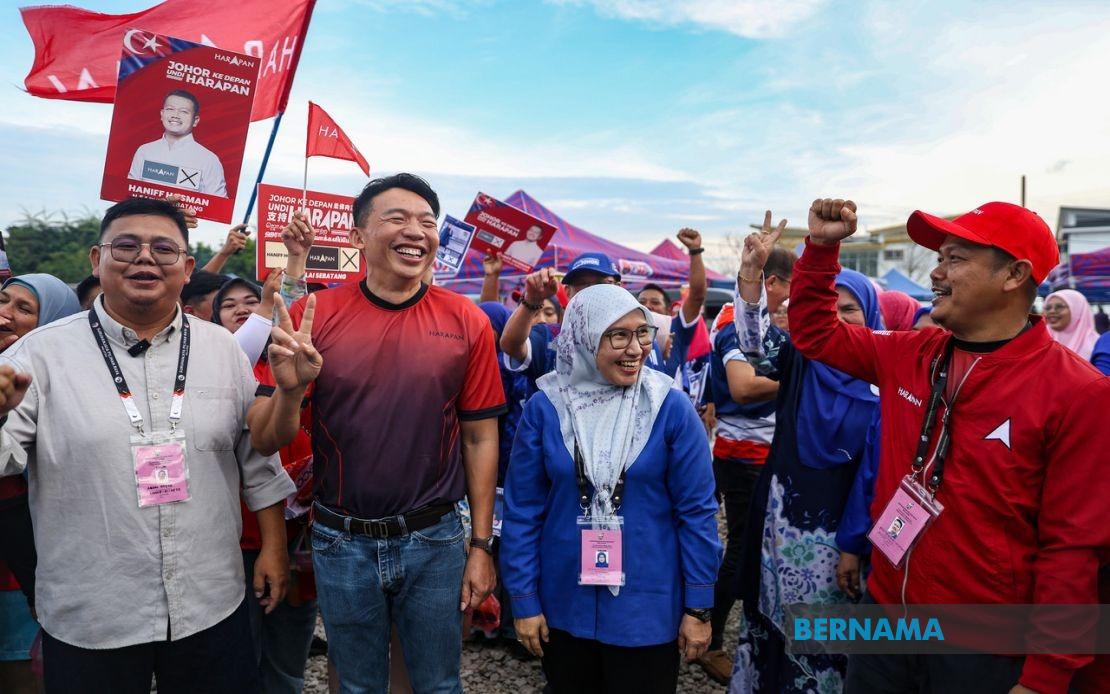
The Johor state election campaign took on a notably cordial tone when four candidates from competing political coalitions crossed paths at Taman Megah night market in Pontian on June 29. The unplanned encounter between representatives of the Pakatan Harapan coalition and Barisan Nasional demonstrated that electoral competition in the state need not preclude personal civility, even as campaigns intensify ahead of polling day.
The three PH candidates—Haniff @ Ghazali Hosman contesting Pulai Sebatang, Abd Razak Ismail vying for Benut, and Cheah Chee Hong seeking Kukup—were conducting a joint campaign walkabout when they encountered Hasrunizah Hassan, the BN candidate for Pulai Sebatang. What might have developed into an awkward moment quickly transformed into a warm exchange of greetings, with the candidates stopping to acknowledge one another despite their competing interests.
The scene captured the attention of night market patrons, who observed the brief interaction between the rival teams, each identifiable by their contrasting red and blue campaign flags. Rather than tension or confrontation, the moment reflected a professional approach to democratic competition that has become increasingly notable in Malaysian electoral contests. The candidates subsequently resumed their separate campaigning activities, continuing to engage with traders and voters throughout the venue.
When approached by journalists following the encounter, Haniff characterised the meeting as evidence of democracy functioning healthily in the constituency. He emphasised that the Pontian campaign environment had maintained its peaceful character, free from disturbances or inflammatory incidents. The Pulai Sebatang candidate highlighted that while candidates naturally advocate for their respective parties and coalitions, personal relationships need not suffer as a consequence of electoral rivalry.
Cheah, representing the PH slate in Kukup, expressed satisfaction with the unified campaign approach his coalition was pursuing across the three constituencies. He called upon voters in Pulai Sebatang, Benut, and Kukup to sustain their support for Pakatan Harapan, framing the election as an opportunity to reinforce the coalition's presence in Johor's parliamentary representation.
Hashirunizah responded to questions about the encounter by positioning it within the broader context of democratic maturity in Johor. She noted that such meetings between candidates from different parties during campaign periods were unremarkable and entirely consistent with the standards of conduct expected in modern Malaysian elections. Her perspective suggested that maintaining civility and professional boundaries did not undermine the intensity or sincerity of campaign efforts.
The BN candidate further observed that despite the campaign period entering what might typically be described as a competitive phase, the state had experienced no meaningful security concerns or disturbances. She indicated that such encounters actually reinvigorated BN's campaign motivation, suggesting that healthy competition strengthened rather than weakened their resolve to mobilise support for Barisan Nasional and the Maju Johor coalition.
The Johor state election represents a significant political contest, with voting scheduled for July 11, preceded by early voting on July 7. The Pontian encounter illuminates broader patterns emerging in Malaysian electoral campaigns, where candidates increasingly recognise that democratic competition and personal respect are compatible rather than mutually exclusive principles. This approach contrasts with earlier periods in Malaysian politics when electoral contests occasionally devolved into personalised animosity or community tensions.
For Malaysian observers, the Pontian incident carries implications beyond the immediate state election context. It suggests that Malaysian democracy continues to mature in its institutions and practices, with political actors increasingly understanding that robust competition for votes need not translate into social division or breakdown of civic norms. The public's receptiveness to witnessing candidates from opposing camps interact peacefully further reinforces this democratic evolution.
The episode also reflects shifting campaign strategies across Malaysian coalitions, where voter engagement increasingly emphasises issues and policy platforms rather than personality-driven conflict or partisan identity politics. In a state as significant as Johor to national political calculations, the maintenance of campaign civility carries symbolic weight beyond the immediate electoral contest. Both coalitions demonstrated awareness that their conduct during this campaign period would shape voter perceptions and contribute to the broader democratic culture.
As the state election approaches its culmination, the Pontian night market encounter serves as a reminder that electoral competition in Malaysia, while genuinely contested and high-stakes, continues to operate within frameworks of democratic respect. Whether this tone will persist through the final campaign week and influence voting patterns remains to be determined when Johor voters cast their ballots on July 11.

