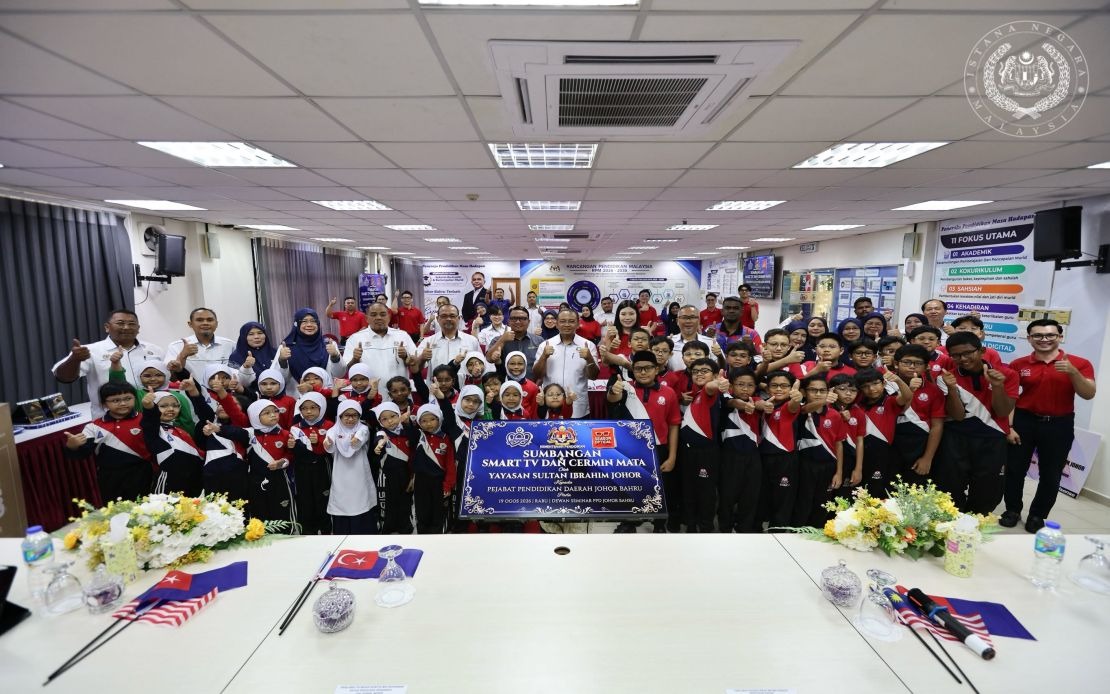
Yayasan Sultan Ibrahim Johor (YSIJ) has strengthened its commitment to educational advancement across the state through a substantial donation package delivered to institutions under the Johor Bahru District Education Office. The initiative, unveiled via Sultan Ibrahim Sultan Iskandar's social media channels, reflects the ongoing dedication of the royal foundation to enhance both classroom infrastructure and student wellbeing in one of Malaysia's key economic centres.
The donation comprises two distinct but complementary components addressing different educational needs. Ten 75-inch smart televisions have been allocated to schools across the district to facilitate the transition toward digital learning environments, recognising the critical role of technology in modern pedagogy. Simultaneously, 2,000 pairs of prescription spectacles have been distributed among B40 (bottom 40 percent income) students attending 20 participating schools, directly addressing accessibility barriers that low-income families frequently encounter when securing essential visual correction aids.
A notable innovation accompanying the spectacle distribution programme involves the Columba Vision Screener technology, a sophisticated eye-scanning device initially donated by Sultan Ibrahim. This automated system represents a significant advancement in school health screening capabilities, capable of identifying vision deficiencies within a mere ten seconds per student. The efficiency gains prove particularly valuable in a school setting where time constraints and resource limitations often impede comprehensive health assessments. By accelerating the screening process, the technology enables schools to assess substantially larger student populations than traditional methods would permit.
The quality considerations embedded within the programme demonstrate attention to practical outcomes rather than merely symbolic gestures. The spectacle frames and lenses provided through the initiative are specifically selected for durability and suitability to student lifestyles, ensuring that beneficiaries receive functional eyewear capable of withstanding daily classroom rigours. This focus on sustained utility reflects recognition that poorly fitted or fragile glasses often prove counterproductive, potentially discouraging regular use among young wearers.
Strategic partnership with Season Optical, a major optical retail operator, underpins the programme's operational success. The collaboration leverages private sector expertise in vision care and optical manufacturing, allowing the foundation to maximise the impact of its resources. Such public-private partnerships have become increasingly common in Malaysian social programmes, combining governmental or charitable funding with corporate operational efficiency and supply chain capabilities.
The handover ceremony conducted at the Johor Bahru District Education Office involved multiple stakeholders reflecting the programme's multi-layered governance structure. Shah Reza Md Kanafe, acting as YSIJ's senior manager, formally presented the donations to Mohd Khatta Muhamad of the Johor Education Department and Adnan Samsudin, the district education office's chief officer. The presence of Season Optical's managing director Sally Loh underscored the corporate commitment to the initiative's success.
From a Malaysian educational policy perspective, this donation addresses two persistent challenges within the schooling system. Digital infrastructure remains unevenly distributed across districts, with rural and economically disadvantaged areas often lagging in technology access compared to urban centres. The smart television donations directly contribute to narrowing this digital divide, providing schools serving lower-income communities with tools previously unavailable due to budget constraints. Simultaneously, the vision correction programme tackles an understated yet significant barrier to academic achievement: uncorrected refractive errors affecting concentration, classroom participation, and learning outcomes.
For students in Johor Bahru's B40 demographic, the spectacle programme carries implications extending beyond simple visual correction. Research consistently demonstrates that visual impediments disproportionately affect academic performance among disadvantaged students, whose families often cannot afford professional eye examinations or corrective lenses. By removing this barrier, the initiative potentially unlocks academic potential among students whose performance may have been artificially constrained by undiagnosed or untreated vision problems. The accessibility of the programme through schools rather than requiring family initiative to seek external providers ensures that beneficiaries are identified and supported regardless of parental awareness or knowledge of available services.
The technological dimension of the vision screening process merits particular attention for Southeast Asian contexts. Automated screening tools like the Columba Vision Screener can be rapidly deployed across multiple facilities, generating comparable data that informs broader public health policy. As Malaysia seeks to strengthen preventive health approaches within education systems, such scalable technologies become increasingly valuable for identifying population-level trends and targeting interventions effectively.
The timing and scale of this donation reflect broader patterns of royal foundations engaging with educational development across Malaysian states. Johor, as a economically significant state with substantial population centres, presents both considerable educational needs and the infrastructure to implement large-scale programmes effectively. Foundation support for education has become a consistent feature of state-level development initiatives, often complementing government budget allocations during periods of fiscal constraint or when addressing emerging needs such as digital infrastructure gaps.
Looking forward, the success metrics for these programmes will extend beyond mere distribution figures. Educational stakeholders will monitor whether smart television availability translates into measurable improvements in digital literacy and learning outcomes, and whether spectacle recipients demonstrate sustained usage and corresponding academic gains. These outcomes will inform future iterations of similar initiatives, establishing evidence-based approaches to educational philanthropy within Malaysia.
The initiative ultimately represents a pragmatic recognition that educational advancement requires multifaceted support addressing both infrastructure and student welfare simultaneously. By combining technological tools for classroom instruction with targeted support for physical health barriers affecting learning capacity, the foundation demonstrates sophisticated understanding of the interconnected factors influencing educational outcomes. Such comprehensive approaches, particularly when directed toward disadvantaged student populations, offer valuable models for other philanthropic organisations and government agencies seeking to maximise educational investment returns.

