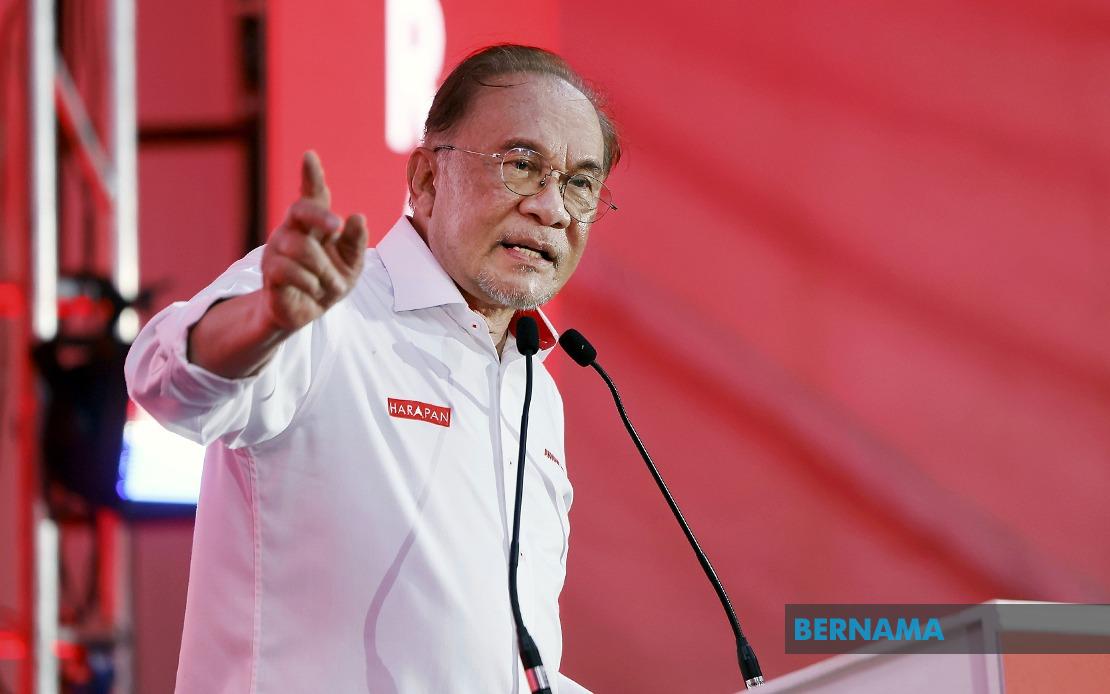
Prime Minister Datuk Seri Anwar Ibrahim has urged Johor residents to support elected representatives who combine intellectual rigour with the resolve to make difficult decisions, arguing that the state deserves leaders genuinely attuned to its citizens' aspirations. Speaking during Pakatan Harapan's campaign launch on July 4 in Johor Bahru, Anwar framed the coalition's candidacy around qualities he characterised as essential for steering the nation's most developed southern state toward greater prosperity and inclusive growth.
The PH chairman's appeal comes as the coalition prepares for the 16th Johor state election, scheduled for July 11, with early voting set for July 7. In his campaign messaging distributed via Facebook video, Anwar positioned PH as the custodian of public interests, pledging the coalition would amplify ordinary Johoreans' concerns while championing the state's developmental agenda. His emphasis on leadership quality signals an attempt to differentiate PH's campaign on governance and competence grounds rather than purely ideological appeals.
Anwar's campaign strategy for Johor demonstrates intensive grassroots engagement. On the opening day of campaigning, he personally attended seven separate community events across multiple constituencies, combining town halls, public dialogues and localised outreach initiatives. This on-the-ground approach aims to consolidate voter backing for coalition candidates while building momentum ahead of polling day. Such direct engagement reflects recognition that state elections, while potentially overshadowed by national politics, turn on local issues and candidates' perceived connection to community concerns.
Pakatan Harapan is fielding a complete slate of 56 candidates across all state constituencies, with the coalition distributing nominations among its component parties. PKR is putting forward 20 candidates, while Amanah presents 19 and DAP contributes 17 representatives. This balanced allocation reflects the internal dynamics of Malaysia's main opposition-turned-government coalition and its attempt to maintain equilibrium among member parties competing for resources and influence. The composition suggests ongoing negotiation between the three parties over seat distribution and campaign emphasis.
The Johor election has attracted substantial competitive interest, with 172 candidates vying for the 56 available state assembly seats. This candidate density indicates both strong internal party competition and the involvement of multiple political formations beyond PH. The crowded field reflects Johor's status as economically significant and politically contested territory, where control of state resources and legislative influence carries considerable stakes for competing coalitions and independent political operators.
Anwar's framing of the election around inter-ethnic cooperation represents a deliberate messaging choice designed to appeal across Johor's demographically diverse population. His specific reference to Malays, Chinese and Indians working collaboratively to develop the state and nation addresses communal concerns while emphasising shared developmental objectives. In Malaysian electoral politics, such messaging carries particular weight in economically advanced states like Johor, where voters often prioritise economic management and infrastructure development over divisive communal appeals.
The PH campaign's emphasis on representation and voice recognition suggests the coalition views Johor as an opportunity to demonstrate responsive governance. By stressing that elected representatives must authentically understand and reflect constituent priorities, Anwar implicitly contrasts PH's approach with perceptions of incumbent or competing administrations. This rhetorical strategy attempts to position PH as more attentive to grassroots concerns, though such claims require substantiation through local policy delivery records.
For Malaysian readers, the Johor election carries significance beyond the state's boundaries. As the most developed state economically and a bellwether for national political trends, outcomes here can influence perceptions of Pakatan Harapan's electoral viability and governance capacity. A strong PH performance would strengthen the coalition's position ahead of potential federal developments, while a weaker showing could embolden competing political coalitions and complicate PH's broader political standing.
The campaign messaging also reflects broader challenges facing Malaysia's current government. Since assuming office in November 2022, PH has navigated complex coalition management with component parties pursuing distinct interests, managing economic pressures including inflation and slower growth, and addressing corruption allegations. The Johor campaign provides an opportunity to rebuild voter confidence and demonstrate that PH remains responsive to local needs, not merely focused on national-level political maneuvering.
For Southeast Asian observers, the Johor election illustrates how Malaysia's federal system allows competitive multi-party politics at state level despite broader national power concentrations. The election demonstrates that Malaysian democracy, despite occasional turbulence and institutional constraints, continues channelling political competition and voter choice through electoral mechanisms. State elections remain meaningful arenas where coalition governments face accountability challenges and opposition coalitions contest for relevance.
The practical implications of Anwar's campaign messaging centre on voter expectations around governance performance. By prioritising leadership quality, decision-making capacity and constituent sensitivity, PH establishes standards against which its candidates will be evaluated. Johor voters, among Malaysia's more economically sophisticated electorates, are likely to assess candidates and manifestos with particular scrutiny regarding economic management, infrastructure investment and service delivery rather than purely partisan loyalty.

