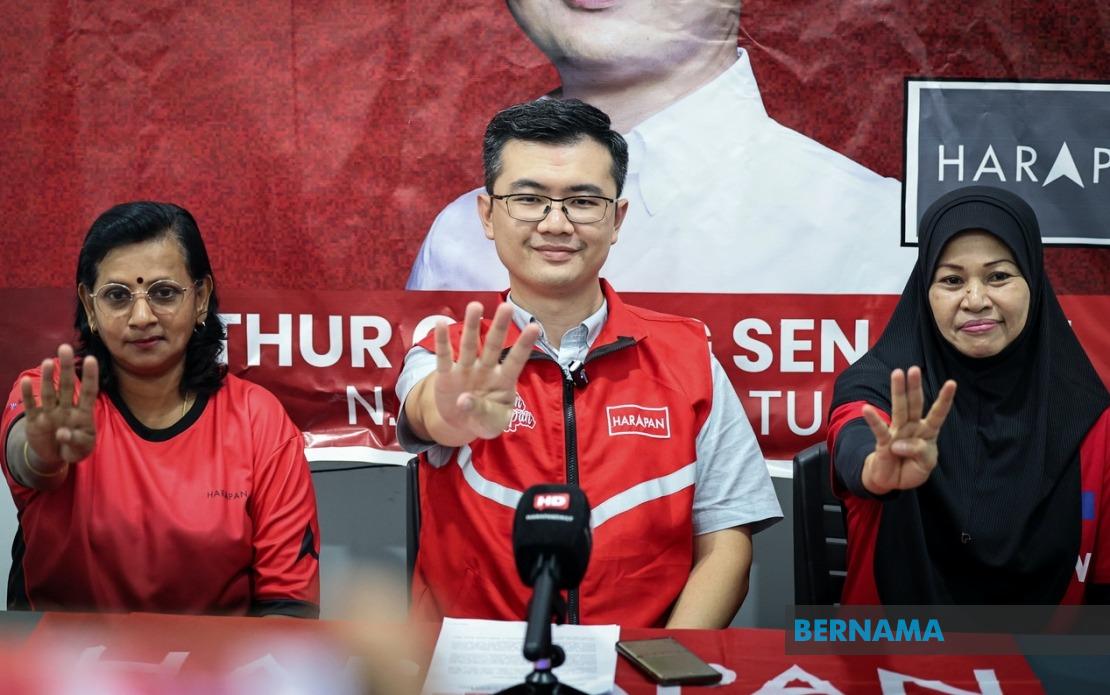
Arthur Chiong Sen Sern, the sitting Pakatan Harapan assemblyman for Bukit Batu, is pulling out all stops in the final stretch before Johor's July 11 state election, betting that elevated voter participation could make the difference in his push to retain a seat he won by just 137 votes in 2022. Speaking from his campaign headquarters at the Main Operations Room N.51 Bukit Batu in Kulai, the incumbent laid out his strategy plainly: boost turnout beyond 60 per cent, and the constituency dynamics shift decisively in his favour. That threshold carries real significance for his prospects, given how narrowly he prevailed three years ago and the volatile nature of Malaysian state politics in recent cycles.
The targeting of 60 per cent turnout is not arbitrary. The 2022 Johor state election saw voter participation of around 54.9 per cent, meaning Chiong's goal represents a meaningful increase of roughly five percentage points. In a constituency as closely contested as Bukit Batu has proved, that swing in turnout composition could determine whether voters who lean toward his coalition mobilise effectively or whether swing voters make the journey to polling stations. PH's machinery in the constituency has elevated its ground presence substantially, according to Chiong's own assessment, with campaign teams knocking on doors daily and reporting encouraging receptiveness across demographic lines.
Chiong's seven-point developmental agenda positions him as a custodian of continuity rather than a revolutionary force. The platform encompasses a data centre industry career bridge—a nod to Johor's ambitions in the digital economy—alongside infrastructure improvements including widening of FT001 road and installation of smart traffic light systems. Healthcare access forms another plank through clinic upgrades, while youth issues ranging from vape and drug abuse receive explicit attention. Tourism sector strengthening and expanded school facilities round out his promises, supplemented by free Malay and History tuition classes that speak to accessibility concerns in education.
What distinguishes Chiong's pitch is his framing of these commitments not as mere electoral pledges but as extensions of work he claims already begun during his first term. This narrative of implementation continuity appeals to voters fatigued by unfulfilled promises, though it also leaves him vulnerable to accusations that progress has been inadequate if these schemes have not visibly transformed the constituency. The emphasis on experienced leadership and strong government relations reflects a pragmatic understanding that state assemblymen operate within constraints set by higher-level governance, a reality Malaysian voters increasingly grasp.
Beyond policy substance, Chiong has attempted to occupy the rhetorical high ground on political conduct. He praised what he termed the culture of "mature politics" amongst contesting candidates, noting that even during campaign encounters rivals exchange courtesies and well-wishes. This characterisation serves multiple purposes: it positions PH as the reasonable party committed to civilised democratic competition, it subtly suggests that aggressive or divisive campaigning comes from other quarters, and it appeals to voter sentiment fatigued by acrimonious political contestation. Whether such rhetoric translates into genuine goodwill or merely reflects the standard professional civility between candidates remains an open question.
The confidence Chiong expresses in voter judgment carries undertones of faith in the electorate's wisdom to distinguish between parties based on track records and vision. Yet this rhetoric papers over fundamental anxieties implicit in his turnout focus: that his electoral base may not automatically materialise, that competing campaigns may energise rival constituencies more effectively, and that the slim margin separating victory from defeat makes every percentage point consequential. The emphasis on voter education regarding manifesto content and policy offerings suggests PH believes its case strengthens with engagement rather than on mere partisan instinct.
Chiong's appeal cuts across racial lines, according to his campaign assessment, suggesting that PH maintains cross-community support in Bukit Batu despite broader political currents elsewhere in Malaysia. This multicommunal foundation remains crucial for PH in Johor, where Malay-Muslim demographics dominate statewide but where specific constituencies contain sufficient non-Malay populations to matter. The specific mention of positive racial feedback implies that PH's messaging on inclusive governance and economic opportunity resonates beyond its traditional urban, non-Malay strongholds.
The broader context of Johor politics has shifted noticeably since 2022. State-level coalitions have realigned, federal dynamics have evolved, and voter sentiment—particularly among youth—has proved volatile. Chiong's reliance on turnout mechanics reflects awareness that his previous victory, though decisive in outcome, rested on narrow foundations vulnerable to marginal shifts. Bukit Batu therefore becomes a microcosm of PH's challenge statewide: maintaining seats won in the previous election against resurgent opposition while simultaneously appealing to voters whose allegiances remain fluid.
For Southeast Asian observers, Bukit Batu exemplifies the increasingly granular nature of Malaysian electoral competition. Individual state seats have become focal points for national coalition dynamics, with each constituency victory carrying implications for federal stability and government formation. A PH loss here would signal broader weakness in Johor, Malaysia's most populous state, with cascading consequences for federal politics. Conversely, retention would suggest that PH can defend modest gains and maintain relevance in peninsular Malaysia's political geography despite recent reversals.
The technical details of the campaign—early voting on July 7 and main polling on July 11—mark the transition from rhetorical combat to actual democratic choice. Chiong's pre-election positioning emphasises his accessibility, delivery record, and commitment to constituent service over partisan theatrics. Whether this appeals sufficiently to a constituency that has demonstrated its capacity for dramatic electoral swings will become clear when voters cast their ballots, determining not merely Chiong's political future but sending signals about PH's broader viability as a governing force within Johor.

