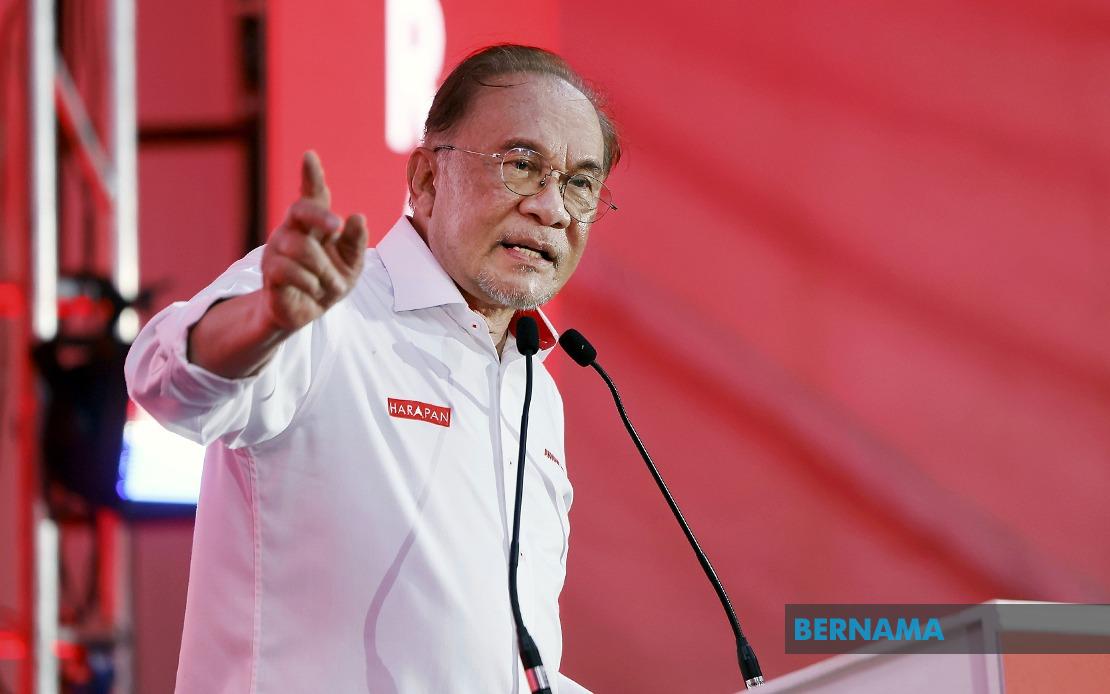
Prime Minister Datuk Seri Anwar Ibrahim asserted that Johor has been the beneficiary of a favourable fiscal arrangement with the Federal government, receiving substantially more in allocations than it has contributed in tax revenues over the past three years. Speaking at a Pakatan Harapan candidate announcement ceremony in Tangkak on June 22, Anwar illustrated the disparity by pointing to Finance Ministry data showing Johor contributed approximately RM14 billion to federal coffers between 2023 and 2025, while simultaneously receiving RM16 billion through various development initiatives, operational budgets, and support programmes.
As both Prime Minister and Finance Minister, Anwar emphasised the importance of communicating this fiscal reality to Johor's residents, framing the net inflow of funds as concrete evidence of Kuala Lumpur's commitment to the southern state's advancement. The comparison carries particular significance given the impending Johor State Election, where the government sought to demonstrate tangible progress in infrastructure and public services to voters. By quantifying federal investment, Anwar aimed to counter potential criticism that Johor has been neglected or underserved relative to other regions.
Operating expenditure allocations reveal a notable trajectory of increased support under the current administration. During the previous government's tenure, Johor received approximately RM6 billion to RM7 billion annually in operating funds. Under the present MADANI Government, this figure has risen to RM8.7 billion annually, representing a material increase of roughly 20 to 45 percent depending on the baseline year. This expansion in recurring expenditure translates to enhanced funding for schools, hospitals, administration, and other day-to-day governmental functions that directly affect residents' quality of life.
The development expenditure trend similarly demonstrates enhanced fiscal prioritisation. Between 2022 and 2026, Johor's development allocation more than doubled, climbing from RM2.3 billion to RM4.8 billion. This category encompasses capital projects such as roads, ports, industrial zones, and public facilities that generate long-term economic benefits and job creation. The substantial increase underscores a strategic shift toward infrastructure investment in the state, aligning with broader economic diversification efforts in the region beyond traditional sectors.
Within the broader national allocation framework, Johor occupies a significant position. According to Anwar's presentation, the state ranks as the third-largest recipient of combined operating and development expenditure allocations nationwide, surpassed only by the larger East Malaysian states of Sabah and Sarawak. This ranking reflects both the state's population size and strategic importance to the national economy, given its role as a manufacturing hub, logistics centre, and proximity to Singapore. The positioning ensures Johor receives comparable proportional investment to other major states while acknowledging the distinct fiscal needs of the larger East Malaysian territories.
Social assistance programmes further demonstrate the Federal government's redirection of resources toward Johor. The state ranks as the second-largest beneficiary of both Sumbangan Tunai Rahmah (STR) and Sumbangan Asas Rahmah (SARA) schemes, trailing only Selangor. These targeted cash assistance programmes aim to support lower-income households and vulnerable populations, reflecting a welfare-focused approach to resource distribution. The substantial allocation to Johor suggests either a larger eligible population requiring such support or a deliberate policy emphasis on inclusive growth across the state's diverse communities.
The fiscal narrative presented by Anwar serves multiple strategic purposes within Malaysia's complex federal-state dynamics. By publicly demonstrating that Johor receives more from federal coffers than it contributes in direct revenues, the government addresses longstanding regional sensitivities about equitable resource distribution. Many Malaysians from economically productive states harbour concerns that their contributions are disproportionately redistributed to less developed regions, potentially fuelling regional grievances or electoral discontent. Quantifying the net inflow attempts to assuage such anxieties by showing that even a significant revenue-generating state benefits substantially from federal mechanisms.
However, this fiscal accounting approach warrants scrutiny regarding what constitutes "contribution" and "allocation." Federal revenues encompass not only state-level taxes but also corporate income taxes, indirect taxes, and other national revenue sources where Johor-based businesses contribute but the attribution may be complex. Conversely, federal allocations include infrastructure benefiting multiple states, administrative overhead, and security spending whose direct benefit to Johor residents requires careful analysis. The simplified presentation, while politically effective, necessarily glosses over these complexities in resource accounting.
The timing of these disclosures reflects the electoral calendar and political competition. With Johor State Election scheduled, the government sought to demonstrate material commitment to residents' welfare and development, countering opposition narratives about neglect or favouritism toward particular states. By highlighting year-on-year increases in allocations and positioning Johor prominently within national spending rankings, the administration aimed to build momentum for Pakatan Harapan candidates competing for state legislative seats. The fiscal figures effectively become campaign ammunition illustrating governmental performance metrics.
For Malaysian voters and observers, the broader implication concerns how federal finances function in a diverse, multi-ethnic federation with significant regional economic disparities. The redistribution mechanisms reflected in these allocations—where productive states receive allocations exceeding their direct revenue contributions—represent a conscious national policy of reducing regional inequality and ensuring adequate public services nationwide. Whether such redistribution is calibrated appropriately remains subject to legitimate debate among economists, policymakers, and citizens across different regions.
Looking forward, maintaining these elevated allocation levels will require sustained federal revenue generation and budgetary prioritisation. Economic fluctuations, shifting national priorities, or changes in government could alter the trajectory of spending toward Johor. The state's development trajectory will ultimately depend not merely on budget allocations but on effective project implementation, corruption prevention, and strategic alignment with evolving economic opportunities in Southeast Asia. Anwar's fiscal revelations provide a snapshot of current commitment but represent only one dimension of comprehensive state development.
The disclosure also highlights the Finance Ministry's enhanced transparency regarding federal-state fiscal relationships, enabling informed public discourse about resource allocation. Greater clarity about how federal funds flow to different states and communities facilitates accountability and allows voters to assess governmental performance against stated commitments. This transparency, while serving immediate political purposes, contributes to healthier democratic discourse around fiscal federalism and equitable development across Malaysia's diverse geography.