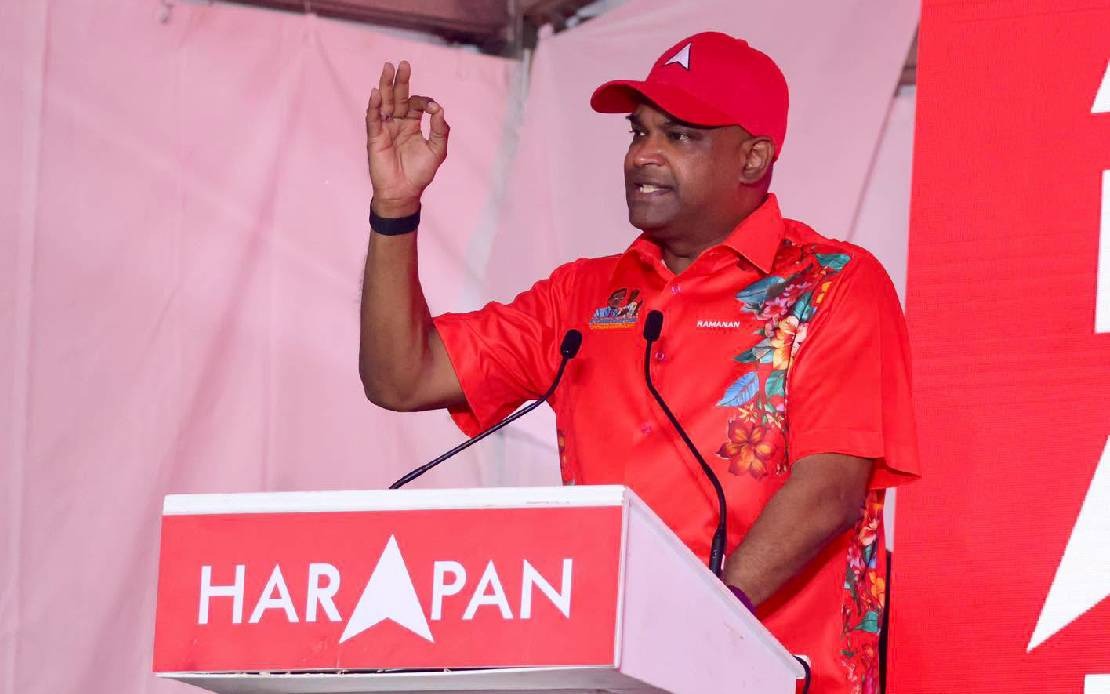
The Federal Government remains committed to channelling major investments and large-scale infrastructure projects into Johor as part of its broader national development strategy, according to senior Pakatan Harapan officials. Speaking at a roadshow in Simpang Renggam, PKR Vice-President Datuk Seri R Ramanan underscored the administration's sustained focus on the state, emphasising that development benefits are being distributed equitably across Johor's communities through a range of assistance schemes.
Ramanan's remarks come as the coalition intensifies its campaign messaging ahead of the July 11 Johor state election, seeking to consolidate support among voters who will decide the composition of the state assembly. The emphasis on federal-level backing reflects a coordinated strategy by Pakatan Harapan to position itself as capable of delivering economic progress and social programmes to Johor residents, a critical electoral battleground that has historically shaped Malaysia's political trajectory.
The commitment outlined by the PKR leader encompasses not only infrastructure development but also a structured approach to welfare and community support. By framing federal investment as purposeful and targeted, the coalition aims to counter narratives suggesting unequal resource allocation or political neglect. For Johor voters evaluating their electoral choices, such assurances carry weight given the state's economic importance as a manufacturing and trade hub and its role as a gateway to Singapore.
A fundamental component of Ramanan's messaging involves the administrative synchronisation argument—the proposition that state and federal governments operating under the same political coalition can achieve faster implementation and fewer bureaucratic obstacles. This has been a recurring theme in Malaysian political discourse, particularly when discussing development execution timelines. The logic suggests that alignment between Putrajaya and Johor's state administration would eliminate potential friction over resource competition or policy divergence, thereby accelerating project delivery.
The Johor Ke Depan, Undi Harapan roadshow programme, which featured multiple coalition candidates for contested state seats including Machap, Benut, and Layang-Layang, served as a platform for direct voter engagement. The presence of diverse coalition partners—including Amanah Secretary-General Faiz Fadzil alongside PKR representatives—signalled a unified front, though such visible coordination can also underscore internal coalition dynamics that shaped candidate selection and campaign positioning in a state where seat distribution among partners remains contested.
With 172 candidates preparing to contest the July 11 polling, the electoral landscape reflects intense competition across Johor's 56 state constituencies. Early voting scheduled for July 7 represents an institutional acknowledgement of logistical complexity in managing democratic exercises across a geographically dispersed electorate. The scale of candidacy suggests multiple parties are contesting, indicating that Pakatan Harapan's message of federal prioritisation must also counter competing narratives from opposition parties presenting alternative visions for state governance.
The developmental narrative advanced by the coalition carries particular significance for constituencies like Kluang, where rural and semi-urban communities often prioritise tangible improvements in infrastructure, healthcare access, and economic opportunity. Federal investment announcements and infrastructure projects—if delivered visibly—translate into voter perceptions of responsiveness and competent administration. Conversely, delayed or incomplete projects risk undermining confidence in political commitments, a consideration that shapes electoral behaviour in states where infrastructure deficits remain apparent.
For Malaysia's political economy, Johor's electoral outcome holds implications extending beyond the state. As the country's second-largest economy and a crucial component of regional trade networks, Johor's political direction influences national coalition stability and policy direction. A Pakatan Harapan victory would reinforce the coalition's claim to national relevance and continued governance capacity, whereas opposition gains would reshape parliamentary dynamics and the balance of power within the federal system.
The campaign messaging also reflects broader questions about how federal resources are allocated within Malaysia's federal system. The assertion that Johor receives priority funding implicitly acknowledges pressures for equitable distribution across states with varying needs and political affiliations. In a federal system where resource competition is inevitable, political actors seeking re-election must credibly demonstrate their ability to secure central funding, a function that becomes more challenging when state and federal governments operate under different coalitions.
Ramanan's address sought to consolidate support among voters who may feel ambivalent about political change or uncertain regarding coalition competence. By emphasising continuity of development commitment rather than proposing radical restructuring, Pakatan Harapan positioned itself as a stable custodian of state progress. This approach carries particular appeal in Johor, where economic stability and investment climate considerations influence voter calculations alongside social policy concerns.

