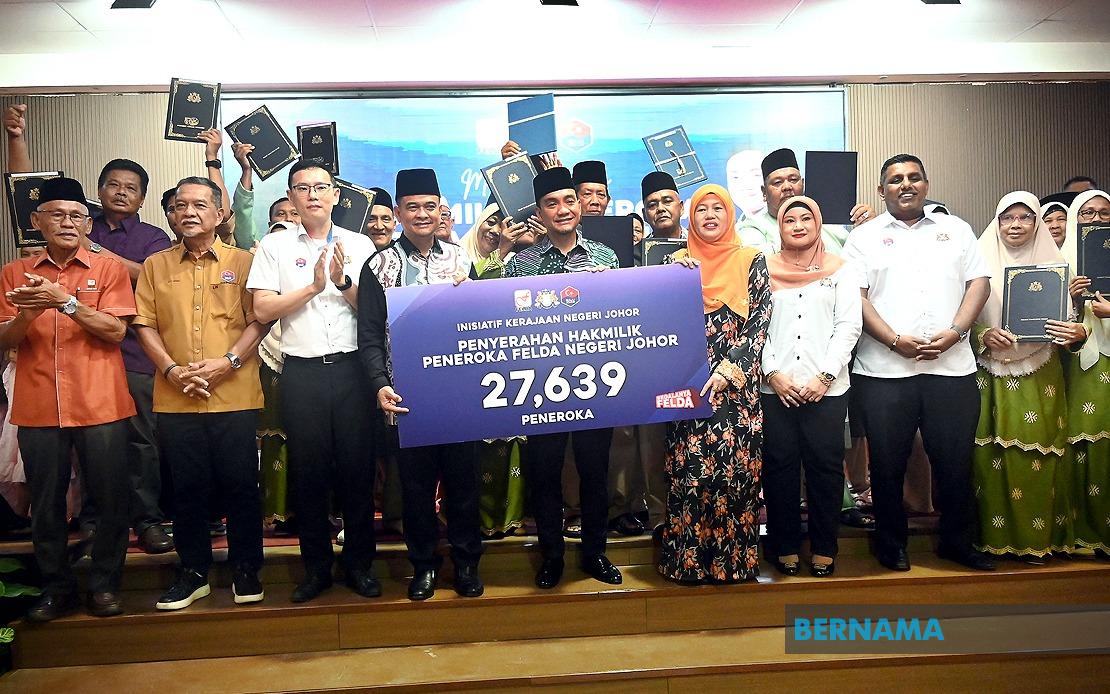
The Johor government has brought an end to one of the most persistent grievances among Federal Land Development Authority (FELDA) settlers in the state, marking a watershed moment in efforts to regularise land ownership within these historically marginalised communities. At a land title presentation ceremony in Kluang on June 23, Menteri Besar Datuk Onn Hafiz Ghazi announced that the administration had successfully processed 27,639 out of 27,642 applications—a near-complete resolution of a problem that has haunted settlement schemes for decades. The acknowledgment of this achievement underscores the complexities that have long characterised land administration in FELDA schemes, where administrative gaps between settlers' occupancy and formal legal recognition have created profound insecurity and limited economic prospects.
The ceremony itself reflected the practical significance of the milestone, as 210 settlers from three major settlement areas—Kluang, Kota Tinggi, and Mersing—formally received their land titles, transforming their relationship with property they have often worked for generations. These three districts represent some of Johor's oldest and most established FELDA settlements, making the resolution particularly symbolic for communities whose struggles with land documentation have constrained their ability to secure credit, transfer property, or exercise full ownership rights. The presentation ceremony functioned not merely as a bureaucratic formality but as a public acknowledgment that the government recognises the legitimacy of their claims and the validity of their long occupancy.
Menteri Besar Onn Hafiz articulated the resolution as part of a broader rural development philosophy that positions FELDA settlements as deserving priority attention. His remarks during the ceremony emphasised that the state government views these communities not as peripheral concerns but as integral to Johor's development trajectory. This framing matters significantly because it suggests a shift in political approach toward FELDA settlers, who have historically felt marginalised within both state and federal policy discussions. The commitment to treat such issues as ongoing priorities signals that the administration anticipates further concerns may emerge and has positioned itself to respond systematically rather than reactively.
The land title resolution also carries substantial economic implications for affected settlers. Formal property documentation opens pathways to institutional credit that have previously been blocked or severely constrained. Settlers holding official titles can now leverage their assets for business expansion, agricultural modernisation, or intergenerational wealth transfer—mechanisms that have remained largely unavailable to communities operating within legal ambiguity. For a demographic that has historically relied on subsistence and smallholder agriculture, this regularisation potentially catalyses economic transformation, though realising such benefits depends on settlers' access to complementary services such as agricultural extension, market linkages, and financial literacy.
The 99.99% completion rate itself warrants scrutiny, as the remaining 0.01%—just three unresolved applications—raises questions about the nature of these outstanding cases. Complex disputes, boundary disagreements, or inheritance complications likely account for the residual applications, suggesting that a truly comprehensive resolution may require more targeted, case-by-case intervention rather than the standardised processing model that addressed the bulk of claims. This distinction matters because it indicates that while the major administrative hurdle has been cleared, resolving the remainder may demand different approaches and longer timescales.
Johor Agriculture, Agro-based Industry and Rural Development Committee chairman Datuk Zahari Sarip's presence at the ceremony underscored the cross-sectoral nature of FELDA settlement challenges. Rural development encompasses far more than land documentation—it encompasses marketing infrastructure, pest management, market access, and agricultural pricing mechanisms that directly determine whether settler households can generate adequate livelihoods from their holdings. The integration of agricultural policy leadership into the land title resolution process signals recognition that property regularisation alone is insufficient without complementary rural development initiatives.
The backdrop to this resolution involves Johor's particular position as a state with significant historical FELDA presence and a government that has invested considerable political capital in articulating rural development as a governing priority. The timing of the announcement, coupled with its scale, suggests deliberate positioning for both immediate political benefit and longer-term constituency management. FELDA settlers represent a demographic with significant electoral influence, particularly in rural parliamentary constituencies, making the resolution both a substantive policy achievement and a politically calculated gesture.
For Southeast Asian observers, the Johor outcome offers instructive perspectives on how state governments can address legacy administrative problems within agrarian communities. The comparative experience varies widely across the region, with some jurisdictions having resolved analogous issues more rapidly while others have allowed such disputes to calcify. Johor's near-complete resolution demonstrates that systematic processing, political commitment, and adequate resourcing can resolve even deeply embedded bureaucratic failures, though the fact that such resolution requires executive-level public ceremonies and media attention suggests ongoing structural challenges within land administration systems.
The implications for FELDA as a national institution merit consideration as well. FELDA settlements, originally conceived as vehicles for rural poverty alleviation and land redistribution, have evolved into complex communities with diverse socioeconomic profiles and varying levels of prosperity. The land title crisis represented a institutional failure at the federal level, with responsibility ultimately residing with FELDA's administration. That state governments must now coordinate resolution efforts indicates fragmentation in how settler welfare is managed across different levels of governance. The Johor resolution may encourage other states with significant FELDA populations to undertake similar inventories and resolution initiatives, potentially exposing additional administrative gaps elsewhere.
Moving forward, the state government's assertion that FELDA settlements will receive continued priority attention requires operationalisation through sustained policy action and resource allocation. Land titling represents a necessary but not sufficient condition for settler prosperity; complementary investments in infrastructure, market access, technological adoption, and human capital development will determine whether the regularisation translates into tangible livelihood improvements. The Johor administration's framing of this achievement as part of a rural development agenda suggests broader commitments may follow, though translating such rhetoric into consistent implementation remains the substantive challenge ahead for both state and federal policymakers responsible for these communities.