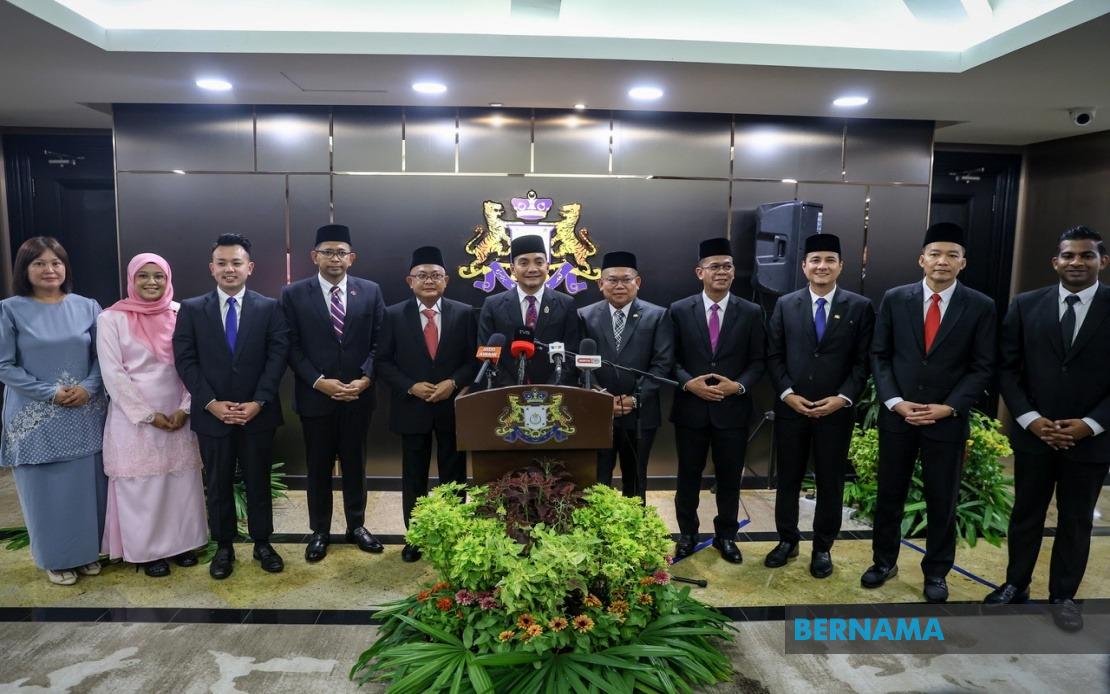
Johor's leadership has moved to fortify its administrative machinery by appointing 10 deputy chairmen across key State Executive Council committees, a structural enhancement unveiled by Menteri Besar Datuk Onn Hafiz Ghazi at Kota Iskandar. The appointments signal a deliberate strategy to expand the state government's governance capacity as Johor pursues an ambitious development roadmap designed to elevate the state to developed-nation status within the next six years.
The initiative reflects growing recognition that the complexity of modern governance demands deeper organisational layers to manage the expanding portfolio of state initiatives. By introducing deputy committee leadership positions, Johor is attempting to create faster decision-making channels and more efficient implementation mechanisms across its administrative apparatus. This pyramidal restructuring allows the state government to distribute oversight responsibilities more granularly, potentially reducing bottlenecks that can impede project execution at the grassroots level where citizens directly experience government service quality.
Onn Hafiz framed the appointments as instrumental to realising the Maju Johor 2030 framework, the state's overarching development vision that encompasses economic transformation, infrastructure expansion, and inclusive growth across all districts. The parallel Johor Economic Transformation Plan (JETP) provides the strategic thrust, outlining specific sectoral targets and investment priorities. As the state navigates this complex developmental trajectory, administrative capacity becomes a critical bottleneck—appointing experienced deputy committee chairs essentially multiplies the state government's management bandwidth without adding multiple new committees, offering a pragmatic solution to scaling governance without bloating bureaucracy.
The structural reorganisation signals confidence that expanded middle-management layers can translate political commitment into tangible outcomes. Each deputy chair assumes responsibility for monitoring project implementation, coordinating field operations, and ensuring initiatives penetrate beyond state headquarters into communities. This distributed leadership model theoretically reduces the concentration of institutional knowledge and decision-making authority among senior committee chairs, creating redundancy that improves resilience and responsiveness. For Malaysian states observing administrative reform trends, Johor's approach offers a replicable blueprint for governance enhancement without comprehensive restructuring.
Critically, the appointments received formal endorsement from Tunku Mahkota Ismail, the Regent of Johor, underscoring institutional consensus at the highest levels. This constitutional blessing carries significance beyond bureaucratic formality—it signals that the state's traditional and elected leadership align on administrative priorities, reducing potential friction between different power centres that occasionally complicates state governance in Malaysia's constitutional monarchy framework. The regent's approval legitimises the appointments and demonstrates unity of purpose within Johor's power structure, essential for maintaining policy continuity regardless of future electoral outcomes.
Onn Hafiz emphasised the collaborative dimension of these appointments, stipulating that deputy committee chairmen must work synergistically with senior committee chairs, relevant departments, and external agencies to ensure seamless policy execution. This governance philosophy prioritises horizontal coordination over vertical command structures, reflecting contemporary understanding that complex policy challenges—infrastructure integration, economic competitiveness, environmental sustainability—require interdepartmental cooperation rather than siloed departmental action. The deputy chairs effectively become coordinators and facilitators, positioned to broker agreement among departments often competing for limited resources and political attention.
For Johor's business community and citizens, these appointments represent potential improvements in service delivery timelines and policy clarity. When administrative bottlenecks are addressed through enhanced capacity, government-dependent processes—licensing, permitting, infrastructure coordination—theoretically accelerate. This matters particularly for investors evaluating Johor as an investment destination or for citizens navigating government bureaucracy, since more responsive state apparatus can enhance competitive advantage relative to other Malaysian states competing for foreign direct investment and internal resources.
The timing of these appointments reflects broader pressures facing Malaysian state governments as they attempt to simultaneously manage decentralised development mandates, accommodate expanded digital-era citizen expectations for responsiveness, and maintain cost discipline amid fiscal constraints. Johor's solution—expanding leadership capacity without necessarily expanding headcount proportionally—represents pragmatic governance adaptation. By elevating emerging administrative talent into deputy committee roles, the state also creates career progression pathways that may improve talent retention and motivation within its public service.
However, the success of this administrative expansion depends fundamentally on who occupies these deputy positions and whether appointed individuals possess requisite experience and political capital to influence outcomes. Appointments to government committees in Malaysia often reflect factional considerations, patronage networks, and political balance rather than pure meritocratic selection. The extent to which the 10 deputy chairs are selected primarily for administrative competence versus political representation will substantially influence whether this restructuring delivers promised efficiency gains or merely adds another layer of bureaucratic complexity.
Looking forward, the restructured committee system should produce measurable outcomes if the state government maintains rigorous accountability frameworks. Performance metrics for deputy chairs—implementation timelines, project completion rates, citizen satisfaction indices—should guide evaluations and demonstrate whether the appointments translate structural changes into substantive improvements. For other Malaysian states considering similar administrative enhancement, Johor's experiment will provide valuable lessons about whether expanded middle management genuinely accelerates governance or simply multiplies institutional layers without improving effectiveness.
The appointment announcement arrives as Malaysian states increasingly compete on governance quality alongside traditional factors like infrastructure and taxation policy. Investors and high-skill workers increasingly evaluate state destinations based on bureaucratic efficiency and policy predictability. Johor's administrative restructuring thus carries significance beyond internal state management—it signals to external stakeholders that leadership recognises governance capacity as strategically important to state competitiveness. Whether this signal translates into observable governance improvements within the next fiscal cycle will determine the real strategic value of these appointments.

