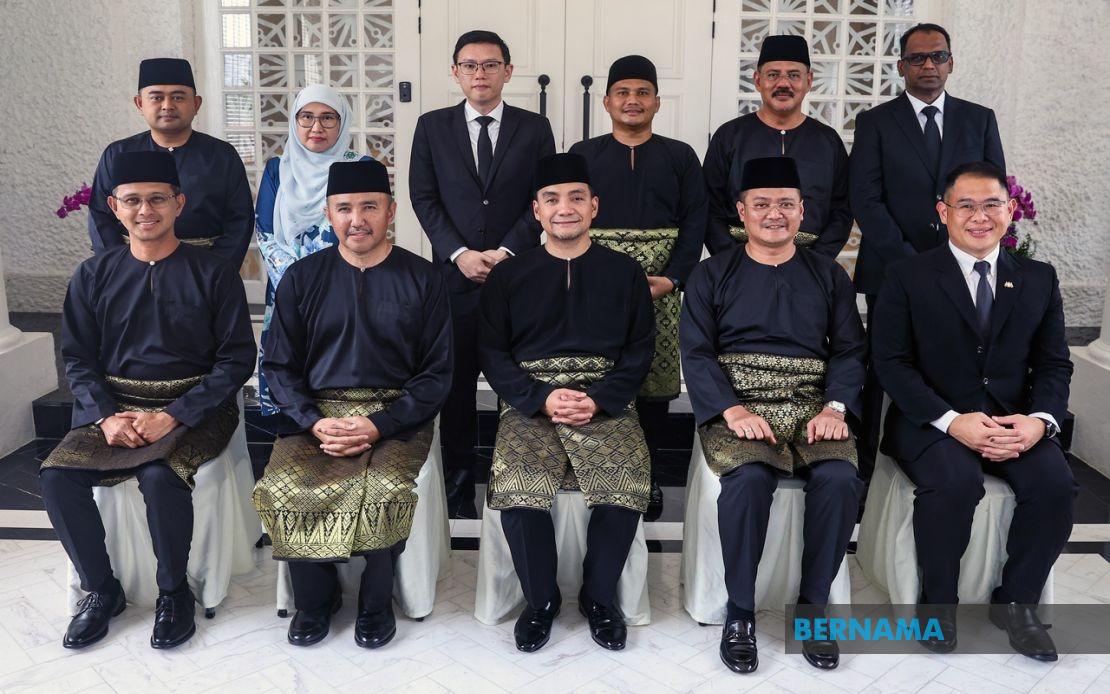
Johor's new state government has formally installed its executive council following Barisan Nasional's commanding performance in the recent state election. All ten members of the Johor State Executive Council were sworn in before the Regent of Johor, Tunku Mahkota Ismail, during a ceremony at Istana Bukit Serene in Johor Bahru on July 18. The swearing-in marks the completion of the administrative framework that will govern Malaysia's southern state for the coming term, with fresh faces joining experienced hands to steer the state's development agenda.
The reshuffle brought four new exco members into the fold while retaining six seasoned administrators from the previous term. This mix of continuity and renewal reflects the incoming administration's strategy to balance institutional knowledge with new perspectives. The four appointees—Md Israk Abdullah, P. Pannir Selvam, Hasrunizah Hassan, and Dr Muhammad Naqib Md Ghazali—each assume leadership of critical state committees that touch on agriculture, cultural development, education, and social welfare respectively. The decision to bring in new voices across these portfolios signals the government's intent to refresh its approach to longstanding challenges facing Johor's communities.
Md Israk Abdullah, representing the Kukup state seat, has been tasked with leading the Agriculture, Agro-Based Industry and Rural Development Committee, a role of particular significance given Johor's substantial agricultural sector and the need to modernize rural economies. P. Pannir Selvam from Perling will chair the Unity, Heritage and Culture Committee, positioning him to oversee efforts that strengthen social cohesion across Johor's diverse population. Dr Muhammad Naqib Md Ghazali heads the Education and Information Committee, placing him at the helm of initiatives shaping the state's educational landscape and information dissemination strategies. Hasrunizah Hassan, who represents Pulai Sebatang, assumes responsibility for the Women, Family and Community Development Committee, a portfolio that addresses critical social dimensions of state governance.
The six retained exco members ensure institutional continuity within the state administration. Their presence preserves accumulated expertise and maintains momentum on ongoing projects and policy initiatives. These experienced councillors will continue directing their respective portfolio areas, providing stability as the state government enters its new term. This continuity is particularly valuable in administrative domains requiring long-term planning and sustained implementation, such as infrastructure development, religious affairs, and investment promotion.
The formation of this exco line-up follows Menteri Besar Onn Hafiz's second consecutive oath-taking as Johor's chief executive. Onn Hafiz, who represents the Machap state seat, was sworn in just days earlier after leading Barisan Nasional to a landslide victory in the 16th Johor State Election. The Menteri Besar retained his own seat with a commanding majority of 15,375 votes, a result that underscored public confidence in his stewardship and vindicated the coalition's electoral strategy.
Barisan Nasional's performance in the election was decisive by any standard. The coalition captured 48 out of 56 state seats, granting it unambiguous authority to shape the state's direction for the new term. This electoral mandate provides the government with considerable scope to pursue its policy agenda without the complications that minority governments typically face. For Johor specifically, the strong mandate offers an opportunity to implement coherent, sustained development strategies across multiple sectors simultaneously.
The breadth of the exco portfolios reflects the complexity of modern state governance in Malaysia. Beyond the traditional domains of finance and administration, the committee structure encompasses agriculture, housing, unity and culture, youth and sports, religious affairs, health and environment, investment and trade, public works, and education. This comprehensive architecture acknowledges that effective state administration must address interconnected challenges ranging from economic development and social stability to environmental sustainability and citizen welfare.
For Malaysian observers, the Johor reshuffle carries implications extending beyond the state's borders. As the nation's gateway to Singapore and a crucial economic hub in the southern corridor, Johor's governance directly influences regional prosperity and stability. The investment promotion and trade facilitation roles within the exco become particularly significant in this context, as they shape the state's competitiveness for foreign and domestic capital investment. Similarly, the focus on education and skills development under Dr Muhammad Naqib's new committee will influence the human capital available to Johor's growing sectors.
The appointment of new committee chairs also signals attention to social dimensions of development that have gained prominence in contemporary Malaysian politics. The enhanced visibility given to women, family and community development through Hasrunizah's appointment reflects broader societal shifts in expectations regarding inclusive governance. Heritage and culture portfolios, now led by Pannir Selvam, address the intangible dimensions of community life that economic metrics alone cannot capture. These appointments suggest the new administration recognizes that sustainable development encompasses social cohesion and cultural vitality alongside economic growth.
For the state's administrative machinery, the transition period ahead will test coordination between new and returning exco members. Fresh appointees will need to rapidly acquaint themselves with ongoing projects, departmental operations, and stakeholder relationships within their respective domains. The success of this administrative transition will largely determine whether the government can translate its electoral mandate into tangible policy outcomes during its tenure. The interplay between institutional continuity and fresh energy will shape whether Johor can address inherited challenges while charting new directions.

