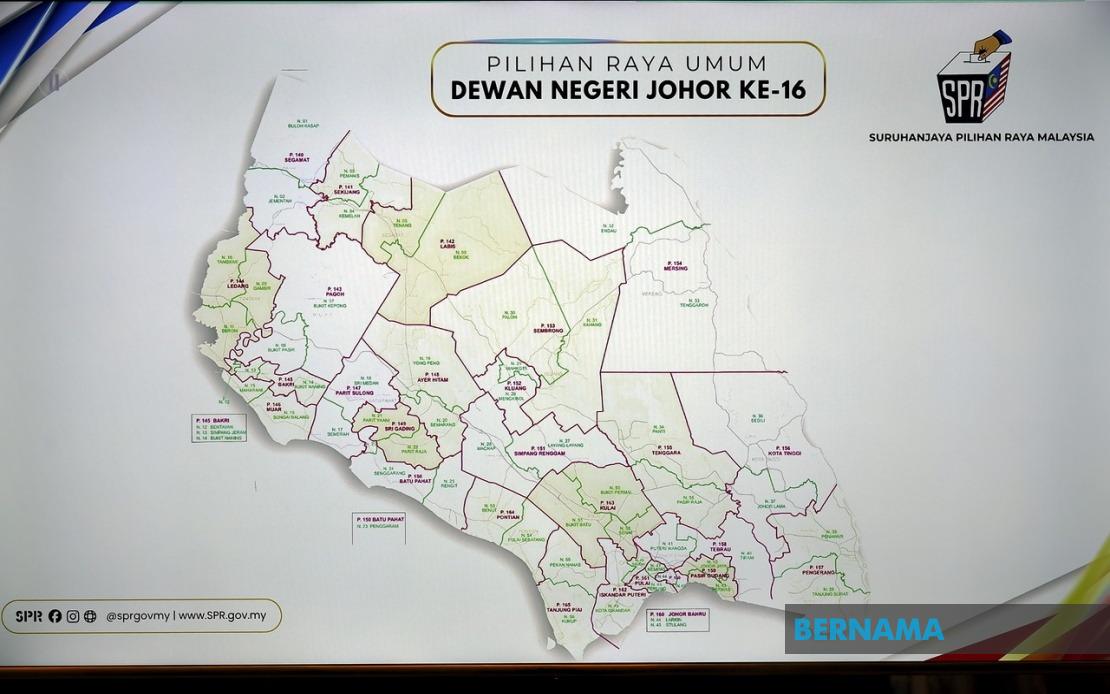
The 16th Johor state election moves into its decisive stage tomorrow as nomination day formally opens the race for control of all 56 state assembly seats. This electoral milestone represents a turning point for one of Malaysia's most politically significant states, with major political coalitions readying their full arsenals of candidates—a mixture of battle-tested veterans, emerging newcomers, and politicians attempting political comebacks. The nomination process will run between 9 am and 10 am at designated registration centres throughout the state, after which the Election Commission will release the comprehensive roster of contenders once verification procedures are completed. Polling day has been scheduled for July 11, with early voting permitted on July 7, giving the state's considerable electorate a month-long campaign season to evaluate competing visions for Johor's future.
The scale of this election underscores Johor's weight in Malaysia's political balance. According to the Election Commission's official data, some 2.7 million ordinary voters are registered to participate, supplemented by military personnel and spouses totalling 12,041, and police officers and spouses comprising 12,710. This collective electorate of 2,727,926 represents a substantial segment of the national voting population, making outcomes here significant bellwethers for broader political trends across Malaysia. The inclusion of military and law enforcement voters—a constituency that historically leans towards establishment parties—adds an additional dimension to how different coalitions might perform in this contest.
Pakatan Harapan has committed to fielding candidates in all 56 seats, demonstrating the coalition's determination to mount a comprehensive challenge to incumbent structures. The lineup comprises 20 candidates from Parti Keadilan Rakyat, 19 from Amanah, and 17 from the Democratic Action Party, reflecting an attempt to balance representation among its component parties while maximising competitive reach across different demographic and geographic constituencies. This full-slate approach signals PH's aspirations to capitalize on any anti-incumbent sentiment that may have developed since the previous election cycle.
Barisan Nasional has equally committed to the full 56-seat battleground, projecting confidence in its electoral machinery. UMNO is fielding 36 candidates, while the Malaysian Chinese Association contributes 16, and the Malaysian Indian Congress provides four. This distribution heavily favours UMNO's dominance within the coalition, reflecting both the party's traditional strength in Johor's rural and semi-urban areas and the evolving dynamics of multiethnic politics in the state. The BN configuration suggests a coalition banking significantly on UMNO's ground networks and traditional voter bases.
Perikatan Nasional, the third major player in this three-way contest, has mounted a selective but still substantial effort, contesting through the Pan-Malaysian Islamic Party's 11 candidates, Bersatu's 16, and the Malaysian Indian People's Party's five seats. This approach suggests PN is targeting specific constituencies where it perceives competitive advantages rather than attempting blanket coverage. The strategic concentration of effort may indicate calculations about where the coalition believes it can convert votes into seats most effectively given Malaysia's first-past-the-post electoral system.
Beyond the three main coalitions, newer and smaller political entities are also seeking parliamentary representation. The Malaysian United Democratic Alliance is contesting four seats, positioning itself as an alternative for voters potentially dissatisfied with larger establishment parties. The Socialist Party of Malaysia has fielded a single candidate, maintaining its presence in electoral contests despite limited resources. Most significantly, Parti Bersama Malaysia is making its electoral debut across 15 seats, suggesting an emerging political force attempting to establish itself in Johor's competitive landscape. Together, these smaller parties add complexity to the contest and potentially fragment voting patterns in ways that could affect seat distribution outcomes.
The Election Commission has issued practical guidance to prospective candidates ahead of tomorrow's critical deadline, emphasising early verification of nomination documents at the Returning Officer's Office or State Election Office to prevent procedural complications. Additionally, candidates are being instructed to settle deposit payments promptly and retain receipts as evidence when submitting formal nomination papers. These administrative reminders reflect lessons from previous elections where last-minute documentation issues have occasionally disqualified otherwise viable candidates or created unnecessary complications during the nomination period.
Anti-corruption oversight will operate at heightened levels throughout the campaign period. The Malaysian Anti-Corruption Commission has issued explicit warnings to all candidates and parties prohibiting unlawful conduct under both the MACC Act 2009 and the Election Offences Act 1954 (Amendment 2012), categories that encompass everything from financial impropriety to abuse of official positions for electoral advantage. To enforce this mandate, the MACC has established five dedicated 24-hour operations rooms at Tampoi, Batu Pahat, Kluang, Segamat, and Mersing, providing geographic coverage across the state's diverse constituencies and creating accessible channels for members of the public to report suspected violations. This institutional arrangement reflects ongoing national concerns about electoral integrity and the visible deployment of anti-corruption machinery during election cycles.
The political context for this election is shaped substantially by the previous 2022 Johor state election outcomes, which delivered Barisan Nasional 40 seats, Pakatan Harapan 12 seats, Perikatan Nasional three seats, and MUDA a single seat. These results granted BN decisive control of the state assembly and the ability to form government without coalition support, though two years have elapsed since that verdict. Political dynamics in Johor have likely shifted during this intervening period, with local governance records now subject to voter evaluation alongside broader national political trends. The previous election represented a significant BN performance that exceeded results in several other Malaysian states, underscoring Johor's traditionally more conservative electoral orientation, though recent shifts in voter sentiment across Malaysia suggest previous assumptions about regional political stability warrant reassessment.
The Johor State Legislative Assembly's dissolution on June 1 initiated the legal framework that has culminated in tomorrow's nomination day. From this point forward, the campaign enters its most visible phase, with political parties conducting public rallies, distributing campaign materials, and competing directly for voter attention and support. The institutional machinery of Malaysian elections—carefully calibrated regulations, transparent nomination processes, and established timelines—now transitions from administrative planning into the messy reality of political competition where candidates must convert party machinery and messaging strategies into actual electoral support among a diverse and increasingly unpredictable electorate.

