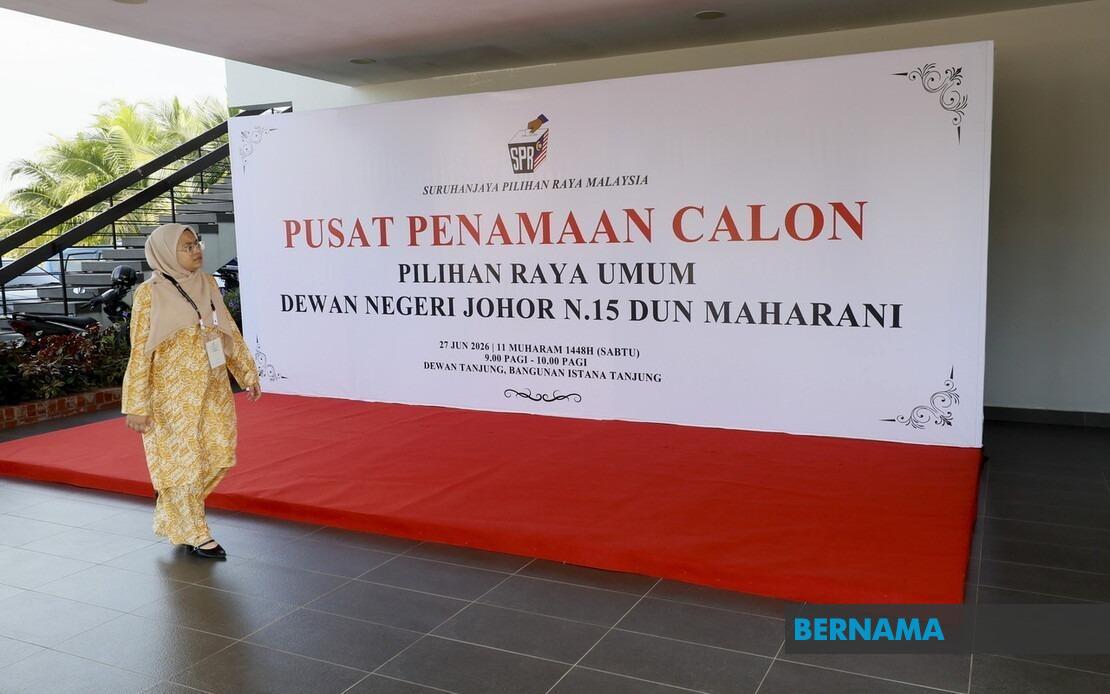
The 16th Johor State Election formally commenced today, marking the beginning of what promises to be a closely contested battle for control of Malaysia's southern industrial powerhouse. Nomination centres across all 56 state constituencies opened their doors from 9 am, with prospective candidates given a tight one-hour window to lodge their nomination papers with the respective Returning Officers. This compressed timeframe ensures that only those adequately prepared and properly backed by their political organisations can meet the stringent filing deadlines set by the Election Commission.
As of yesterday, the level of political engagement across Johor's various coalitions showed encouraging signs of broad participation. A total of 593 nomination forms had already been distributed to interested aspirants, while 133 candidates had formally confirmed their candidacy by submitting their mandatory election deposits. These figures suggest that despite the compressed timeline, all major political blocs have mobilised their machinery to put forward competitive slates, reflecting the continued vigour of electoral competition in one of Malaysia's most politically significant states.
The electoral contest will ultimately involve over 2.7 million registered voters, a figure that underscores Johor's substantial weight within the Malaysian political landscape. This electorate comprises 2.7 million ordinary voters, supplemented by 12,041 military personnel and their spouses, and 12,710 police officers and their families. The breadth of this voter base, drawn from Johor's diverse urban, suburban, and rural communities, ensures that election outcomes here carry implications extending well beyond the state's borders, influencing broader national political calculations and coalition dynamics.
Pakatan Harapan has committed to contesting the full slate of 56 seats, fielding candidates through three component parties in proportional distribution: PKR brings 20 candidates, Amanah contributes 19, and DAP fields 17. This unified approach across the opposition coalition signals a disciplined organisational structure and a determination to present voters with a complete alternative to the incumbent government. The distribution of seats among PH component parties reflects careful negotiation and reflects historical performance patterns across different constituencies.
Barisan Nasional, the incumbent governing coalition holding 40 of the previous 56 seats, is similarly fielding complete coverage through its traditional component parties. UMNO fields 36 candidates, MCA contributes 16, and MIC provides four. This comprehensive slate underscores BN's confidence in defending its dominant position, despite the electoral headwinds that have buffeted the coalition in other recent state contests. The composition of BN's candidate pool will be closely scrutinised by analysts as an indicator of the coalition's strategic priorities and demographic targeting across different communities and constituencies.
Perikatan Nasional, the relative newcomer to national and state-level coalition politics, is adopting a differentiated strategy by fielding candidates across multiple partner parties. PAS will contest 11 seats, Bersatu commits 16 candidates, the Malaysian Indian People's Party offers five candidates, and Parti Pejuang Tanah Air runs a single candidate. This multi-party approach allows PN to contest widely while maintaining the distinct identities of its component organisations and allows parties to contest constituencies where they maintain specific organisational strength or community connections.
The election will also witness participation from several smaller political entities, reflecting the increasingly fragmented nature of Malaysia's political landscape. MUDA, the youth-oriented newcomer that surprised observers with success in previous contests, fields four candidates across constituencies where it believes it maintains momentum. Parti Sosialis Malaysia maintains its presence with a single candidate, while the newcomer Parti Bersama Malaysia makes its electoral debut with an ambitious slate of 15 candidates, suggesting it has conducted serious groundwork in preparations for this contest.
The 14-day campaign period will unfold between today and 11.59 pm on July 10, providing parties with a substantial window to engage voters across traditional and digital platforms. Early voting is scheduled for July 7, catering to military and police personnel, while polling day itself falls on July 11. This electoral calendar follows the dissolution of the State Legislative Assembly on June 1, which formally initiated the process leading to today's nomination exercise. The spacing of these dates allows campaigns to develop momentum while preventing excessive fatigue among voters and candidates alike.
Logistical preparations to accommodate the nomination process have been substantial. The Election Commission has mobilised 4,832 police personnel across Johor to maintain order, manage traffic flows, and oversee security at the 56 nomination centres. Nineteen major roads near these centres face planned closures and diversions throughout the day, requiring residents and motorists to anticipate disruptions and plan alternative routes. Such security deployments, while routine for major electoral events, underscore the state's commitment to ensuring peaceful and orderly conduct of the nomination process.
The Election Commission has issued formal reminders to all candidates and their supporters regarding compliance with the Election Offences Act 1954 and relevant local authority regulations. Particular emphasis has been placed on restrictions governing the use of loudspeakers mounted on vehicles and musical instruments during campaign activities. These regulations, designed to maintain public order and prevent disruption to daily life, remain familiar to regular observers of Malaysian electoral contests but occasionally generate friction between enthusiastic campaigners and enforcement authorities.
Weather conditions present an additional variable for today's proceedings. The Malaysian Meteorological Department has forecast morning showers in several parts of Johor, with afternoon thunderstorms anticipated across portions of the state. Such weather patterns, while typical for Johor's tropical climate, may influence voter turnout patterns during the early voting phase and potentially affect the logistics of campaign activities. The Election Commission's experience managing elections across varied weather conditions should ensure that meteorological factors do not significantly disrupt the nomination process.
The composition of candidate pools across different constituencies will reveal much about each political party's succession planning and internal dynamics. The mix of incumbent office holders seeking re-election, newcomers with fresh mandates, and returning former elected representatives who previously stepped aside or lost their seats reflects the natural churn of democratic politics. Voters will assess not only party platforms and campaign messaging but also the calibre and local rootedness of individual candidates presented to them across the diverse constituencies spanning Johor's geography.
Johor's strategic importance within Malaysian politics extends beyond its substantial electoral weight. The state represents a crucial battleground where coalition politics intersect with efforts to reshape Malaysia's political structures. Results here will provide early signals to observers monitoring whether opposition coalitions can sustain recent electoral gains, whether BN can reverse recent losses, and whether newer political movements can consolidate support beyond headline-grabbing electoral breakthroughs. The unfolding Johor campaign will therefore warrant close attention from political analysts and observers concerned with Malaysia's broader political trajectory.

