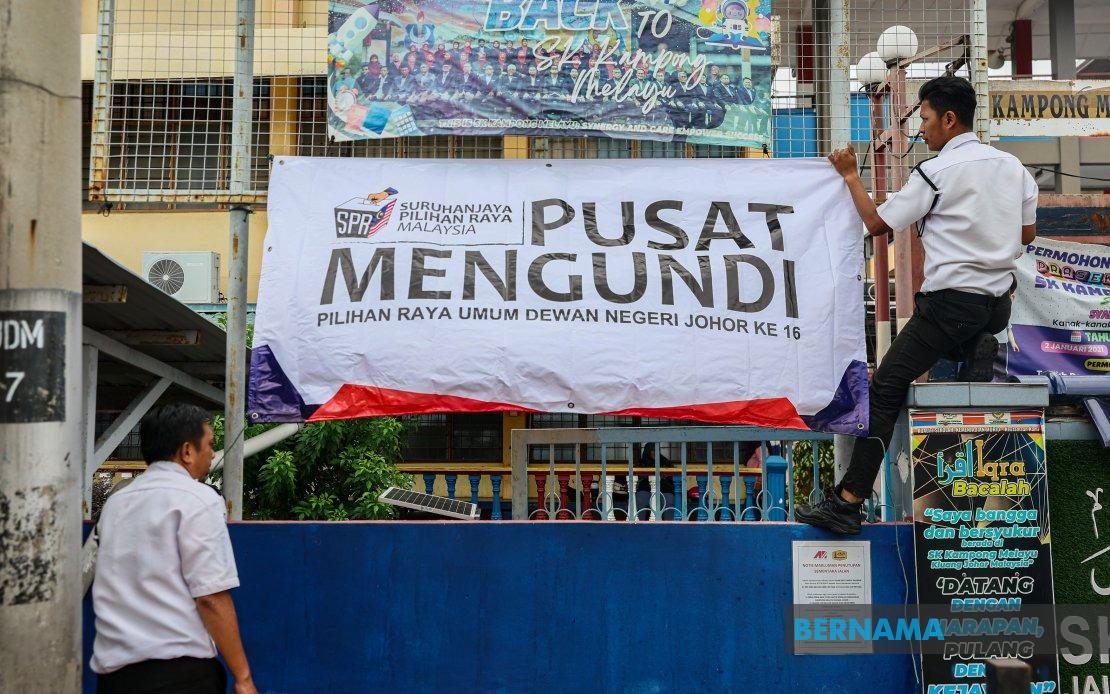
The Johor state election unfolded across the southern peninsula on July 11 as more than 2.7 million registered voters headed to polling stations to select their representatives in the State Legislative Assembly. This 16th election for Johor represents a significant political moment for Malaysia's second-largest state by population, determining the composition of all 56 seats in the assembly and setting the direction of state governance for the coming years. The voting exercise concluded a fortnight of intensive campaigning that ended at the stroke of midnight on the preceding day, during which competing coalitions and independent candidates made their final pitches to an electorate with considerable influence over regional politics.
Operations commenced simultaneously across Johor at eight in the morning, with the Election Commission mobilising an extensive logistical apparatus to facilitate the democratic process. A total of 1,076 distinct polling centres distributed throughout the state managed the voting through 4,889 separate voting streams, enabling authorities to process the large number of ballots efficiently while adhering to established protocols. To support this undertaking, the Election Commission deployed 43,036 election workers—encompassing polling officials, security personnel, and administrative staff—who worked in coordinated shifts throughout polling day. This substantial workforce reflected the complexity of running a statewide election across diverse geographical terrain, from densely urbanised areas to more remote islands and rural localities.
The Electoral Commission had set an ambitious target of securing approximately 70 per cent voter participation, a benchmark that would represent a notable improvement over the previous state election cycle. In contrast, the 2022 Johor state election achieved a turnout of 54.92 per cent, suggesting that organised efforts and greater electoral engagement might yield a significantly higher figure this year. The commission's confidence in this projection derived partly from early voting results, with 20,607 individuals—comprising police officers, military personnel, and their spouses—having cast ballots on the preceding Tuesday, indicating robust participation among organised sectors. The expectation of a healthier turnout reflects broader trends of heightened political consciousness among Malaysian voters and recognition of local elections' importance in determining state-level policy outcomes.
Logistically, the voting centres operated on a staggered closure schedule designed to accommodate geographical variations and island accessibility. Remote island polling stations on Pulau Besar closed as early as eleven in the morning, with Pulau Aur and Pulau Pemanggil following at noon, allowing officials to complete vote-counting and transport materials under daylight conditions. Mainland polling stations remained open considerably longer, with most facilities operating until five or six in the evening. This phased approach ensured that results from distant locations could be collated and verified before the final tallying occurred. By ten o'clock in the evening, the Election Commission anticipated that comprehensive results would be available, allowing political parties and the broader public to understand the electoral outcome with minimal delay.
Weather presented a variable challenge across different regions of Johor on polling day. The Malaysian Meteorological Department had forecast morning rainfall in several populated areas including Johor Bahru itself, Batu Pahat, Kulai, Muar, Pontian and Tangkak, with conditions expected to improve during afternoon and evening hours. Conversely, the eastern districts of Kluang, Kota Tinggi and Segamat faced afternoon thunderstorm warnings, while Mersing experienced unsettled conditions from mid-afternoon through evening. Despite these meteorological challenges, the Election Commission maintained that weather would not materially disrupt voting operations, as polling centres possessed adequate shelter and contingencies to accommodate voters regardless of precipitation.
The candidate field encompassed 172 individuals representing eight distinct political entities, reflecting the fragmented nature of Malaysian party politics and competing visions for Johor's future. The two dominant coalitions fielded full slates of 56 candidates each: Pakatan Harapan, the incumbent federal ruling coalition, and Barisan Nasional, the historically dominant coalition that governed most Malaysian states until recent electoral shifts. Perikatan Nasional, an Islamist-leaning coalition, presented 33 candidates, while Parti Bersama Malaysia offered 15. Smaller parliamentary contenders, including MUDA with four candidates, Parti Orang Asli Malaysia with one, and Parti Sosialis Malaysia with one, rounded out the field alongside six independent candidates seeking assembly seats without party affiliation.
The preceding assembly composition provided crucial context for understanding this election's significance. Before dissolution on June 1, Barisan Nasional dominated with 40 seats, while Pakatan Harapan held 12, Perikatan Nasional controlled three, and MUDA occupied one. This distribution suggested that incumbent Barisan Nasional would face determined challenges from both Pakatan Harapan, which governed the federal government, and Perikatan Nasional, which maintained strongholds in certain districts. The election thus represented not merely routine political renewal but a potential inflection point that might reshape southern Malaysian politics and influence broader national political calculations.
Employers throughout Johor received explicit reminders from electoral authorities that workers must receive reasonable time away from their duties to exercise voting rights, reflecting constitutional and electoral principles established across Malaysia. This directive sought to prevent organisational barriers to participation and affirmed that voting constituted a fundamental civic responsibility superseding normal employment obligations. Such guidance carried particular weight in Johor, where manufacturing, port operations, and tourism constitute major employment sectors with potential to generate scheduling conflicts during the working day.
Postal voting, while numerically less significant than in-person balloting, remained an important accommodation for voters unable to reach polling centres. A total of 24,677 postal ballots had been distributed to eligible recipients, and these votes required return to electoral authorities by six o'clock in the evening to qualify for inclusion in the official tally. The postal voting mechanism primarily benefited state residents temporarily absent from their constituencies, overseas workers, and individuals with documented impediments to physical attendance at polling stations.
This election carried implications extending well beyond Johor's state boundaries. As Malaysia's second-largest state and a significant economic contributor to the federation, Johor's political composition influences broader national alignments and coalition dynamics. The state's outcome would reveal whether Pakatan Harapan's federal administration could translate central government legitimacy into regional electoral success, whether Barisan Nasional retained sufficient grassroots organisation to maintain traditional strongholds, and whether Perikatan Nasional continued expanding influence in Malaysia's east coast and southern regions. For the broader Southeast Asian region, Johor's result would signal whether Malaysia's democratic institutions could manage peaceful power transitions and electoral competition without institutional strain, setting important precedents for the region's other electoral democracies.

