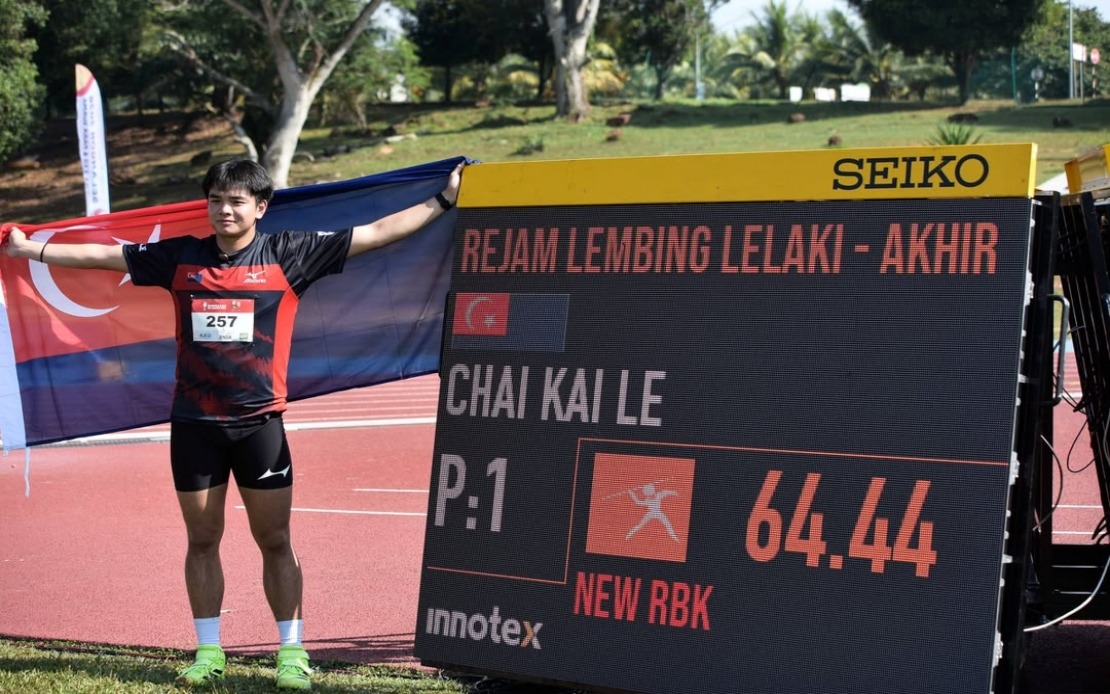
Johor's Chai Kai Le has etched his name into Malaysian sporting history by obliterating a quarter-century-old javelin record at the Selangor 2026 Malaysia Games, hosted at the Universiti Putra Malaysia Sports Centre in Serdang. The 18-year-old athlete's magnificent throw of 64.44 metres on his second attempt surpassed the previous Games standard of 62.33 metres, which had remained unchallenged since Sarawak's Kho Mei Kuan established it in 2000 during the Penang edition. The performance represents a significant milestone for Malaysian track and field, demonstrating the emergence of a new generation of competitive throwers capable of challenging longstanding national benchmarks.
Kai Le's triumph marked the dominant showing from Johor in the javelin competition, with his state claiming two of the three podium positions. Penang's Tan Chun Wei secured the silver medal with a respectable 60.43 metres throw, while Kai Le's Johor teammate Mohd Noor Iman Norman rounded out the podium in third place with a 59.04 metre effort. The strong showing from the Johor contingent underscores the state's investment in developing throwing disciplines, an area where Malaysian athletics has historically struggled to maintain consistent excellence at regional and international levels.
Speaking after his victory, the teenage sensation revealed that his record-breaking performance was no accident but rather the culmination of meticulous preparation spanning two years. Kai Le disclosed that challenging the Games record had formed a central component of his training objectives leading into the Selangor competition. His confidence in achieving the feat stemmed from rigorous conditioning and technical refinement conducted under his coaching team's guidance during this extended preparation phase. The athlete's calculated approach to setting and pursuing specific benchmarks reflects a maturity of mindset uncommon among competitors his age, suggesting a well-structured development pathway has been cultivated at the state level.
However, Kai Le's account of his performance also revealed the physical toll demanded by elite-level throwing competition. Following his record-setting second throw, the teenager acknowledged that a technical error in his execution triggered pain in his lower back region and subsequent fatigue that compromised his capacity for further attempts. Rather than pursuing additional throws that risked compounding the injury, Kai Le adopted a pragmatic approach focused on damage mitigation and injury prevention. This decision-making demonstrates not only physical awareness but also tactical acumen, prioritizing long-term athletic development over the pursuit of marginally better performances that could jeopardize his career trajectory.
Kai Le's personal record provides further evidence of his exceptional promise and the gap between his Games performance and his maximum capability. The teenager currently holds the national under-20 record of 65.65 metres, suggesting room for improvement even at his current competitive level. This differential between his u-20 standard and his Games achievement indicates that further refinement of technique and development of strength could unlock even greater throws as he transitions into senior competition and ages into a body capable of supporting heavier loads. The progression pathway from junior to senior competition typically yields additional performance gains as athletes mature physically and technically.
The athletics programme at Selangor 2026 also showcased excellence in race walking disciplines, with Penang's Mohammad Aiman Haikal Sahrudin claiming victory in the men's 10,000 metres race walk. The 18-year-old covered the distance in 47 minutes 28.84 seconds, demonstrating consistency and competitive edge over a field that included strong regional representatives. Kelantan's Ahmad Farish Irfan Ahmad Fahmi captured the silver medal with a time of 47 minutes 37.17 seconds, maintaining close proximity to the winner throughout the competition, while Federal Territories athlete Khor Jing Hong secured third place in 47 minutes 49.27 seconds.
Mohammad Aiman's victory represented significant personal progress, building upon his previous competitive experience at the same event. At the earlier Sarawak edition of SUKMA, the Penang-based athlete had finished in second place, suggesting a systematic improvement trajectory as his fitness and tactical understanding of race walking have developed. His competitive output indicates that states beyond the traditional athletic powerhouses are nurturing competitive talent capable of contending at Games level, a broader positive trend for Malaysian sports development.
Furthermore, Mohammad Aiman articulated clear aspirations extending beyond the domestic Games circuit, revealing ambitions to secure selection for the national squad and ultimately represent Malaysia at the 2027 Southeast Asian Games. This forward-looking perspective is increasingly common among emerging athletes who recognize the importance of international exposure in developing their sporting credentials and accelerating their competitive progression. However, the teenager demonstrated tactical awareness regarding the specific events available in SEA Games competition, noting that the 10,000 metres race walk format does not feature on the regional championship calendar. He accordingly signalled intention to concentrate on the 20,000 metres race walk variant, which aligns with SEA Games programming and represents his strategic pathway to international representation.
The performances at Selangor 2026 collectively illustrate how the Malaysia Games continue to function as a crucial developmental platform for identifying and nurturing emerging athletic talent within Malaysia's state-based sporting structure. Athletes like Kai Le and Mohammad Aiman demonstrate that when appropriate coaching infrastructure, technical support, and competitive opportunities converge at the state level, young competitors can achieve performances that rival national records and challenge established standards. The investment in athletics programmes by states like Johor and Penang appears to be yielding tangible returns in the form of record-breaking performances and emerging athletes with genuine potential for international representation.
Moreover, these achievements occur within a competitive context where regional rivals are similarly developing their athletics programmes, creating a dynamic environment where Malaysian standards must continuously evolve upward to maintain competitiveness. The fact that records established in 2000 are only now being challenged suggests that sustained, systematic investment in athlete development across multiple states has been necessary to push performance boundaries. For Malaysian athletics to maintain momentum and establish consistent excellence in international competition, the developmental pathways exemplified by these Games performances require continued institutional support, adequate funding allocation, and coaching expertise at both state and national levels.

