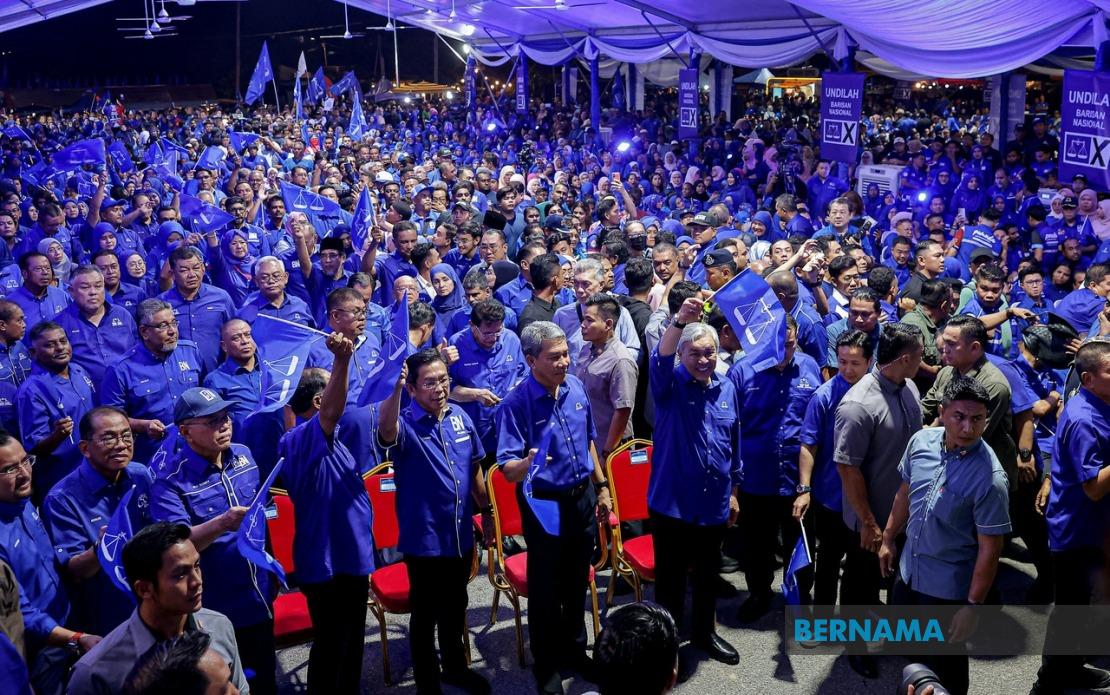
Barisan Nasional's commanding performance in Johor should catalyze the coalition into an aggressive campaign for the Negeri Sembilan state election, according to BN chairman Datuk Seri Dr Ahmad Zahid Hamidi. Speaking at the launch of the party's electoral machinery in Seremban on July 15, the Deputy Prime Minister and UMNO president framed the Johor triumph as a blueprint for success in the upcoming contest, urging immediate door-to-door canvassing and voter engagement across the state.
The Johor result provides substantial political capital for BN's regional ambitions. The coalition captured 48 of the 56 available state seats whilst securing nearly 60 per cent of the popular vote—a performance Zahid characterized as the coalition's most dominant victory in Johor's electoral history. Such a commanding mandate signals renewed public confidence in BN's governance model, encompassing political stability, economic management, and administrative competence. For many observers, the scale of the victory represented a significant reversal from the coalitional losses suffered in the 2022 general election and subsequent state contests, suggesting that voter sentiment may be stabilizing in BN's favour.
Zahid emphasized that Johor's success derived principally from cohesion within the BN family, with constituent parties operating as a unified team built on mutual trust and complementary strengths. This diagnostic assessment carries particular importance for Negeri Sembilan, where internal factional tensions and competing candidate preferences have historically threatened party discipline. By invoking the Johor experience, Zahid articulated a message directed internally at BN's grassroots: setting aside personal grievances and factional loyalties remains essential to preventing fragmentation that could undermine the coalition's electoral performance.
The call for unity extends beyond mere rhetoric given the party's prior struggles in Negeri Sembilan. In the 2023 state election, the coalition secured only 14 seats, reflecting significantly weaker electoral positioning than BN's current national trajectory. Zahid's framing of Johor as a model therefore implies that organizational discipline and internal alignment directly translate into electoral outcomes. The admonition that party members must prioritize coalition victory over individual candidacy aspirations addresses a recurrent challenge in Malaysian politics, wherein competition for nomination can occasionally overshadow commitment to collective success.
The candidate selection and ground operations were formally launched at Tuanku Abdul Rahman Stadium in Paroi, with BN deputy chairman Datuk Seri Mohamad Hasan and other coalition leaders in attendance. The timing of the campaign launch—immediately following the successful Johor election and ahead of the Election Commission's nomination day on July 18—enabled BN to project momentum and organizational readiness to voters. Early voting was scheduled for July 28, with polling day set for August 1, providing a compressed three-week campaign window in which BN sought to consolidate support and mobilize its voter base.
Zahid's address contained pointed guidance regarding campaign mechanics and messaging discipline. Party machinery representatives received instructions to maintain operational intensity, organize strategic communication, and systematize voter outreach to maximize electoral penetration. This emphasis on methodical organization suggests BN's strategic approach relies upon sustained ground presence rather than episodic political events. The directive further acknowledges that regardless of which candidate receives nomination as the Menteri Besar selection, the primary machinery responsibility remains unchanged: securing pluralities at the constituency level and aggregate vote majorities statewide.
The Deputy Prime Minister expressed confidence that BN would substantially improve upon its 2023 performance, thereby recovering ground lost during that election cycle. Such aspirational statements serve multiple functions within Malaysian political communication: they project organizational confidence to internal party members, signal determination to voters evaluating the coalition's viability, and establish performance benchmarks against which future results will be measured. For regional observers, BN's Negeri Sembilan performance will provide an important indicator of whether Johor's triumph represents a broader coalitional resurgence or a state-specific phenomenon reflecting local factors.
For Malaysian political observers and business constituencies, the Negeri Sembilan contest assumes significance beyond its immediate electoral stakes. The state sits adjacent to the Klang Valley economic corridor and maintains important manufacturing and agricultural sectors. A BN victory would reinforce the coalition's restoration of political dominance in peninsular Malaysia, potentially strengthening its negotiating position ahead of future general elections. Conversely, a weaker-than-expected performance would complicate narrative claims of categorical popular reendorsement and might signal that Johor's results reflect particularized state-level dynamics rather than nationwide sentiment shifts.
The emphasis on internal unity messaging reflects mature recognition that Malaysian voters assess not merely policy platforms but also coalitional cohesion and organizational stability. Factionalism, candidate disputes, and visible internal disagreements communicate weakness to electorate, undermining confidence in governance capacity. Zahid's repeated emphasis on setting aside differences and operating as one team therefore addresses voter psychology, attempting to project the unified, professionally-managed organization that Johor voters apparently rewarded. This psychological dimension of campaign strategy—presentation of organizational harmony—may prove as consequential as traditional ground operations or policy announcements.
Looking toward August 1, BN's campaign strategy hinges upon translating organizational enthusiasm generated by Johor success into sustained grassroots mobilization across Negeri Sembilan's constituencies. The coalition confronts the perpetual challenge of maintaining voter focus across multiple sequential elections without exhausting volunteer enthusiasm or allowing competing political narratives to gain traction. The three-week campaign window compresses this challenge further, requiring rapid, efficient deployment of party machinery and messaging resources. Should BN achieve substantial improvements upon 2023 results, it would reinforce perceptions of coalitional momentum and potentially influence political calculations in other states where elections remain pending or anticipated.

