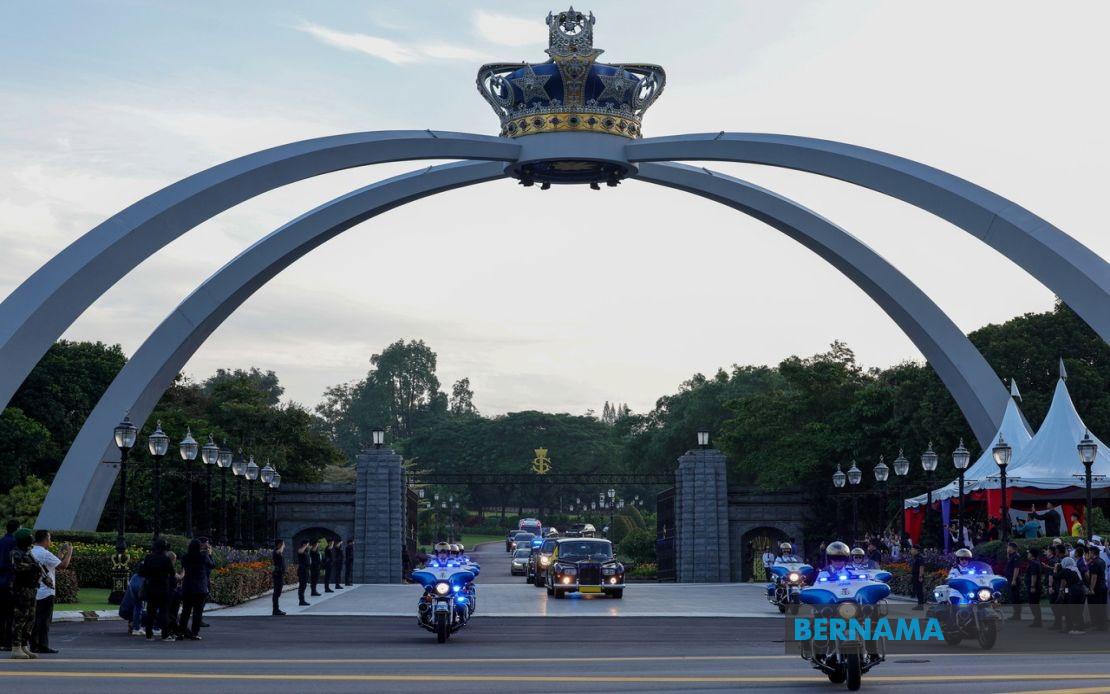
Johor's next Menteri Besar is set to be formally sworn in during an official ceremony at Istana Bukit Serene this afternoon, the Johor Palace confirmed through a media advisory distributed via WhatsApp. The swearing-in will take place at 3 pm, with press representatives permitted to cover proceedings from the Crown Arch entrance of the historic royal residence in Johor Bahru. Despite circulating the timing and venue details, the palace invitation stopped short of naming the incoming chief minister, leaving the identity of the appointee a matter of anticipation.
The announcement triggered a steady flow of journalists to strategic vantage points throughout the morning. Media personnel gathered at the official Menteri Besar residence in Saujana from midday onwards, while additional contingents assembled outside Istana Bukit Serene's gates, positioning themselves to capture developments as they unfolded. This visible media mobilisation underscored the political significance of the transition at hand, particularly given the preceding electoral context.
The backdrop to today's ceremony is Barisan Nasional's decisive performance in Johor's state election held yesterday. The coalition achieved a commanding mandate, securing 48 of the 56 state seats contested, a result that substantially strengthens BN's position in the southern state and carries implications for national coalition cohesion. This landslide outcome essentially predetermined today's leadership outcome, though formal procedures necessitated the palace's official confirmation and swearing-in ritual.
Sultan Ibrahim Iskandar's movements over recent hours signalled the imminent transition. Earlier on July 12, the Sultan received Barisan Nasional national chairman Datuk Seri Ahmad Zahid Hamidi during an audience at Istana Pasir Pelangi. The meeting, which extended nearly an hour, also brought together Johor BN chairman Datuk Onn Hafiz Ghazi, suggesting high-level deliberations regarding the leadership arrangement. These consultations between the monarch and senior coalition figures represent standard constitutional protocol for executive appointments in Malaysian states.
For Malaysian observers, the Johor transition highlights the interplay between electoral outcomes and formal state ceremonial procedures. While the election results on July 11 effectively determined the political composition of Johor's state assembly, the formal constitutional process demands that the Sultan exercise his prerogative to appoint the Menteri Besar, typically the leader commanding majority support in the assembly. This separation between electoral victory and formal appointment, though brief in practice, preserves important constitutional principles regarding the monarchy's role in state governance.
The timing of Johor's state election and its rapid transition to chief ministerial swearing-in reflects broader patterns in Malaysian electoral politics. Unlike federal elections, which involve extended periods between polling and formation of government, state-level transitions often proceed more expeditiously. Johor's sequence demonstrates how decisive electoral mandates can translate into swift administrative changeovers, provided coalition consensus exists regarding leadership selection.
Barisan Nasional's overwhelming success in Johor carries significance beyond the state borders. As one of Malaysia's economically vital regions and a crucial component of the coalition's traditional powerbase, Johor's political health directly influences national political equilibrium. The 48-seat outcome provides BN with a commanding supermajority that enables unilateral decision-making on legislative matters, reducing dependency on independent legislators or coalition partners for passing state measures.
The palace's handling of the swearing-in announcement through WhatsApp reflects evolving communication practices in Malaysian institutional settings. While formal royal ceremonies retain their traditional ceremonial dimensions, the dissemination methods increasingly accommodate contemporary media workflows. Permitting press coverage from designated palace precincts balances ceremonial solemnity with public access to information, a compromise that acknowledges both institutional dignity and press freedom considerations.
For Malaysian readers and Southeast Asian observers tracking regional political developments, Johor's transition exemplifies how electoral competition continues channelling power transfers through constitutional rather than extra-legal mechanisms. Despite occasional political tensions elsewhere in the region, Malaysia's state elections and succession procedures remain anchored in established legal and procedural frameworks. The Johor transition, while administratively routine, reinforces institutional continuity in Malaysian governance.
The identity question surrounding the incoming Menteri Besar, left deliberately unresolved by the palace invitation, will be clarified once the swearing-in concludes. Regardless of who assumes the office this afternoon, the ceremony itself represents continuity in Malaysian constitutional practice—the formal moment when electoral mandates transform into executive authority, mediated through established protocols and royal prerogative. This afternoon's proceedings at Istana Bukit Serene will mark the completion of Johor's electoral cycle and the beginning of a new administrative chapter.

