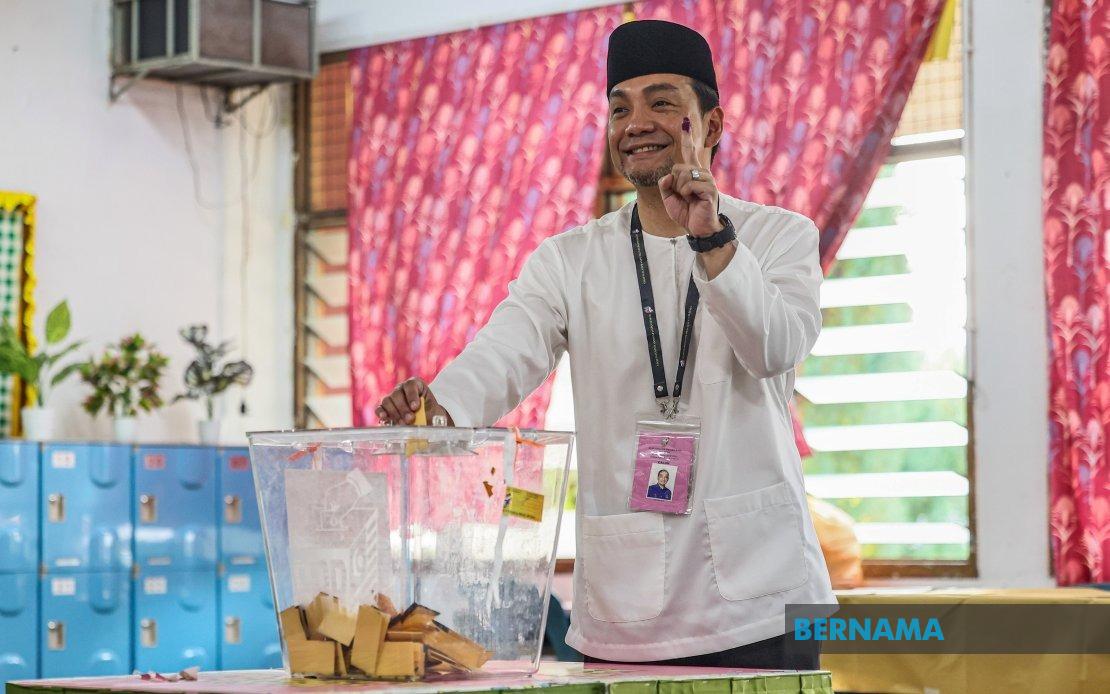
Johor's political leadership participated in voting on July 11 as the state embarked on its 16th electoral exercise, with Menteri Besar Datuk Onn Hafiz Ghazi casting his ballot at Sekolah Kebangsaan Simpang Renggam in the morning. The senior administrator, who chairs the Johor Barisan Nasional machinery, arrived at the polling station around 8.33 am and engaged with constituents present before proceeding to Stream 4 to register his vote.
Onn Hafiz's participation carried particular significance as he seeks to secure a second term as the state's chief executive through what amounts to a direct contest against Nur Hafiz Roslan, representing the Pakatan Harapan opposition alliance. His decision to vote early in the process and interact with fellow voters projected a message of civic engagement that aligned with his subsequent public statements about the electoral exercise.
Following his voting, the Menteri Besar addressed gathered journalists with an appeal for broader participation. He emphasized that voters should make the effort to arrive at polling stations during the day to discharge what he characterised as a fundamental civic obligation. By framing electoral participation as a responsibility rather than merely a right, Onn Hafiz sought to encourage high turnout, which typically benefits incumbent administrations seeking renewed mandates.
The 16th Johor state election itself represents a significant political juncture for Malaysia's southernmost peninsula state. As one of the country's most developed and strategically important states, Johor's electoral outcomes often carry implications extending beyond its borders, influencing broader peninsular political dynamics and federal coalition configurations. The state has traditionally been a stronghold for the Barisan Nasional coalition, though recent electoral cycles have demonstrated increasing competition from opposition forces.
Pakatan Harapan's candidate for the Puteri Wangsa constituency, Dr Maszlee Malik, also fulfilled his voting obligation on the same morning, arriving at SJK (C) Tuan Poon approximately 25 minutes after Onn Hafiz had completed his ballot. The former federal education minister's presence in the electoral race underscored the opposition's determination to compete actively in Johor, deploying experienced political figures to contest seats they view as winnable.
The Puteri Wangsa race exemplified the fragmented nature of contemporary Malaysian electoral competition. Maszlee faced four competing candidates representing diverse political interests across the spectrum. Rashifa Aljunied stood for MUDA, the relatively newer democratic alliance movement; Teow Chia Ling represented the Barisan Nasional component; Nicholas Paul Vincent ran under Parti Bersama Malaysia; while Wang Wee Siong contested as an independent. This five-way configuration meant that victory could be achieved without commanding majority support, a pattern increasingly characteristic of Malaysian electoral contests.
The participation of candidates spanning ideological and organizational breadths reflected evolving patterns in Malaysian electoral politics. Beyond the traditional binary of Barisan Nasional versus Pakatan Harapan, voters in constituencies like Puteri Wangsa could choose between several alternatives, each proposing distinct visions. The presence of independent candidates and smaller parties suggested that some voters had become willing to consider options outside established coalitions, a phenomenon that complicates predictions and potentially fragments support bases.
Onn Hafiz's direct appeal to voters about participation indicated leadership awareness that the state's democratic exercise depended fundamentally on adequate turnout. Malaysian state elections typically attract varying levels of public engagement, with participation rates influenced by numerous factors including voter enthusiasm, perceived stakes, weather conditions, and competing social commitments. An early-morning vote and subsequent public exhortation suggested the Menteri Besar took seriously the task of mobilizing his political coalition's supporters.
The electoral environment in Johor contains distinctive characteristics reflecting the state's demographics and development. As a major economic and manufacturing hub, Johor contains both urban constituencies with diverse, younger populations and more traditionally structured rural areas. Urban voters may prioritize different issues from rural constituents, potentially favoring different candidates and platforms. The state's status as a southern gateway connecting to Singapore also shapes its policy priorities around infrastructure, trade, and cross-border relations.
For Malaysian observers beyond Johor, the state election carried broader significance within the current political trajectory. Federal politics remain fluid following the 2022 general election's complex results, and state-level contests provide indicators of shifting public sentiment. Johor's outcome could influence the confidence and momentum of both major coalitions as they prepare for potential future federal electoral contests. Success or failure in retaining the state would carry psychological and organizational implications for the respective coalitions' leadership structures.
The election day itself proceeded with the routine procedures observers would recognize from previous Malaysian electoral exercises. Polling stations operated according to established protocols, candidates voted to legitimize their participation, and electoral officials managed the logistical undertaking of facilitating millions of voters' exercise of franchise. The participation of senior political figures like Onn Hafiz and Maszlee underscored that electoral contests, whatever their predetermined outcomes might sometimes appear, still commanded the serious engagement of political leadership.

