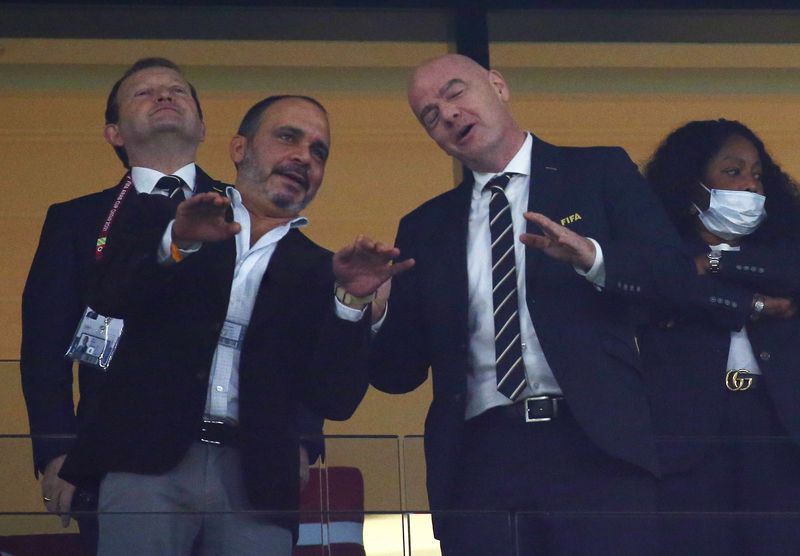
The Jordan Football Association has escalated its conflict with FIFA's leadership, with President Ali bin Hussein levelling serious accusations against FIFA President Gianni Infantino. In a statement released on Tuesday, Bin Hussein claimed that the Swiss official engaged in what amounts to coercive conduct by allegedly linking FIFA assistance to endorsement of his leadership. The accusation represents a rare public confrontation between a national football federation and the world governing body, highlighting tensions within soccer's upper echelons over governance and fairness toward smaller footballing nations.
According to Bin Hussein's account, FIFA officials communicated verbally to Jordan's leadership during the World Cup that supporting Infantino's re-election "would go a long way to helping our FA out." This assertion followed what he characterised as months of inaction from FIFA on matters where the Jordanian federation had sought institutional support. The timing and conditional nature of the alleged offer prompted Bin Hussein to frame the situation as a form of pressure inconsistent with ethical standards. He emphasised that Jordan's FA has traditionally upheld governance principles and would not compromise those values regardless of potential benefits.
Bin Hussein's public rebuke gains particular significance given the broader instability in FIFA's leadership. Infantino has faced mounting opposition from confederations and national associations, particularly following his failed attempt to sell a minority stake in FIFA's commercial operations. That controversial proposal, which carried a September 19 deadline, was rejected outright by soccer's governing bodies. High-ranking FIFA officials, including Secretary General Mattias Grafstrom and Chief of Global Football Development Arsene Wenger, distanced themselves from the initiative, signalling deep fractures within the organisation's executive structure.
Beyond the question of endorsement coercion, Bin Hussein articulated a catalogue of grievances that illustrate the structural disadvantages facing smaller footballing nations within FIFA's ecosystem. Jordan's participation in the 2026 World Cup, held in the United States, has created unexpected financial burdens that larger nations avoided. Specifically, Bin Hussein pointed out that Jordan faces U.S. government taxation on its World Cup participation channelled through FIFA—a cost that teams based in Canada and Mexico did not incur. This disparity highlights how FIFA's administrative structures can inadvertently create unequal conditions across participating nations, burdening smaller federations with resources already stretched thin.
The financial pressures on Jordan's FA extend well beyond World Cup taxation. Bin Hussein detailed how fans have been compelled to pay inflated ticket prices while simultaneously facing visa denials for tournament participation. Such contradictions underscore the disconnect between FIFA's commercial operations and the practical realities facing supporters of smaller nations. Additionally, Jordan has been left waiting since December for the financial rewards due for reaching the Arab Cup final in Qatar—money promised by FIFA itself for tournament participation. This delayed payment occurs even as FIFA boasts substantial financial reserves, creating a stark contrast between the organisation's wealth and its willingness to meet timely obligations to participating federations.
Jordan's maiden World Cup qualification in 2026 should represent a moment of pride and development for the nation's football programme. However, the circumstances surrounding the tournament have instead exposed vulnerabilities in how FIFA structures its relationships with emerging footballing nations. The kingdom's group-stage elimination may have left fans and administrators disappointed on the pitch, but the off-field treatment has generated more substantive frustration. Bin Hussein's decision to air these concerns publicly suggests that behind-the-scenes diplomacy has yielded insufficient results, prompting escalation to the international arena.
The Arab Cup situation deserves particular scrutiny as it reveals FIFA's handling of tournament obligations. The competition, organised directly by FIFA, carries explicit financial commitments to participating federations based on their performance. Jordan's path to the final demonstrates sporting merit that should trigger contractual payments. Yet months of delay in transferring these funds while FIFA maintains substantial reserves raises questions about financial management priorities and the relative importance placed on obligations to smaller nations compared to commercial interests.
Bin Hussein's emphasis on ethical values and principled conduct positions Jordan's complaint within a broader conversation about governance standards in international sports. He explicitly stated that Jordan would not alter its position on endorsement regardless of FIFA assistance, framing the federation's stance as non-negotiable principle rather than negotiating leverage. This rhetorical positioning appeals to broader international sports governance norms and suggests that other national associations facing similar pressures may find validation in Jordan's public resistance.
The allegations against Infantino emerge at a moment when his leadership faces genuine scrutiny from within FIFA's institutional structure. The World Cup stake-sale debacle demonstrated that significant portions of soccer's hierarchy question his strategic direction and decision-making processes. Jordan's accusations, if substantiated through further investigation, would compound concerns about leadership conduct beyond merely controversial policy proposals. Whether these claims receive formal investigation remains uncertain, with FIFA having only acknowledged receipt of allegations without substantive response.
For Malaysian and Southeast Asian readers, Jordan's experience offers instructive lessons about navigating relationships with international sporting bodies. As smaller footballing nations develop their competitive capacities and secure World Cup qualification, understanding the institutional dynamics and potential pressures within FIFA becomes increasingly relevant. The apparent conditioning of administrative assistance on political support suggests that federations should approach such offers with considerable caution and document interactions carefully to protect their autonomy.
The episode also highlights how financial asymmetries persist within global sports governance structures. While FIFA generates billions in World Cup revenue, smaller federations struggle with costs and delays that larger nations avoid. Regional confederations and national associations may benefit from coordinating positions on such inequities, potentially creating stronger collective leverage for reform. Jordan's willingness to speak publicly may encourage others to raise similar concerns that might otherwise remain private complaints.
The resolution of this dispute will likely depend on whether FIFA initiates formal investigation and whether other national associations voice similar experiences. The organisation's response will signal whether Infantino's leadership can survive mounting criticism from multiple directions, or whether the institutional pressure catalysed by this World Cup stake controversy proves sufficient to trigger leadership change. For Jordan's football community, the immediate priority remains securing promised financial obligations and ensuring that World Cup participation translates into institutional development rather than financial hardship for a small nation.

