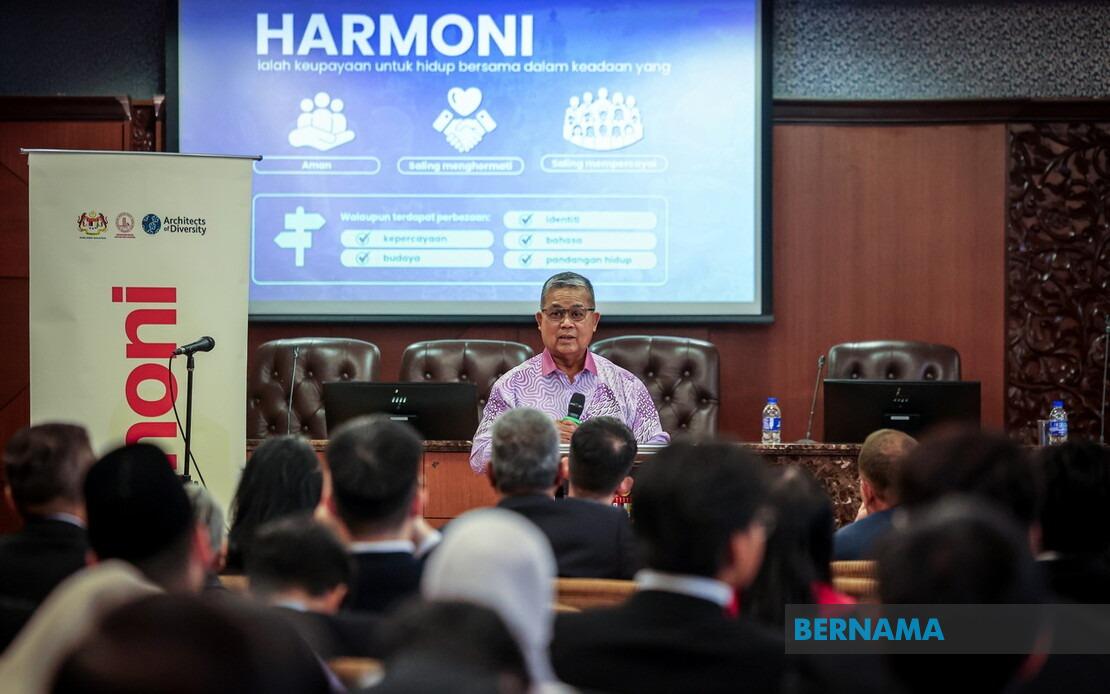
Malaysia's push to fortify national unity has entered a new phase with the Department of National Unity and National Integration (JPNIN) undertaking a comprehensive study to create a Community Tension Index. This initiative, unveiled by Minister of National Unity Datuk Aaron Ago Dagang at the 2026 Harmony Symposium on Parliament grounds in Kuala Lumpur, represents a data-driven approach to understanding and safeguarding the country's multicultural fabric.
The Community Tension Index will function as a measurement tool for monitoring social cohesion while simultaneously tracking sensitivities related to race, religion and royalty—the so-called 3R issues—across the nation. By quantifying these indicators, the government aims to gain granular insight into the health of community relationships and identify potential flashpoints before they escalate into broader conflicts. This systematic approach represents a departure from reactive crisis management toward proactive social management.
Minister Aaron emphasized that the findings from this index would become crucial strategic guidance for government policy-makers designing early intervention programmes. By establishing baseline metrics for community tension, officials can tailor targeted initiatives to regions or demographics showing elevated sensitivity levels. The data will essentially serve as an early-warning system, allowing authorities to deploy resources and messaging strategies where they are most needed to preserve harmony.
The initiative arrives at a critical juncture when online spaces have become primary arenas where social divisions manifest and amplify. Between January 2025 and January 2026, the Malaysian Communications and Multimedia Commission (MCMC) removed 1,493 pieces of online content concerning religion, royalty and race issues through formal enforcement actions. This statistic underscores how digital platforms have become contested territory where traditional community sensitivities intersect with technology's unprecedented reach and speed.
One of the most pressing concerns highlighted by Minister Aaron is the role of algorithmic design in fragmenting public discourse. Social media platforms engineer "filter bubbles" and "echo chambers"—mechanisms that show users content aligned with their existing beliefs while filtering out opposing viewpoints. This technological architecture inadvertently creates parallel information ecosystems where communities inhabit increasingly separate informational worlds. The consequence is a narrowing of the conversational space where genuine understanding can flourish, replacing dialogue with mutual incomprehension and deepening the gulfs between Malaysia's communities.
The digital shift in threats to national unity carries particular significance for a diverse nation like Malaysia, where historical grievances and contemporary identity politics intersect in complex ways. Unlike earlier eras when divisive content faced natural constraints—geographic distance, limited distribution channels, slow propagation—today's viral mechanism means inflammatory content can reach millions in minutes, often before fact-checkers or authorities can intervene. This acceleration of information flow has compressed the timeframe for official response and multiplied the potential for organic escalation.
Beyond the Community Tension Index, JPNIN is pursuing a complementary institutional innovation through a proposed National Harmony Commission (SKN). The government has already conducted extensive stakeholder engagement sessions to gather preliminary perspectives on this proposal. The envisioned commission would operate as a dedicated institutional body focused on three pillars: early prevention of tensions before they crystallize into crises, mediation between conflicting parties seeking mutually acceptable resolutions, and formal investigation of matters threatening national harmony.
This institutional approach reflects international best practices in conflict prevention and resolution. Countries facing similar challenges from polarization have found that dedicated commissions with clear mandates, adequate resources and cross-community representation can meaningfully reduce tensions when operating with genuine political support. The SKN would theoretically position Malaysia alongside comparative democracies employing institutional mechanisms to protect social cohesion in diverse societies.
The proposed commission's investigative function is particularly noteworthy, as it suggests an intention to move beyond reactive content removal toward understanding root causes and patterns of divisive behavior. By examining cases that threaten harmony, investigators could identify common triggers, organizational actors, funding sources or coordinated campaigns that might otherwise remain invisible. Such intelligence could inform both prevention strategies and targeted interventions before issues gain momentum.
However, the success of both the Community Tension Index and National Harmony Commission hinges on their independence, transparency and acceptance across Malaysia's diverse communities. Trust in these institutions depends on demonstrable political will to apply standards consistently across all groups, avoiding perceptions of bias favoring majority interests or government supporters. Without such credibility, these mechanisms risk becoming viewed as tools of political control rather than genuine safeguards of collective wellbeing.
The initiative also reflects a broader recognition that Malaysia's diversity is not a problem to be eliminated but a characteristic to be actively managed with sophistication and intention. Rather than suppressing disagreement or enforcing artificial consensus, the index and commission approach presume that tensions can be measured, understood and addressed through systemic attention. This represents a maturation of how the government conceptualizes its role in maintaining harmony—not as enforcer of uniformity but as custodian of the conditions enabling different communities to coexist.
Looking forward, the Community Tension Index and National Harmony Commission represent interconnected elements of a larger strategy to navigate Malaysia's multicultural complexity in an increasingly digital age. As online platforms continue reshaping how Malaysians communicate, encounter difference and potentially experience conflict, institutional innovations and data-driven interventions may prove essential complements to traditional legal frameworks. The practical challenge ahead lies in implementation: whether these mechanisms can become trusted, effective tools serving all communities or remain viewed with skepticism by segments fearing marginalization or preferential treatment for others.

