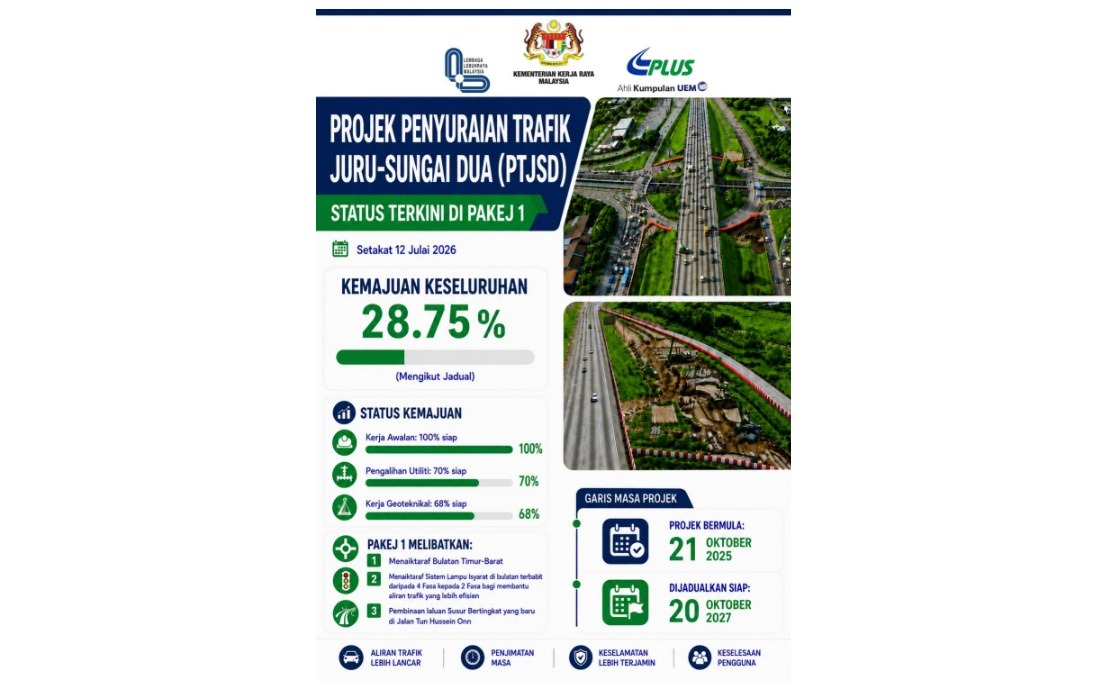
The Juru-Sungai Dua Traffic Dispersal Project (PTJSD) continues its steady advancement through Penang, with PLUS Malaysia Berhad confirming that Package 1 has reached 28.75 per cent completion as of mid-July and remains aligned with its delivery schedule. This milestone demonstrates that despite the scale and complexity of the undertaking, the project consortium is managing logistics and construction sequences effectively across the heavily congested northern corridor.
Major preliminary milestones have already fallen into place. PLUS reported that foundational works requiring site preparation and environmental clearance have been concluded in full, while utility relocation—a labour-intensive process involving the repositioning of electricity, water, telecommunications, and gas infrastructure—stands at 70 per cent. Geotechnical investigations and ground stabilisation work have separately progressed to 68 per cent, indicating that the essential groundwork required before structural assembly can accelerate is nearly complete. These preparatory phases are critical; delays here would cascade into later construction stages.
Package 1 centres on transforming the bottleneck at East-West Roundabout, one of the Juru-Sungai Dua corridor's most congested choke points. The work encompasses a complete renovation of the roundabout itself, along with a sophisticated new traffic light coordination system designed to optimise vehicle flow through the intersection. The project's most visible addition will be a new elevated slip road constructed along Jalan Tun Hussein Onn, allowing vehicles to bypass traditional surface-level routing and merge directly onto the elevated section of the new bypass.
The overarching PTJSD initiative stretches 17.3 kilometres and cuts across three administrative zones within the Seberang Perai district—South, Central, and North—making it a regionally significant undertaking for Penang. The corridor serves as the primary artery linking the state with northern Malaysian territories including Kedah, Perlis, and Kelantan, funnelling an estimated 200,000 vehicle movements daily through what had become increasingly congested surface routes. The project's completion in October 2027 will mark a watershed moment for regional connectivity and commerce in the north.
At an estimated cost of RM3 billion, this represents one of the country's substantial infrastructure investments. The financial commitment reflects both the project's technical demands and its strategic importance to Malaysia's peninsular transport network. PLUS Malaysia, as the executing agency, has brought its experience from managing existing tolled highways to bear on this complex urban and semi-urban reconstruction effort. The Ministry of Works and the Malaysian Highways Authority provide policy oversight and regulatory coordination, ensuring alignment with broader national transport planning objectives.
The anticipated traffic redistribution outcome underscores the project's transformative potential. Modelling suggests that the new direct Juru-Sungai Dua route will attract approximately 30 per cent of current corridor traffic, an enormous relief valve for surface congestion. More strikingly, the project promises to compress peak-hour travel time from the current hour-long journey to just 20 minutes—a 66 per cent reduction that would substantially enhance logistics efficiency, reduce business operating costs, and improve quality of life for the hundreds of thousands who traverse this corridor weekly.
For Malaysian readers and regional observers, the implications extend beyond Penang's borders. The northern corridor connects major manufacturing hubs, agricultural production zones, and port facilities that feed regional and international supply chains. Reducing travel times directly lowers freight costs and improves delivery predictability, benefiting exporters and import-dependent industries. The project also reduces vehicle emissions per kilometre travelled, contributing modestly to national climate and air quality objectives. Furthermore, improved connectivity strengthens Penang's position as an investment destination by shortening commute times and facilitating worker mobility across the state's industrial parks.
The project's scheduling toward October 2027 provides a reasonable implementation window given the scope of earthworks, utility coordination, and structural construction. However, the timeline assumes continuous progress without major geological surprises or supply-chain disruptions—assumptions that became more precarious in the post-pandemic environment. The 68 to 70 per cent completion of geotechnical and utility work suggests that major unknowns have largely been encountered and resolved, reducing residual risk in the critical path.
From a governance perspective, the PTJSD exemplifies the collaborative approach increasingly common in Malaysia's major infrastructure programmes, with private toll-operator expertise (PLUS), public works ministry direction, and highways authority regulation working in tandem. This tripartite model can distribute risk, pool technical capabilities, and improve accountability. The quarterly progress updates released to the public reflect growing transparency in how such projects communicate with stakeholders and the communities affected by construction activities.
The project's success will be measured not merely by punctual opening but by whether the promised congestion relief materialises in practice. Behavioural factors—such as driver route choices, adoption of congestion pricing if implemented, and changes in regional logistics patterns—will ultimately determine whether the RM3 billion investment achieves its full potential. Early engagement with freight operators, tourism bodies, and daily commuters will be crucial to maximising the corridor's utility when it opens.

