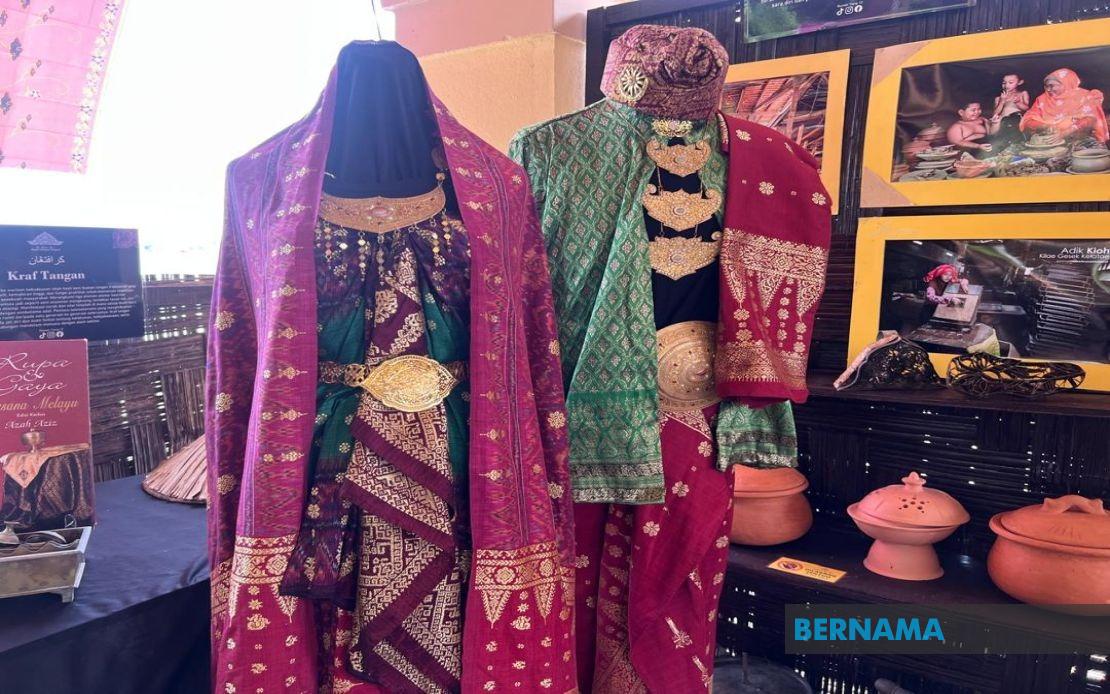
Malaysia's most refined traditional textile—the Kain Lima—stands at a critical juncture, with dwindling numbers of heritage craftspeople threatening to erase one of Southeast Asia's most sophisticated weaving traditions. The alarming decline in practitioners was highlighted during the Kelantan Arts Festival at Tok Bali, where cultural custodians and textile experts expressed growing concern about the imminent loss of this distinctive art form.
Unlike the more widely recognised songket, which relies on supplementary gold or silver thread embellishment, Kain Lima represents a fundamentally different approach to Malaysian textile artistry. The fabric's defining characteristic is its integration of tie-dye or bound threads that are meticulously woven into intricate patterns, creating a subtle interplay of colour and light that reflects differently depending on viewing angle and natural illumination. This sophisticated technique demands extraordinary precision from weavers, who must individually arrange multiple coloured threads and position each motif with exacting care before commencing the labour-intensive weaving process itself.
According to Nik Mohd Murdani Nik Hassan, caretaker of Galeri Rumah Tiang 12 in Kelantan, the technical mastery required to produce authentic Kain Lima sets it fundamentally apart from standardised commercial textiles. He explained that true connoisseurs of traditional fabrics can instantly identify Kain Lima through its distinctive weaving structure, pattern composition, and the unconventional materials employed in its construction. The distinction matters considerably for collectors and cultural institutions seeking to preserve Malaysia's textile heritage with integrity and scholarly accuracy.
The labour intensity and skill requirements of Kain Lima production directly correlate with its substantial market valuation. Contemporary pieces command prices between RM3,000 and beyond RM4,000 depending on multiple determinants: the textile's chronological age, the complexity and rarity of its motif design, its physical condition, and the inherent fineness visible in the weaving execution. These price points position Kain Lima among Malaysia's most valuable traditional fabrics, accessible primarily to affluent collectors, museums, and institutions rather than ordinary consumers.
Historically, Kain Lima occupied an elevated position within Malay society, functioning as a symbol of wealth, refinement, and aristocratic status. Members of royal households selected Kain Lima for formal sarongs, ceremonial shawls, and state occasions, establishing its cultural prestige across centuries. This royal association enhanced the fabric's reputation and ensured transmission of weaving knowledge through generations of palace craftspeople and their designated apprentices, creating an unbroken lineage of expertise.
The contemporary crisis emerges from the collapse of this traditional transmission system. Fewer young Malaysians pursue weaving as a profession, preferring more lucrative or less physically demanding occupations. The modern economy offers limited financial viability for artisans dedicating months to individual pieces, particularly when alternative employment prospects promise steadier income and reduced physical strain. This economic pressure threatens to sever the intergenerational bonds through which specialised textile knowledge has historically perpetuated itself.
Galeri Rumah Tiang 12 has emerged as a vital institution attempting to reverse this trajectory of cultural erosion. Since Nik Mohd Murdani joined the gallery in 2020, it has curated substantial collections of Kain Lima sourced from private collectors, establishing a physical space where the Malaysian public can directly observe and engage with heritage textiles. The gallery's strategic function extends beyond mere preservation; it serves an educational mission, allowing visitors to comprehend the technical distinctions separating Kain Lima from superficially similar fabrics like songket, thereby cultivating informed appreciation for traditional craftsmanship.
The contemporary revival movements depend significantly on grassroots participation from working artisans and creative practitioners. Nur Anira Akmal Che Abdul Aziz, a 34-year-old handicraft maker from Pasir Mas, represents this emerging cohort of cultural entrepreneurs who view heritage textile study as inspiration for developing innovative craft products that maintain distinctly local character. Her participation in heritage exhibitions reveals a crucial pathway toward revitalisation: connecting contemporary makers with historical knowledge, enabling them to reinterpret traditional techniques through modern creative lenses whilst respecting foundational artistic principles.
This approach differs fundamentally from conservation efforts that merely preserve artefacts in static museum contexts. Instead, it activates heritage knowledge within living creative communities, permitting traditional skills to evolve organically rather than crystallising as historical curiosities. When contemporary artisans like Che Abdul Aziz encounter Kain Lima's motif vocabulary, weaving structures, and production methodologies, they extract design principles and technical insights that fertilise their own creative output, ensuring that heritage knowledge influences present-day cultural production rather than remaining archival.
The implications for Southeast Asian cultural conservation extend beyond Kelantan's borders. Malaysia's situation mirrors challenges confronting textile traditions throughout the region—from Thailand's mudmee to Indonesia's batik—where industrialisation and economic pressures have fractured traditional apprenticeship networks. The Kain Lima crisis demonstrates that heritage preservation requires more than institutional collecting or exhibition programming; it demands economic models that make traditional craftsmanship financially sustainable for practitioners whilst simultaneously nurturing contemporary creative applications that maintain cultural relevance.
Governmental and non-governmental institutions increasingly recognise that Kain Lima's survival depends on immediate intervention. This recognition has spawned various initiatives promoting heritage textiles through cultural festivals, exhibition programmes, and artisan support schemes. However, sustained impact requires systemic transformation: establishing viable market mechanisms that reward textile makers justly, integrating traditional weaving into formal education curricula, and fostering collaborations between heritage craftspeople and contemporary designers seeking authentic Malaysian cultural content.
The Kelantan Arts Festival represents one component of this broader revitalisation effort, providing platforms where heritage knowledge circulates publicly and contemporary makers encounter traditional expertise. Such gatherings generate crucial momentum, but isolated events cannot reverse decades of declining participation. Long-term sustainability demands that Kain Lima weaving achieves economic viability comparable to alternative occupations, cultural prestige acknowledged throughout Malaysian society, and integration within national identity narratives that position traditional textiles as contemporary cultural assets rather than historical relics. Without these foundational changes, Malaysia risks losing irreplaceable knowledge—along with the sophisticated aesthetic, technical ingenuity, and historical significance that Kain Lima represents within global textile traditions.

