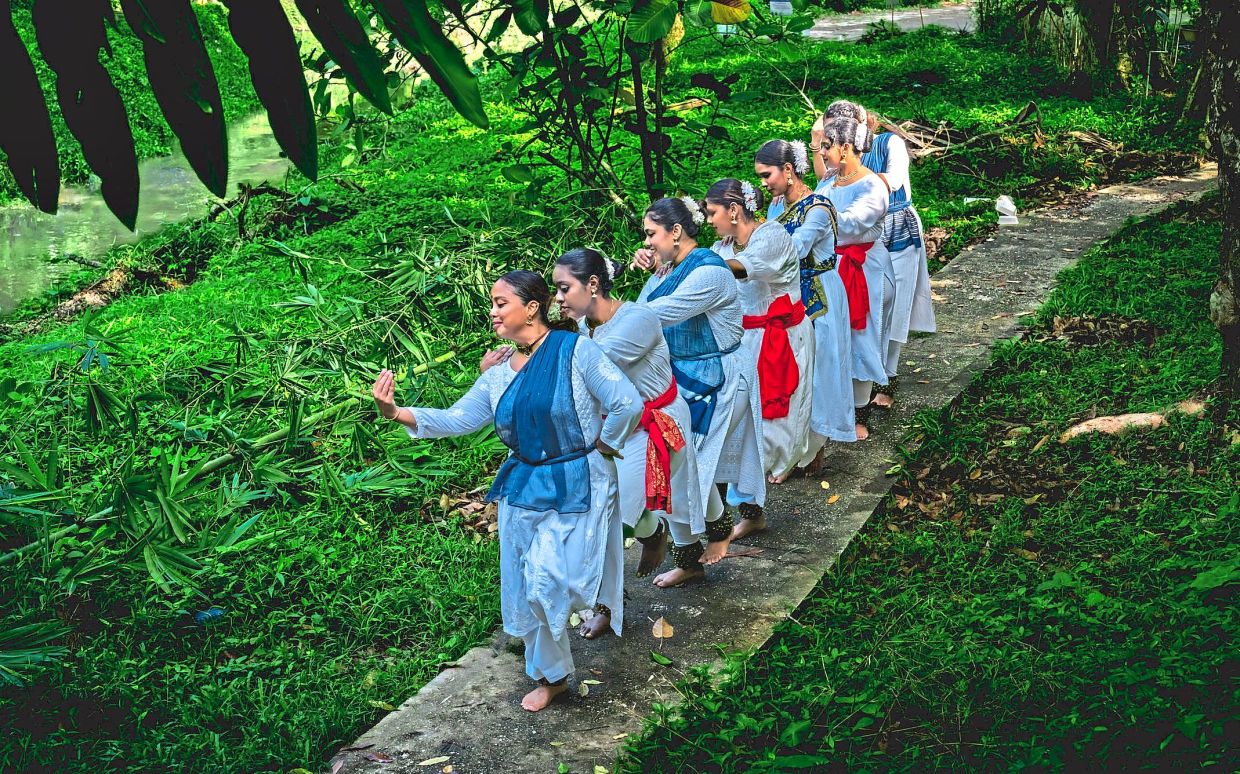
Kuala Lumpur-based Kalpana Dance Theatre has navigated three decades of artistic uncertainty and financial precarity to reach a significant milestone this year, much like the rivers that inspire its latest production. The company's ability to sustain itself in an unpredictable creative landscape reflects the broader challenges facing performing arts organisations across Southeast Asia, where institutional support remains sporadic and audiences demand constant innovation to justify ticket prices and attract sponsorship.
To mark the occasion, founder-director Shangita Namasivayam is mounting an ambitious bharatanatyam concert at the Shantanand Auditorium, Temple of Fine Arts in Kuala Lumpur on August 8. The production represents the culmination of her philosophy that artistic vision requires the same careful nurturing as a living organism—beginning as fragile concept and developing through sustained commitment before reaching audiences in fully realised form. For Shangita, this process of transformation from imagination to tangible performance remains the incomparable moment that justifies the years of labour behind the scenes.
The creative framework centres on two major Indian rivers: the Ganga in northern India and the Kaveri in southern India. The Ganga holds profound spiritual significance across Hindu civilisation, while the Kaveri—known as the Ganga of the South—sustains agriculture, irrigation and power generation across southern regions. Historically, both waterways have inspired centuries of classical and folk artistic traditions, their waters becoming metaphors for spiritual cleansing, cultural continuity and material prosperity. By selecting these rivers as her thematic anchor, Shangita positions classical dance as a vehicle for addressing contemporary environmental crises with ancestral knowledge.
The artistic concept carries explicit environmental messaging. Shangita describes the Ganga as the shore of compassion and the Kaveri as the mother of prosperity—one washes away sins while the other enables life to flourish. Yet her interpretation extends beyond metaphor into urgent activism: she emphasises that rivers represent far more than flowing water, but rather embody the inner peace communities must cultivate as they confront planetary degradation. Her specific concern centres on how contemporary society abuses, pollutes and neglects these vital ecosystems, rendering oceans and rivers increasingly toxic and unsuitable for sustaining human or ecological life.
To translate these concerns into concrete action, KDT has partnered with The Alliance of River Three (ART!), a Malaysian volunteer-driven environmental organisation established in 2018 by Kennedy Michael. ART! focuses on rehabilitating the Klang River through community-built River Three Parks, weekly maintenance cleanups and long-term ecosystem restoration projects. The group's recognition as a winner of The Star Golden Hearts Awards in 2020 underscores the growing visibility of grassroots environmental work within Malaysia's civil society landscape. Since January, KDT dancers have participated in cleanup operations at Taman Melawati River Three SDG Park and Mid Valley River Three SDG Park, projects ART! aims to complete by 2030 as part of the United Nations Sustainable Development Goals framework.
Shangita notes that this ground-level environmental work has provided her young dancers with experiences alien to their usual training environments. Many have never engaged in manual labour or direct contact with polluted urban waterways, making these cleanup sessions transformative learning experiences that connect artistic practice to ecological citizenship. This generational disconnect—whereby young artists remain sheltered from environmental realities—reflects broader urbanisation patterns across Southeast Asia, where development has systematically insulated middle-class communities from the consequences of degradation occurring upstream or downstream.
The production itself represents a transnational creative collaboration spanning decades. Shangita has worked repeatedly with choreographer PT Narendran, musician OS Arun and scriptwriter Dr Va Ve Subramanian from Chennai, India, allowing their shared artistic language to deepen through accumulated experience rather than starting anew with each project. This continuity distinguishes the production from one-off cultural exports, instead positioning it as an evolving dialogue between Malaysian and Indian artistic sensibilities. Through months of detailed discussions, their initial concepts gradually converged into a production balancing creative ambition with shared philosophical purpose.
The 90-minute thematic presentation features 54 dancers ranging from six to 62 years old, deliberately including differently-abled performers to ensure inclusive representation rather than showcasing individual virtuosity. This democratic approach—providing equitable roles rather than featuring soloists—reflects contemporary dance theatre's movement toward collective rather than hierarchical artistic models. The script combines Tamil dialogue with English narration, delivering poetic yet profound language that weaves together lyrical beauty and philosophical reflection to create narratives resonating across generational and linguistic boundaries.
The accompanying music ensemble comprises 30 artistes, though logistical constraints prevent bringing the entire Indian team to Malaysia. Instead, Shangita has strategically created opportunities for young Malaysian dancers to train intensively with internationally respected masters. This pedagogical approach yields benefits extending beyond technical refinement—students absorb distinctive perspectives, methodologies and philosophical approaches from master artistes, developing deeper appreciation of bharatanatyam's internal diversity and evolving possibilities within contemporary dance theatre contexts.
Financial constraints remain perpetually challenging for Shangita, yet her commitment to providing performance experiences for students persists as fundamental to her mission. She emphasises that performing arts education cannot confine itself to regular classroom instruction without culminating in public presentation. Performances demand qualitatively different effort and psychological preparation from dancers, creating formative experiences that transform technical competence into embodied artistry. By prioritising access to stage experience despite funding difficulties, Shangita ensures her students inherit bharatanatyam as living heritage they carry forward rather than merely as historical knowledge.
The production ultimately operates on multiple registers simultaneously: it functions as artistic milestone celebrating three decades of institutional persistence, as environmental activism integrated into classical dance pedagogy, and as transnational cultural exchange that positions Malaysia within broader Indian artistic networks. By linking ancient river symbolism to contemporary climate urgency, KDT demonstrates how traditional performance forms remain relevant to pressing concerns facing Southeast Asian societies wrestling with rapid urbanisation, water scarcity and environmental degradation. For Malaysian audiences, the August performance offers opportunity to witness how cultural heritage can address present-day crises without abandoning classical forms or romanticising tradition.

