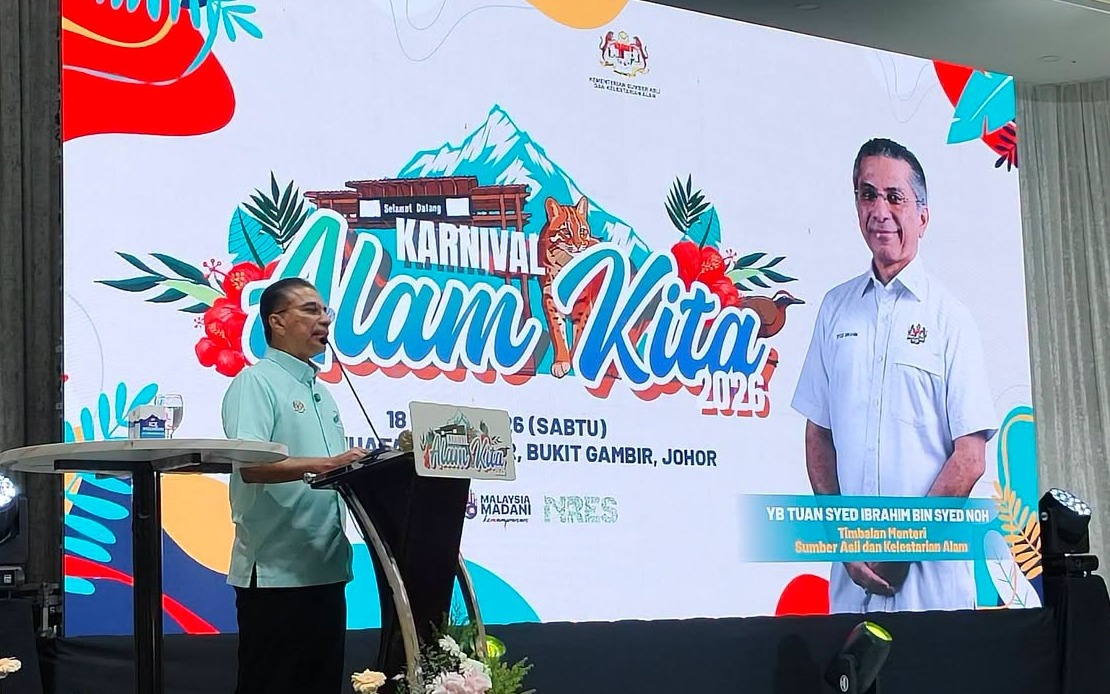
The Ministry of Natural Resources and Environment unveiled Karnival Alam Kita 2026 in Johor Bahru on July 19, positioning environmental stewardship as a shared civic responsibility rather than a government-led exercise. Deputy Minister Syed Ibrahim Syed Noh articulated a fundamental shift in how sustainability messaging reaches ordinary Malaysians, emphasising that real progress depends on individuals understanding how green practices integrate into their daily routines. The carnival's design reflects a recognition that abstract environmental terminology—rare earth elements, carbon footprint accounting, forestry management—alienates public audiences unless reframed through the lens of household economics and immediate personal benefit.
The ministry's organisational philosophy for this year's carnival centres on accessibility and demystification. Rather than hosting stationary exhibitions in urban centres, officials have brought interactive displays, technical expertise, and tangible sustainability resources directly into communities where families make purchasing and lifestyle decisions. Syed Ibrahim stressed that environmental responsibility cannot function as top-down mandate; it must emerge organically from grassroots understanding of how individual choices accumulate into measurable environmental outcomes. This approach represents a departure from earlier public awareness campaigns that often struggled to connect policy-level initiatives with street-level consumer behaviour.
A cornerstone initiative launched at the carnival is the Young Environmental Ambassador Programme, designed to cultivate environmental leadership among secondary school students. By training teenagers as peer educators and community guides, the ministry seeks to establish sustainability advocates operating within existing social networks—families, neighbourhoods, and youth organisations. This strategy acknowledges that behavioural change often spreads more effectively through peer influence than government advocacy. Young ambassadors can translate technical concepts into language their families and friends understand, while simultaneously building a cohort of citizens internalising environmental values during formative years.
Concurrently, the NRES Lestari Squad—in partnership with Bateriku (M) Sdn Bhd—conducted the KUDAH waste collection initiative during the carnival. This collaborative cleanup recovered 37 kilograms of refuse, including 17.3 kg of plastic bottles, demonstrating quantifiable environmental impact through participatory action. The Ministry calculated that collected materials represent an avoidance of 43.2 kilograms of carbon dioxide equivalent emissions—equivalent to eliminating exhaust from a petrol vehicle travelling 100 kilometres. By translating waste collection into precise carbon reduction metrics, organisers make environmental improvement tangible and measurable for participating communities.
For Malaysian and Southeast Asian audiences, these initiatives address a persistent communication challenge: environmental sustainability has become politically prominent across the region, yet public participation remains inconsistent. Governments struggle to transition sustainability from ministerial focus areas into household practice. Karnival Alam Kita 2026 attempts to bridge this gap by creating festive, accessible spaces where families encounter sustainability not as obligation but as practical problem-solving. The carnival format invites participation rather than demanding compliance, potentially cultivating voluntary adoption more effectively than regulatory approaches.
The event's emphasis on electronic waste recycling and used cooking oil collection targets specific waste streams causing significant regional environmental burden. Throughout Southeast Asia, e-waste management remains inadequate, with many developing nations lacking proper recycling infrastructure. Used cooking oil disposal poses particular challenges in communities relying on home-based food preparation. By featuring these issues at community carnivals alongside interactive demonstrations, the ministry normalises responsible disposal practices before they become legislative requirements. Citizens encountering these programmes at festive events may internalise sustainable practices more readily than through public service announcements.
Johor's selection as a carnival venue carries strategic significance. As Malaysia's most industrialised southern state, Johor experiences intense development pressures and faces infrastructure demands typical of rapidly urbanising regions throughout Southeast Asia. Communities in Johor confront real-time trade-offs between economic development and environmental preservation. Positioning sustainability messaging in this context underscores that green practices remain compatible with economic activity and urban growth—a crucial message for development-focused constituencies sceptical of environmental initiatives they perceive as economically restrictive.
The presence of government officials at the launching ceremony—including NRES deputy secretary-general Datuk Khalid Mohamed and district education officials—signals institutional commitment to sustainability integration across multiple governance levels. Environmental action requires coordination between natural resources ministries, education authorities, and local government. The carnival's structure, featuring interactive stations operated by government agencies, NGOs, and private strategic partners, models this multi-sector approach. Bateriku's participation as a corporate partner demonstrates that environmental initiatives increasingly attract business participation, suggesting market-driven sustainability gains momentum alongside regulatory frameworks.
Looking toward Malaysia's net-zero carbon ambition by 2050, initiatives like Karnival Alam Kita 2026 establish behavioural and cultural foundations necessary for meeting decarbonisation targets. Substantial emissions reductions require transformation across energy generation, transportation, industrial processes, and household consumption patterns. Government policy and investment address systemic change, but household-level shifts in consumer behaviour remain equally essential. Young Environmental Ambassadors recruited through this carnival may develop career interests in environmental science, engineering, and policy—creating human capital necessary for implementing Malaysia's longer-term decarbonisation strategy.
The carnival's integration of recycling campaigns, biodiversity awareness exhibitions, and green product sales reflects recognition that sustainability encompasses economic opportunity alongside environmental responsibility. Green technology markets, sustainable agriculture, and circular economy businesses represent growth sectors. By exposing communities to these economic dimensions alongside environmental benefits, the ministry positions sustainability not as sacrifice but as shared prosperity pathway. This framing proves particularly important across Southeast Asia, where development aspirations remain strong and environmental initiatives risk rejection if perceived as restricting economic advancement.
For Malaysian policymakers and regional observers, the Karnival Alam Kita model offers a replicable framework for translating national environmental commitments into community-level action. The carnival approach—combining youth leadership development, quantifiable environmental impact, multi-sector partnerships, and accessible public engagement—addresses persistent implementation gaps between policy announcement and household adoption. As Southeast Asian nations increasingly commit to climate targets and sustainability agendas, successful models for embedding these commitments into everyday practice become increasingly valuable for determining whether regional environmental goals remain aspirational or become genuinely achieved.

