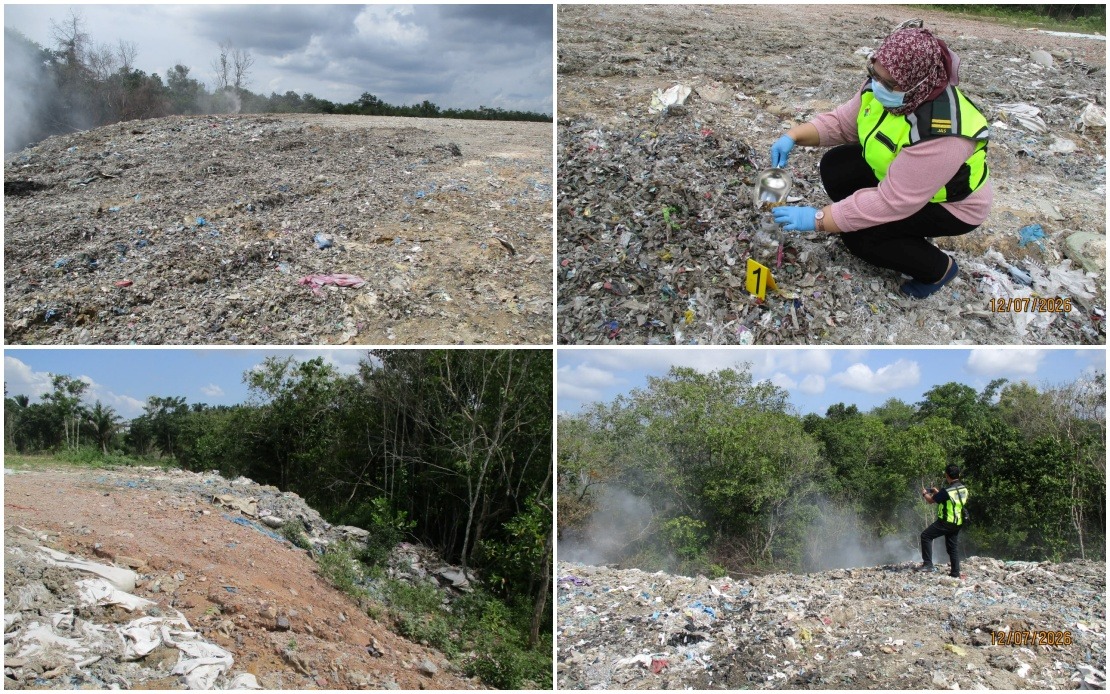
The Kedah Department of Environment has moved swiftly to address environmental violations following the discovery of an unlicensed waste disposal facility in Bukit Banyan, near Sungai Petani, where extensive open burning activities have been ongoing. The state DOE director, Sharifah Zakiah Syed Sahab, revealed that the investigation commenced after residents lodged formal complaints about acrid smoke permeating the neighbourhood, prompting authorities to examine the site thoroughly and document the extent of the infractions.
The illicit operation centres on a cleared parcel of land approximately 250 square metres in area, where substantial quantities of domestic waste have accumulated without any regulatory oversight or environmental clearance. Investigators determined that smoke visible at the location stemmed directly from intentional open burning conducted by unscrupulous individuals attempting to extract valuable metals from the accumulated refuse. This practice, commonly employed by informal waste processors seeking to recover copper wiring and other recyclable metals, generates hazardous air pollutants and toxic residues that pose significant risks to surrounding communities and the broader environment.
A critical finding emerged during the investigation: the waste disposal operation was functioning entirely without formal written approval from the director-general of the Environment Ministry, representing a fundamental breach of regulatory requirements governing solid waste management across Malaysia. Such approval mechanisms exist specifically to ensure that waste handling facilities meet stringent environmental and public health standards before commencing operations. The absence of authorization suggests either deliberate circumvention of regulations or gross negligence regarding legal obligations.
Investigators traced the illegal activity to a contractor engaged in collecting domestic waste from industrial zones throughout the district, indicating that the operation forms part of a larger waste collection network potentially servicing multiple industrial clients. This connection raises questions about supply chain accountability and whether the industrial clients were aware of where their contracted waste was ultimately being disposed. The involvement of a contractor adds complexity to enforcement, as responsibility may be distributed across multiple parties within the waste management chain.
The Kedah DOE has initiated a comprehensive analytical response by collecting representative samples of the accumulated waste for submission to the Department of Chemistry. Laboratory analysis will determine the precise composition of materials dumped at the site, identify any hazardous substances present, and establish baseline environmental contamination data that could prove essential for any remediation efforts or enforcement proceedings. This forensic approach strengthens the evidentiary foundation for prosecution and helps quantify environmental damage.
Prosecution will proceed under two distinct provisions of the Environmental Quality Act 1974, a foundational piece of Malaysian environmental legislation. The first charge invokes Section 29A(1), which specifically criminalizes open burning activities on land without authorization, directly addressing the smoke and air quality violations observed by residents. The second charge relies on Section 34A(6), targeting the operation of an unregulated sanitary solid waste landfill facility, which penalizes the fundamental illegality of the disposal site itself. The dual-charge approach provides prosecutors with comprehensive legal tools to address both the burning violations and the underlying unlicensed disposal operation.
Moving forward, the Kedah DOE has formally referred the matter to the Solid Waste and Public Cleansing Management Corporation (SWCorp), the national agency vested with enforcement authority and ongoing monitoring responsibilities for solid waste management across Malaysia. This institutional handoff ensures that specialized waste management enforcement expertise becomes engaged in the case, complementing the environmental investigation already conducted by state authorities. SWCorp's involvement also signals that this violation will receive attention at the national regulatory level, potentially triggering broader scrutiny of informal waste disposal networks operating throughout the state.
The Bukit Banyan discovery underscores persistent challenges within Malaysia's waste management ecosystem, particularly regarding informal or semi-formal operators who circumvent regulatory frameworks to reduce disposal costs. Open burning of waste, while sometimes presented as a cost-effective recovery method, generates severe air quality degradation, releases carcinogenic compounds into the atmosphere, and contaminates soil with toxic residues. Communities living near such sites face elevated health risks including respiratory diseases, cancers, and other pollution-related maladies that can persist for years.
For Malaysian and Southeast Asian readers, this case exemplifies the ongoing tension between informal waste management practices and regulatory environmental protection frameworks. As rapid industrialization and urbanization across the region generate ever-increasing waste streams, unscrupulous operators often exploit weak enforcement or bureaucratic gaps to dispose of materials illegally rather than absorbing legitimate disposal costs. The apparent involvement of industrial waste sources raises important questions about corporate responsibility and supply chain transparency that extend beyond Kedah into manufacturing networks across Malaysia.
The investigation also highlights the critical role of public vigilance in environmental protection. The residents who lodged initial complaints about burning smells triggered the enforcement response that revealed the full scope of violations. In densely populated regions, community reporting mechanisms and accessible complaint channels remain essential tools for identifying environmental infractions before they escalate into more serious contamination events. Authorities must maintain responsive systems that transform public concern into timely investigation and remediation action.
Looking ahead, the Bukit Banyan case will likely establish important precedent regarding enforcement intensity against illegal waste disposal operators in northern Malaysia. If SWCorp's enforcement produces meaningful penalties and remediation outcomes, it may deter similar operations elsewhere in the region. Conversely, if the case languishes or results in nominal sanctions, operators may perceive minimal risk in continuing unlicensed disposal practices. The consistency and vigor with which authorities pursue these violations will directly shape compliance behaviour across the waste management sector in coming months.

