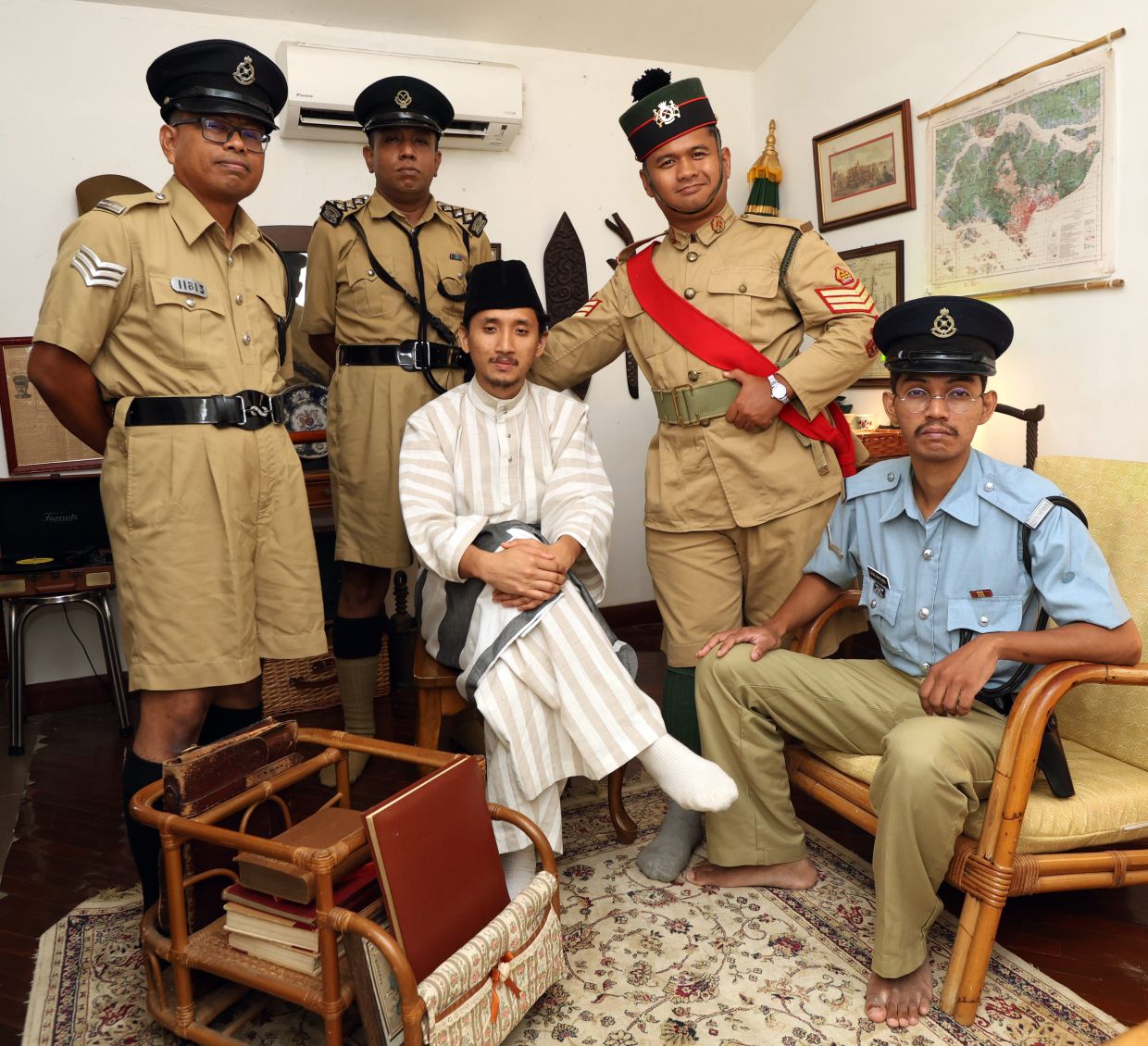
Weekends in Malaysia have taken on a different character for a dedicated group of history enthusiasts who gather not merely to discuss the past, but to inhabit it. The Persatuan Reka Ulang Sejarah, or PRUS, dressed meticulously in historical military uniforms spanning various eras, congregates to transform abstract historical narratives into lived experiences. These sessions go far beyond casual reminiscence—they represent a structured, methodical approach to historical preservation that treats every detail, from the crease of a uniform to the cadence of marching patterns, as essential to authentic understanding.
What began as an informal assembly of military uniform collectors at an event organised by the Port Dickson Army Museum during the early 2010s has evolved into something considerably more purposeful. The group initially operated under the informal banner of "We Are Re-enactors" before formalising its structure through official registration as PRUS in 2023. This transition from hobbyist gathering to registered society reflects a fundamental shift in purpose—from personal enthusiasm to public education. The trajectory reveals how grassroots cultural initiatives in Malaysia can crystallise into meaningful institutional efforts to preserve and transmit historical knowledge.
Chairman Abdul Hakim Abdul Rani articulates the motivating impulse behind the group's formation with clarity born from practical experience. His work as a tour guide exposed him to widespread confusion surrounding historical military uniforms, particularly from the era when photography existed only in monochrome, rendering distinctions between different military branches visually indistinguishable to the untrained eye. This observation crystallised into a mission: to leverage the collective expertise of uniform collectors to disseminate accurate historical knowledge. The official registration transformed PRUS from a niche hobby into an educational platform capable of organising formal exhibitions and classroom presentations at schools and museums throughout Malaysia.
The difference between surface-level costume performance and genuine historical re-enactment lies in a dimension most observers overlook. PRUS members invest considerable intellectual effort into understanding the behavioural codes, physical deportment, and communicative styles unique to each historical period. The way soldiers marched, their bearing when standing at attention, the manner in which they addressed superiors—these seemingly peripheral details become central to authentic representation. Abdul Hakim insists that accuracy extends beyond visual fidelity to uniform design; it encompasses the entire embodied experience of inhabiting a historical moment. This commitment to verisimilitude distinguishes PRUS from theatrical costume groups and positions them as genuinely educational enterprises.
The depth of their engagement became spectacularly evident during a two-day, one-night re-enactment jamboree conducted in July, where members undertook systematic training based on original pre-Independence military manuals. The curriculum encompassed marching protocols, map reading, navigation techniques, and fundamental combat manoeuvres—all executed with documentary precision. Abdul Hakim, drawing upon his background in the Territorial Army, facilitated these sessions with the authority of practical military experience. Notably, the exercises employed sticks rather than actual weapons, demonstrating that the objective centred on understanding tactical methodology rather than rehearsing violence. This pedagogical framework reveals PRUS's deeper purpose: to illuminate how soldiers of previous eras actually functioned operationally and socially.
Beyond classroom and museum exhibitions, PRUS has cultivated relationships with Malaysia's film and television production industry, offering consultancy services that ensure visual and material authenticity in period dramas. Vice chairman Mohd Fadzreeq Mokti describes this collaborative role as extending far beyond extras work; members function as quality-control mechanisms ensuring that visual representations align with historical reality. When productions dress actors in uniforms or depict military contexts, PRUS members ensure that audiences encounter historically plausible presentations rather than anachronistic confusion. This engagement with popular media amplifies their educational reach, as film audiences often absorb historical impressions from entertainment media that outlast formal instruction.
The timing of PRUS's activities follows Malaysia's national calendar, with particular intensification during August and September when National Month and Malaysia Day activities dominate public consciousness. These periods present concentrated opportunities to position historical exhibitions prominently before younger audiences who might otherwise encounter Malaysian history solely through classroom textbooks. Abdul Hakim has observed with some concern that contemporary students demonstrate significant gaps in familiarity with pivotal historical figures and watershed events in Malaysian history. This observation has reinforced his conviction that schools represent crucial venues for early historical engagement, particularly when history moves beyond static text into interactive, embodied experience.
Mohd Fadzreeq, who works professionally as a school teacher, has witnessed firsthand how uniformed historical presentation transforms student engagement. His appearance at school in historically accurate military dress—authorised by school administration—consistently generates enthusiasm among younger pupils who pose questions and request repeat appearances. This response illuminates a fundamental pedagogical insight: children possess innate curiosity about history when presented through sensory and visual channels rather than textual abstraction alone. The absence of museum access or opportunities for tactile historical engagement constitutes a genuine educational barrier in many communities, one that PRUS members help bridge through their physical presence.
The conceptualisation of PRUS members as "walking museums" captures something essential about their social function. They transcend the role of mere costume performers by embodying historical periods—when encountering them, citizens initiate conversations, pose questions, and receive knowledgeable responses grounded in exhaustive preparation. The extensive reading of historical texts, military manuals, and period documentation that precedes each appearance ensures that the group functions as a genuine knowledge resource rather than theatrical artifice. This approach transforms public spaces into informal learning environments where historical understanding becomes accessible to populations who might lack exposure through institutional channels.
The implications of PRUS's work extend beyond individual educational outcomes. In Malaysia's diverse society, where contemporary national identity remains contested and evolving, the work of preserving and accurately transmitting pre-Independence military history serves important functions in establishing shared historical consciousness. The group's emphasis on documentary accuracy rather than nationalist myth-making positions them as custodians of historical integrity. Their growing visibility and institutional recognition suggest that Malaysians increasingly value experiential historical engagement—learning that activates multiple sensory channels and creates memorable impressions beyond what conventional education provides.
For younger Malaysians who have encountered primarily textbook representations of their nation's transition from colonial administration through the independence struggles and into modern statehood, encounters with PRUS members offer something distinctly valuable. The physical presence of authentically dressed figures, the demonstration of period-appropriate movement and communication, and the availability of knowledgeable individuals willing to answer questions create educational moments that textbooks cannot replicate. As Malaysia continues navigating questions of national identity and historical understanding, organisations like PRUS demonstrate how grassroots enthusiasm, combined with rigorous scholarship, can serve the larger project of ensuring that subsequent generations inherit not merely abstract knowledge of their past, but tangible, embodied understanding of the historical journey that shaped their nation.

