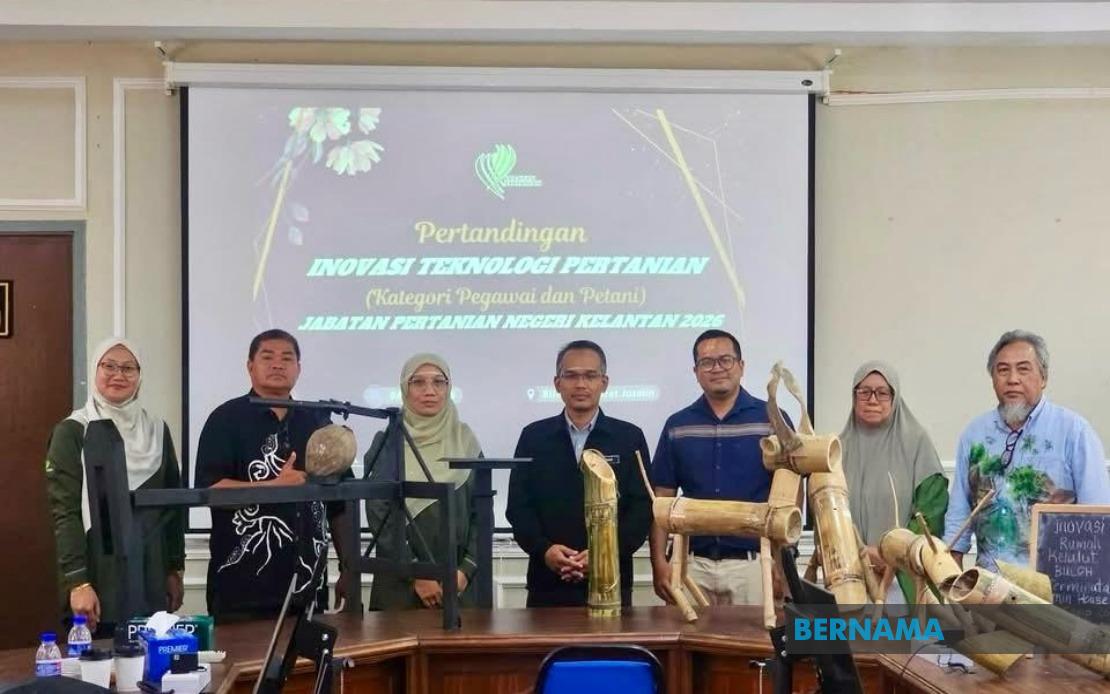
Che Adnan Che Kadir's portable coconut dehusking machine has captured the attention of agricultural experts and policymakers in Kelantan, earning a four-star rating that signals potential far beyond its original farming application. The 56-year-old plantation entrepreneur developed the innovation on his six-hectare property in Kampung Chetok, Pasir Mas, addressing a longstanding challenge in coconut processing. Judges at the Kelantan Department of Agriculture's 2026 Agricultural Technology Innovation Competition have now flagged the possibility of expanding the device's scope into other high-value crops, particularly durians—a development that underscores how targeted agricultural innovation can unlock broader economic opportunities across Malaysia's farming sector.
The device represents a significant efficiency gain in an otherwise labour-intensive process. Traditional methods of removing coconut husks consume between two and three minutes per fruit when performed manually, whereas Che Adnan's machine completes the same task in approximately one minute. For experienced operators, the timeline shrinks further to just forty to forty-five seconds, a dramatic productivity improvement that carries substantial implications for commercial coconut cultivation. At only 3.5 kilograms, the equipment's portability makes it practical for smallholder farmers and larger plantation operations alike, removing barriers to adoption that often plague farm mechanisation initiatives in the Southeast Asian context.
The judging panel's suggestion to explore durian applications reflects strategic thinking about Malaysia's agricultural future. Durians require skilled, careful handling during opening and processing—work that demands precision, strength, and repetition. Workers face genuine injury risks from the fruit's sharp exterior, and the variability in manual skill levels creates inconsistency in output quality and safety standards. By adapting Che Adnan's mechanical approach to durian processing, developers could standardise an operation that currently relies heavily on artisanal expertise. This pivot towards mechanisation becomes increasingly valuable as Malaysia seeks to professionalise its durian supply chain and meet rising international demand without proportionally increasing labour costs or workplace accidents.
Che Adnan's achievement in the farmer category award positions him for representation at the national level during National Innovation Week in Putrajaya at the end of September. This progression reflects the structured pathway the Malaysian government has established to identify, nurture, and scale agricultural innovations. The support from the Department of Agriculture enabled his initial state-level participation, where technical experts from the department, the Malaysian Agricultural Research and Development Institute (MARDI), and polytechnic institutions evaluated his work. This multi-stakeholder assessment approach ensures innovations meet rigorous standards and possess genuine commercialisation potential rather than merely addressing isolated farm problems.
Realising the device's wider market possibilities requires refinement beyond its current state. Che Adnan acknowledges that advancing to national competition demands design improvements aligned with judges' specific recommendations. The development pathway depends significantly on securing innovation funding to enhance the prototype according to industry specifications and production scalability requirements. A national innovation grant, offering a RM10,000 prize, would provide the financial foundation necessary for this maturation process. Such support mechanisms represent Malaysia's strategic investment in homegrown technological solutions that can compete internationally while strengthening domestic agricultural competitiveness.
The entrepreneurial journey that produced this innovation began in 2024, when Che Adnan identified an immediate problem affecting his own operations. Rather than accepting dehusking as an unavoidable bottleneck in coconut processing, he engineered a solution—a decision that exemplifies the farmer-led innovation philosophy increasingly championed across agricultural development circles. This grassroots approach to problem-solving contrasts with top-down technology transfer models that sometimes impose unsuitable solutions on farming communities. When innovations emerge from farmers' lived experiences and operational challenges, their eventual adoption rates and practical efficacy typically exceed those of externally designed systems.
The potential adaptation to durians carries significant economic weight for Malaysia's agricultural sector. The country remains a major durian producer and exporter, with expanding markets throughout Asia and growing demand from international consumers willing to pay premium prices. However, durian processing remains labour-intensive and heavily dependent on manual skill. Mechanising key processing steps while maintaining fruit quality could strengthen Malaysia's competitive position in global durian trade. Processing efficiency directly translates to reduced operational costs, improved workplace safety, and enhanced consistency—factors that together make Malaysian durian products more attractive to international buyers and exporters.
The broader context for Che Adnan's innovation reflects Malaysia's ongoing agricultural transformation. The sector faces mounting pressure to adopt labour-saving technologies as younger generations migrate toward urban employment and wage expectations rise. Simultaneously, global supply chain disruptions and shifting consumer preferences demand greater production reliability and food safety compliance. Agricultural innovations that address these concurrent challenges gain strategic importance. Devices like Che Adnan's coconut dehusker represent accessible entry points into farm mechanisation—affordable solutions tailored to specific crops rather than expensive, comprehensive systems requiring extensive capital investment and technical expertise.
MARDI's involvement in evaluating and potentially advancing the innovation signals recognition of its technical merit and commercial viability. The institute's research capabilities and industry connections position it well to guide the adaptation process for durian applications. Partnership between Che Adnan, government agencies, and research institutions could accelerate the device's evolution from state-level success to nationally distributed technology. This collaborative model—combining farmer ingenuity with institutional expertise and policy support—represents the ecosystem approach Malaysia increasingly emphasises for agricultural modernisation.
The motivational dimension of Che Adnan's experience deserves attention. He explicitly noted surprise that an invention developed for personal farm management could attract interest for commercialisation and market expansion. This sentiment captures a common dynamic in agricultural innovation ecosystems: farmers with practical expertise often underestimate their inventions' broader potential. Institutional recognition and pathway support unlock confidence and resources necessary for scaling operations. The farmer category award validates his technical approach while simultaneously signalling to other agricultural entrepreneurs that their homegrown solutions merit serious consideration and development investment.
Looking ahead, the expansion journey requires careful attention to design standardisation, production methodology, and market positioning. A device optimised for coconuts may require meaningful modifications to function effectively on durians, considering differences in exterior hardness, interior structure, and processing objectives. Development costs and production scalability must align with realistic market pricing that farmers will accept. Success ultimately depends on Che Adnan and his partners demonstrating that the adapted device delivers genuine value—reduced processing time, improved safety, consistent quality, and cost-effectiveness—sufficient to justify adoption across Kelantan's and Malaysia's broader durian farming communities.

