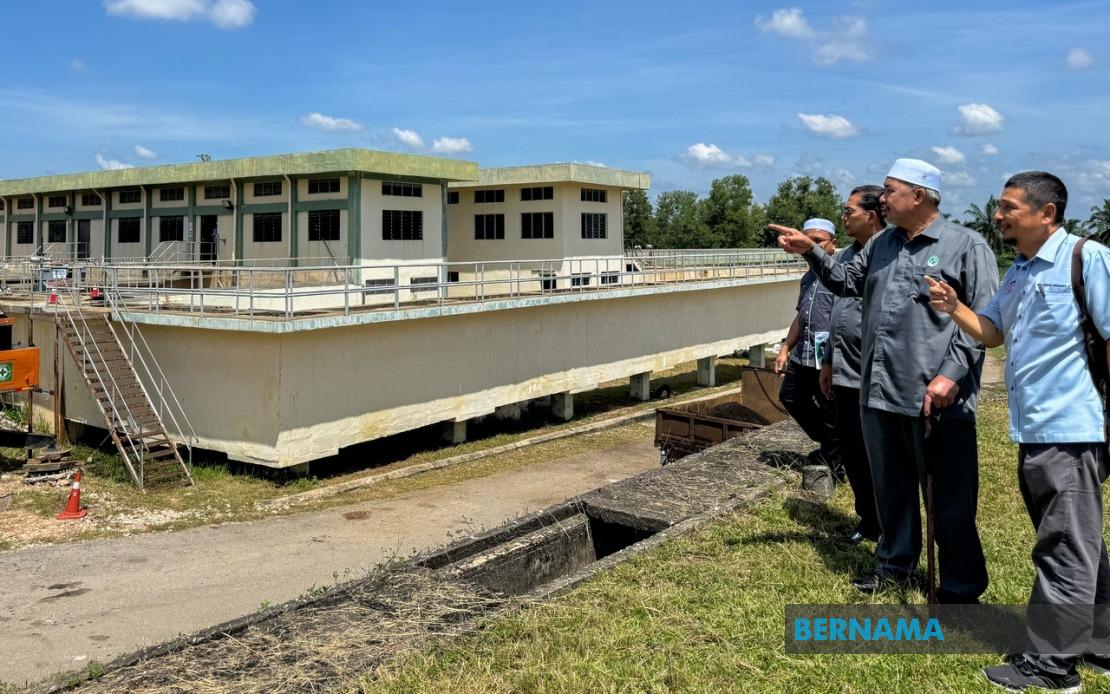
Water infrastructure improvements in Kelantan are set to transform supply reliability across three districts as a RM11.5 million upgrade project nears completion at the Merbau Chondong Water Treatment Plant. The expansion will extend benefits to approximately 34,000 account holders in Machang, Pasir Puteh, and southern Kota Bharu when distribution from the enhanced facility begins in early September. Datuk Dr Izani Husin, chairman of Kelantan Public Works, Infrastructure, Water and Rural Development Committee, announced the progress during an on-site inspection at the treatment plant, signalling the state's commitment to addressing persistent water scarcity challenges that have affected households across the region for years.
The core achievement of this project lies in its significant capacity expansion. The upgraded Merbau Chondong WTP will now treat and produce 80 million litres of water daily, nearly doubling the previous capacity of 45 million litres. This expansion becomes particularly meaningful when contextualised against the operational constraints that previously hampered the facility. Air Kelantan Sdn Bhd, the state's water operator, had been hesitant to push the plant beyond its original limits, fearing that increased production might compromise water quality standards. This conservative approach, while prioritising safety, meant that thousands of residents endured water rationing despite the technical potential for greater supply.
The technological breakthrough enabling this capacity surge involves the installation of the Xylem Underdrain Leopold filtration system, a modern water treatment mechanism that allows the facility to process between 70 million to nearly 90 million litres of raw water daily. This advanced filtration technology addresses the fundamental bottleneck that previously constrained output levels. The system's sophistication lies not merely in handling greater volumes but in maintaining stringent quality standards simultaneously, thereby solving the operational paradox that had stymied earlier expansion attempts. By introducing this filtration upgrade, the plant operators have effectively decoupled the relationship between volume and quality, permitting substantial production increases without sacrificing the purity of treated water delivered to consumers.
Water quality improvement represents a critical secondary benefit that extends beyond simple volume metrics. The upgrade has successfully reduced the Nephelometric Turbidity Unit reading—a measure of water cloudiness and particulate contamination—from over 10 NTU down to three NTU. This substantial reduction indicates that the treated water now meets much stricter international standards for clarity and purity. For Malaysian households already burdened by intermittent supply issues, this quality enhancement ensures that when water does flow through their taps, it meets considerably higher standards of safety and potability. The achievement reflects a holistic approach to water service delivery that addresses both the quantity and quality dimensions of the supply problem.
The completion timeline underscores the project's advanced stage of development. Authorities expect the upgrade work to conclude by the end of July, allowing for system testing and integration throughout August. Distribution to end-users will commence in early September, meaning that residents in the affected areas will experience tangible service improvements within weeks rather than months. This accelerated timeline demonstrates that the infrastructure investment, while substantial, has been executed with reasonable efficiency. For the 34,000 account holders awaiting relief, this schedule offers concrete assurance that their water security predicament will be addressed in the near term.
Beyond the immediate Merbau Chondong upgrade, state authorities are charting an ambitious longer-term infrastructure strategy. The Kelantan government, in partnership with Pengurusan Aset Air Berhad (PAAB), is planning a new Machang Water Treatment Plant valued at RM120 million with a targeted completion date of 2030. This facility will have the capacity to supply 50 million litres of water daily exclusively to Machang residents. The strategic advantage of this approach lies in its decentralisation logic: by establishing a dedicated treatment plant for Machang, authorities can liberate existing capacity at Merbau Chondong for redistribution to other underserved districts across Kelantan. This creates a cascading benefit that extends water security improvements beyond the immediate three-district corridor.
The Machang 1 WTP project remains in preliminary stages pending finalisation of agreements between the state government and PAAB, with contractor appointment processes still forthcoming. This measured pace, while potentially frustrating to those seeking immediate solutions, reflects the complexity of securing funding arrangements and coordinating between multiple governmental and quasi-governmental entities. The RM120 million investment represents significant capital commitment, suggesting that authorities view water infrastructure development as a strategic priority worthy of substantial public resources. Malaysian readers familiar with infrastructure project delays will recognise that a 2030 completion target, while distant, at least provides a defined timeline for future planning.
The broader context reveals that Kelantan's water challenges affect substantially more households than those addressed by the Merbau Chondong upgrade. Air Kelantan Sdn Bhd reports that the operator has resolved approximately 70 per cent of water supply issues affecting 270,000 user accounts across the entire state. This statistic underscores both the scale of the problem and the incremental progress being achieved. The organisation has articulated an ambitious target to reach at least 90 per cent resolution by 2035, suggesting a commitment to systematically addressing the remaining affected households over the next decade. For Kelantan residents, this trajectory, if maintained, offers hope that the chronic water insecurity characterising the state in recent years may gradually give way to more normalised supply patterns.
For Southeast Asian observers monitoring water infrastructure development across the region, Kelantan's experience illustrates both the challenges and opportunities inherent in upgrading ageing treatment facilities. Many states across Malaysia and neighbouring countries face similar predicaments: treatment plants designed for smaller populations now serve expanding urban and suburban communities, yet cannot be easily expanded without substantial capital investment and technical innovations. The Merbau Chondong upgrade demonstrates that modern filtration technologies can genuinely transform infrastructure capabilities, provided institutions commit adequate resources and adopt evidence-based engineering solutions. The success of this project may inform similar upgrade initiatives elsewhere in Malaysia facing comparable water security pressures.
The implications for Malaysian water policy extend beyond Kelantan's borders. The project highlights the importance of moving beyond traditional approaches to water management and embracing technological solutions that permit productivity improvements without compromising quality. As climate uncertainty increasingly threatens water availability across Malaysia, infrastructure efficiency becomes paramount. The RM11.5 million investment, while substantial, proves economically justified when measured against the social cost of continued water rationing affecting tens of thousands of households. This project may establish a replicable model for other states seeking to extract greater value from existing infrastructure assets before undertaking more capital-intensive new development.

