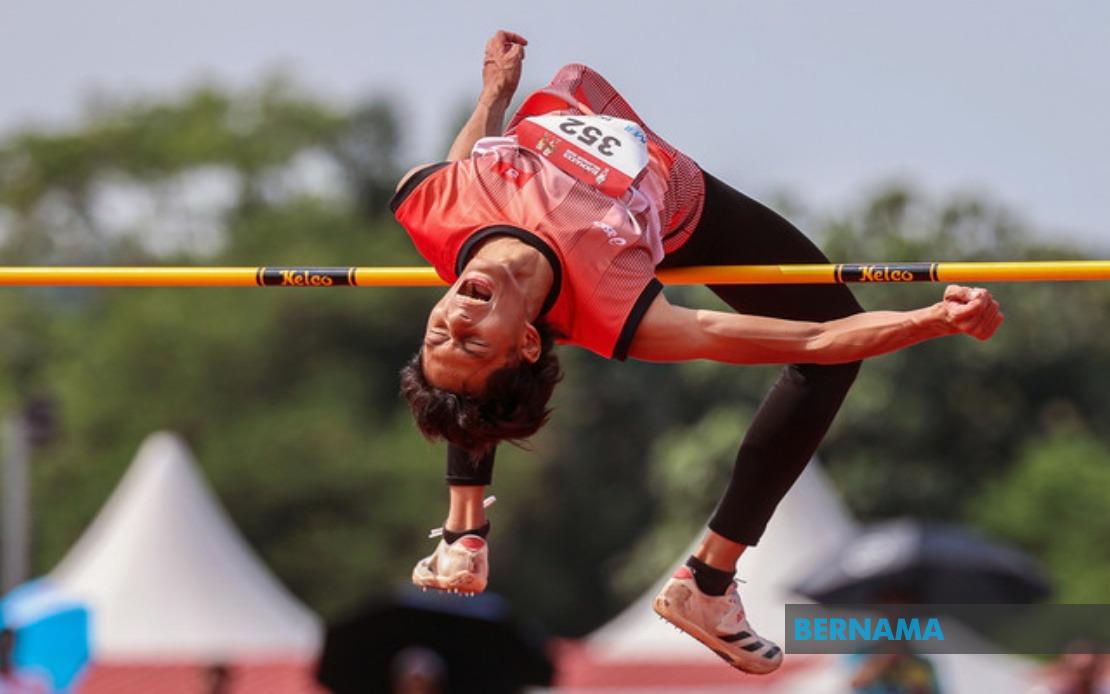
Eighteen-year-old Dzul Darwisy Adam Khairulaswari of Kelantan delivered a stunning upset at the Selangor 2026 SUKMA Games, securing the high jump title at Universiti Putra Malaysia (UPM) Sports Centre with a personal best clearance of 2.09 metres. The achievement marks an extraordinary leap in competitive standing for the athlete, who had struggled to medal just two years earlier at the Sarawak Malaysia Games, finishing only 11th. His gold represents Kelantan's second athletics medal at the biennial championship, underlining the state's growing strength in the sport at national level.
Dzul Darwisy's victory came amid intense competition from Kedah, whose representatives claimed the remaining podium spots. Muhamad Nawawi Mohamad captured the silver medal with a clearance of 2.07 metres, while Muhammad Naufal Zulkifli took bronze at 2.04 metres. The podium sweep by Kedah athletes highlights the concentration of high-jump talent in the northern region, though Kelantan's triumph signals emerging challenges to established strongholds in the discipline. The presence of Lee Hup Wei, a former national high-jump champion now serving as the national reserve coach, at the final underscored the competitive calibre of the event.
For Dzul Darwisy, the win represented far more than a medal—it marked his maiden victory at the senior national championship stage, a threshold many athletes fail to cross despite years of competition. Speaking immediately after the final, the teenager reflected on the improbability of his achievement with evident emotion, describing the result as a blessing and, by some measures, miraculous. He credited his family, friends, and their prayers in sustaining him through his competitive journey, revealing the psychological and emotional dimensions of athletic breakthrough that often remain unspoken in official records.
His path to the podium had been neither linear nor marked by early success. At the 2023 Malaysian School Sports Council (MSSM) Championships while still in Form Three, Dzul Darwisy achieved a third-place finish, a respectable result that nonetheless failed to generate momentum for immediate progression. Following that performance, his development had stalled, with performance improvements remaining marginal until this year's dramatic emergence. The two-year gap between Sarawak and Selangor encompasses a formative period in an athlete's maturation, suggesting that technical refinement, strength conditioning, and mental resilience have converged in his favour.
The physical toll of competition became evident as Dzul Darwisy disclosed that he had navigated a back injury throughout the Selangor Games, yet persisted in refining his technique and pushing for personal advancement. Despite this handicap, he surpassed his previous best of 2.03 metres by six centimetres, a meaningful improvement that nonetheless fell short of his pre-competition aspirations. He had entered the Games targeting a height between 2.13 and 2.15 metres, indicating that his 2.09-metre clearance, while career-defining, leaves substantial room for future development and raises questions about what might have been achieved in full health.
Looking forward, Dzul Darwisy has articulated an ambitious competitive roadmap that extends beyond regional championships. His immediate objective is to clear 2.16 metres, a threshold he views as essential for securing qualification to next year's SEA Games—a competition that would elevate his profile considerably across Southeast Asia. The SEA Games represents a natural stepping stone for Malaysian athletes seeking international exposure and competitive experience against the region's elite performers. Beyond that target lies the SUKMA record, established by Negeri Sembilan's A. Kavee Alagan at 2.21 metres during the 2012 Pahang Games. Attempting to break a twelve-year-old national record would position Dzul Darwisy among Malaysia's all-time high-jump greats, a distinction that would reshape his trajectory entirely.
The significance of Dzul Darwisy's breakthrough extends beyond personal achievement. Kelantan's success in athletics at SUKMA 2026 reflects the effectiveness of state-level sports development programmes and the identification of emerging talent from smaller athletic centres. The state has traditionally competed with larger, better-resourced competitors from Selangor, Kuala Lumpur, and Penang, making medal success particularly noteworthy. His victory demonstrates that athletic talent exists throughout Malaysia's regions and that investment in grassroots development and coaching infrastructure can yield competitive results at the highest domestic levels.
The narrative of Dzul Darwisy's rise also carries implications for Malaysian athletics' broader trajectory. As the sport seeks to maintain competitiveness in regional and global contexts, the emergence of young athletes from non-traditional powerhouse states suggests a decentralisation of excellence that strengthens the national talent pool. SUKMA serves as both a showcase for regional pride and a scouting ground for the national coaches tasked with building squads for international competitions. Dzul Darwisy's performance at UPM may well bring him to the attention of national selectors and international athletics scouts monitoring Southeast Asian development.
His journey from 11th place two years ago to SUKMA gold illustrates the unpredictability inherent in athletic competition and development. While some athletes progress with steadiness and consistency, others experience sudden breakthroughs where physical maturation, technical refinement, and psychological readiness align explosively. Dzul Darwisy's case belongs to the latter category, and whether he maintains this trajectory or achieves the lofty targets he has set will provide compelling narrative fodder for Malaysian athletics over the coming months and years.

