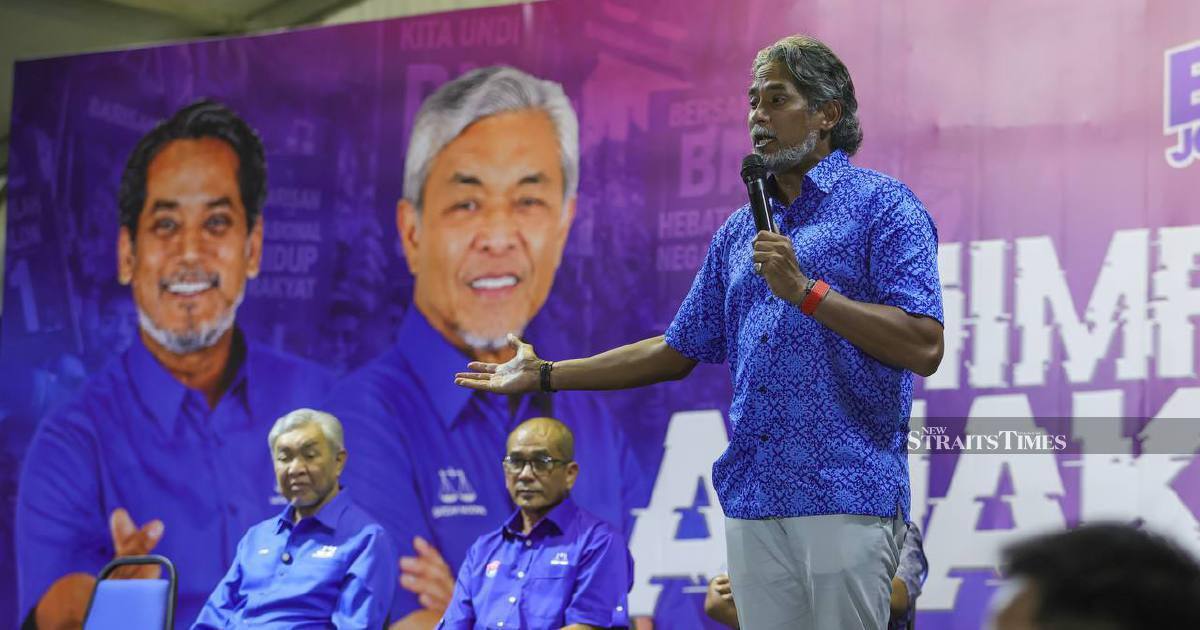
In campaign rhetoric that reflects deepening partisan divisions ahead of the Johor state election, former Umno Youth chief Khairy Jamaluddin has launched a pointed attack on Pakatan Harapan's electoral platform, accusing the opposition coalition of presenting a manifesto that amounts to recycled pledges without substantive policy differentiation. Speaking from Johor Baru, Khairy framed his critique as a matter of political authenticity, suggesting that voters face a clear choice between the Barisan Nasional's established and original agenda against what he characterised as Pakatan Harapan's "copy-and-paste" approach to governance promises.
The accusation represents part of a broader campaign strategy by the ruling coalition to position itself as the custodian of proven developmental vision whilst portraying the opposition as offering warmed-over commitments lacking coherent ideological grounding. For Malaysian political observers, such exchanges underscore the highly personalised nature of electoral contests in the country, where campaign messaging frequently centres on character assassination and policy mimicry rather than substantive debate about competing economic models or governance philosophies. The framing also reflects anxieties within Barisan Nasional ranks about maintaining electoral dominance in Johor, historically a critical stronghold that has provided crucial parliamentary representation to the ruling coalition.
Khairy's intervention into the Johor contest is significant given his position as a senior figure within the United Malays National Organisation and the Barisan Nasional machinery. His willingness to engage in direct criticism of opposition manifestos suggests considerable confidence within the ruling coalition about its electoral prospects in the state, though such aggressive rhetoric can equally indicate underlying vulnerability that campaign strategists seek to address through proactive messaging. The former youth leader's prominence in recent political discourse reflects his elevation within party hierarchies and his cultivation as a potential successor to current party leadership structures.
For Johor voters, the choice between competing manifestos carries particular weight given the state's economic importance to the Malaysian federation and its status as a politically bellwether region. Johor's development trajectory, investment climate, and infrastructure expansion directly impact not only state residents but also southern regional prosperity, making electoral outcomes there consequential beyond mere partisan calculations. The state's diverse economy, spanning manufacturing, agriculture, and services sectors, means that credible development planning assumes heightened importance.
Pakatan Harapan's electoral strategy in Johor has historically struggled against Barisan Nasional's entrenched administrative advantages and historical claim to having delivered decades of developmental progress. The opposition coalition's challenge involves articulating governance models sufficiently different from the ruling coalition's approaches to justify electoral change, whilst simultaneously demonstrating competence and financial prudence to voters concerned about economic management. Critics of the opposition have frequently highlighted tensions between coalition members regarding fiscal discipline and administrative capacity, concerns that Khairy's manifesto critique appears designed to amplify.
The "copy-and-paste" allegation, if substantiated through detailed policy comparison, could prove damaging to Pakatan Harapan's campaign messaging, particularly among swing voters and uncommitted Malay-Muslim constituencies where questions about distinctive policy offerings carry electoral weight. Conversely, if the opposition coalition can demonstrate that its manifesto reflects genuine policy innovation or superior detail regarding implementation mechanisms, the accusation might backfire by appearing partisan rather than substantive. The rhetorical effectiveness of such campaign claims often depends less on factual accuracy than on whether opposition parties successfully rebut charges through credible policy exposition.
Context regarding Johor's prior electoral contests reveals patterns of intense Barisan Nasional dominance, though recent national political trends have demonstrated vulnerability within traditional ruling coalition constituencies. The 2018 general election shock that unseated the Barisan Nasional federally originated partly from urban discontent in states like Johor, signalling that historical voting patterns cannot be assumed immutable. Subsequent electoral contests have produced mixed results, with the ruling coalition recovering ground nationally whilst remaining alert to persistent pockets of opposition strength within traditionally reliable territories.
Khairy's campaign contribution also reflects generational dynamics within Barisan Nasional politics, where younger figures seek to establish policy expertise and rhetorical authority ahead of potential leadership transitions. His engagement with manifesto criticism positions him as actively defending coalition interests rather than occupying peripheral roles in campaign machinery. Such positioning accumulates political capital useful for internal party advancement, particularly if associated messaging resonates with electoral constituencies or generates media coverage amplifying campaign messaging.
For Malaysian media observers and political analysts, the Johor election provides crucial testing ground for evaluating whether traditional electoral coalitions retain mobilisation capacity in contemporary political environments characterised by enhanced information access and declining automatic deference to institutional authorities. The outcome will likely inform calculations regarding stability of federal ruling arrangements and prospects for opposition breakthroughs in other strategically important states. Whether voters ultimately accept Khairy's characterisation of opposition manifestos as derivative or instead reward Pakatan Harapan for policy platforms perceived as genuinely distinctive remains a pivotal question shaping the contest's final trajectory.

