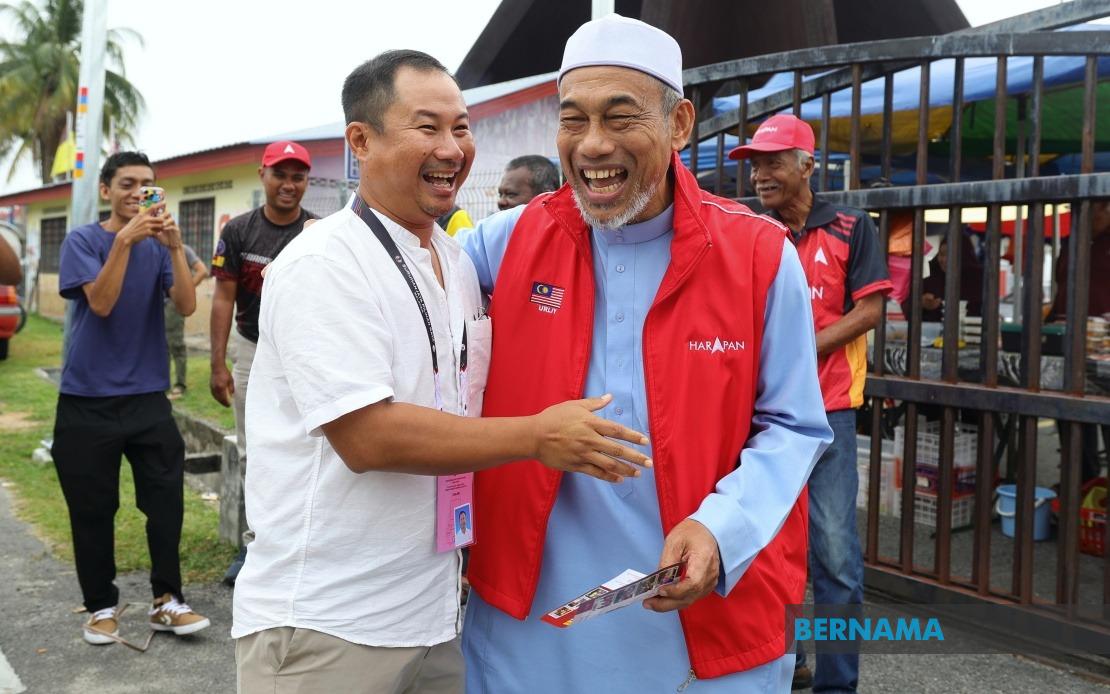
The Negeri Sembilan state election campaign took an unusual turn when family bonds and political rivalry converged at a packed weekend market in Kuala Klawang. Incumbent assemblyman Datuk Bakri Sawir from the Pakatan Harapan coalition and his cousin Danni Rais, representing Perikatan Nasional, arrived almost simultaneously to canvass voters at the Jelebu market on the second day of campaigning. Their unexpected proximity created a moment of genuine public interest, with shoppers and traders pausing their weekend routines to witness the two candidates navigating the same crowds, shaking hands with constituents, and even sharing lighthearted exchanges as they worked separate sections of the marketplace.
The encounter between the related rivals demonstrated a refreshing departure from the acrimony that sometimes characterises Malaysian electoral contests. Rather than engaging in confrontational posturing or trading barbs, both candidates maintained civility throughout their overlapping presence at the market. Voters seized the moment to photograph and video the unusual scene, creating impromptu social media content that captured the candidates' professional demeanour. This cordial interaction suggested that personal relationships need not be permanently fractured by electoral competition, and that political disagreement can coexist with mutual respect and family courtesy.
Bakri spoke to journalists about his philosophy regarding the closely contested race, expressing a notably pragmatic perspective on competing against his own kinsman. He framed the election not as a personal struggle between relatives but as an opportunity for both candidates to demonstrate their respective capabilities and commitment to public service. This approach reflected a broader philosophical stance that positions electoral contests as platforms for showcasing competing visions and qualifications rather than as personal vendettas. By articulating this frame, Bakri attempted to elevate the discourse surrounding the Klawang seat beyond familial rivalry and into substantive territory concerning governance and constituency representation.
The incumbent's commitment to respecting electoral regulations became evident when discussing his recent interaction with local authorities. When the Jelebu District Council objected to campaign flags installed on a stadium fence, Bakri's team immediately complied with the directive and removed the offending materials without protest or resistance. This swift adherence to administrative guidance illustrated a willingness to model lawful behaviour, setting an example for both party machinery and voters themselves. His rhetorical question about how candidates could credibly demand civic compliance from constituents if they themselves disregarded regulations highlighted the ethical dimensions of election management and the importance of moral consistency in political leadership.
Bakri extended his appeal for campaign propriety beyond his own candidacy, explicitly urging all competing parties and their organisational structures to conduct themselves with discipline and respect throughout the electoral period. This call for systemic restraint suggested recognition that individual candidate behaviour, while important, represents only one component of overall campaign quality. Party machinery—including volunteers, activists, and support networks—collectively shapes the electoral atmosphere and public perception of competing coalitions. By emphasising organisational responsibility, Bakri positioned his coalition as committed to preserving community harmony and democratic norms, contrasting an orderly, respectful campaign approach against potentially more antagonistic alternatives.
The Klawang state seat presents a multi-dimensional contest with significant electoral implications for Negeri Sembilan's political trajectory. With 13,355 registered voters on the electoral roll, the seat comprises a substantial rural and semi-urban constituency. The three-cornered race involves not only the Bakri-Danni family contest but also Muhammad Adib Musa from Bersatu, ensuring that voter choice encompasses multiple ideological and organisational options. This tripartite structure complicates traditional coalition mathematics and potentially creates scenarios where a plurality rather than majority vote could determine representation. The inclusion of a Bersatu candidate indicates the party's strategy to contest beyond coalition structures, positioning itself as an independent political alternative.
The electoral timeline established by the Election Commission provides a condensed campaign window critical for candidates to establish voter contact and communicate their platforms. Early voting on July 28 precedes the general polling date of August 1, accommodating voters with scheduling constraints or mobility limitations. This compressed schedule demands intensive campaign activity, particularly grassroots engagement at markets, community centres, and residential areas where candidates can establish direct voter relationships. The rapid pace simultaneously limits candidates' ability to conduct extended constituency tours or organise elaborate campaign events, elevating the importance of spontaneous market encounters like the Klawang market scene.
For Klawang voters, the concurrent family relationship and political competition presents an intriguing dynamic with implications for constituency representation. Bakri's incumbency provides name recognition and established constituent relationships cultivated over his tenure, while Danni's candidacy offers voters an alternative perspective unconstrained by present governance responsibilities. The Bersatu option presents a third distinct choice for electors dissatisfied with either major coalition. This multiplicity of options expands voter agency while potentially fragmenting the electorate across competing candidates, particularly if no single candidate achieves overwhelming support.
The broader significance of the Klawang campaign extends beyond the immediate constituency, offering signals about Malaysian electoral culture and inter-party relations during state-level contests. The harmonious campaign approach demonstrated by Bakri and Danni suggests that state elections may provide space for less acrimonious political competition compared to federal contests, where coalition pressures and national stakes often generate more heated rhetoric. State-level politics sometimes permits greater decoupling from federal partisan warfare, allowing local issues and candidate-specific factors to receive greater consideration. The cordial family conduct at Kuala Klawang market exemplifies this potential for more civilised electoral engagement at the state level.
Negeri Sembilan's electoral landscape reflects broader patterns of political fragmentation and coalition reconfiguration evident throughout Malaysia. The presence of competing coalitions—Pakatan Harapan, Perikatan Nasional, and independent Bersatu candidacies—demonstrates the instability of traditional two-coalition structures that characterised Malaysian politics through much of the post-1998 reformasi era. State elections increasingly serve as laboratories for coalition experimentation, with parties testing different electoral configurations and messaging strategies. Klawang's three-way race exemplifies this evolving complexity, requiring voters to navigate multiple options rather than binary coalition choices.
The Election Commission's management of the campaign period, evident through timely field officer responsiveness to flag placement complaints, indicates reasonable administrative oversight of electoral conduct. Effective enforcement of campaign rules depends on balanced, prompt interventions that apply standards consistently across competing candidates and parties. The fact that Bakri's team received and accepted correction within what appears to be appropriate procedure suggests functional regulatory mechanisms. However, consistent application across all candidates remains essential for maintaining public confidence in electoral fairness and administrative neutrality.
Looking forward, the August 1 polling date will determine whether Bakri retains his seat or whether voters opt for Danni's alternative or Adib's third option. The campaign's tone and conduct, exemplified by the respectful market encounter, may influence voter perceptions regarding candidate trustworthiness and suitability for continued or initial representation. Constituencies increasingly consider not merely policy platforms but also demonstrated character and integrity during campaign periods. The Klawang candidates' willingness to maintain civility despite political opposition may resonate with voters seeking representation characterised by professionalism and community respect.

