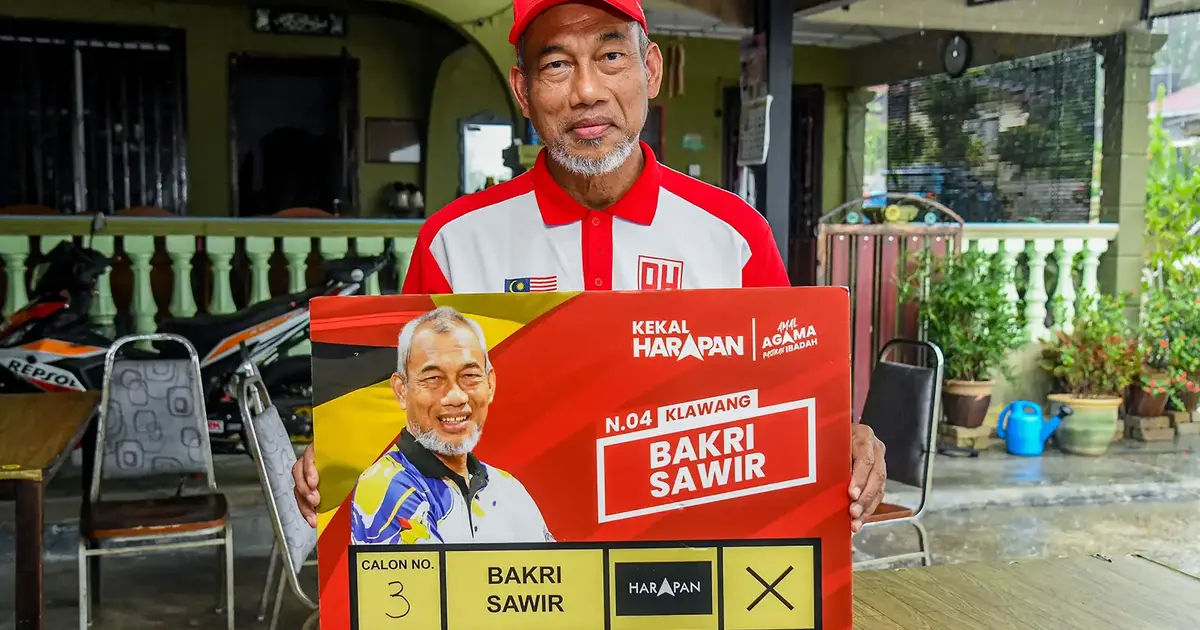
Two-term Klawang assemblyman Bakri Sawir has dismissed concerns about the emerging alliance between Barisan Nasional and Perikatan Nasional, expressing confidence that his constituency can once again deliver victory for Pakatan Harapan without support from the rival coalition's heavyweight component, Umno. The assertion carries particular weight given Sawir's recent electoral history, which he views as vindication of his independent standing among voters in the Selangor constituency.
Sawir's optimism stems from his experience during the 2023 Selangor state election, when he felt let down by Umno despite the broader coalitional framework of Malaysian politics at that time. Rather than viewing this as a liability, the assemblyman has reframed the episode as proof that his personal mandate and community connections transcend party machinery. This narrative reflects a broader pattern within Pakatan Harapan's strategy of emphasising ground-level organisation and candidate credibility over reliance on traditional power brokers.
The political landscape for Klawang has shifted considerably since 2023. The consolidation of Barisan Nasional and Perikatan Nasional into a formal pact represents a significant recalibration of Malaysian coalition politics, particularly in Selangor where Pakatan has held state control. Such arrangements typically reshape local electoral dynamics by concentrating resources and messaging around a unified opposition front, potentially threatening incumbents who lack the organisational depth of larger parties.
However, Sawir's track record as a two-term representative suggests substantive support among constituents independent of broader party alignments. This is not uncommon in Malaysian state politics, where local grievances and constituent services often eclipse national political narratives during elections. Klawang voters may well prioritise representation and developmental issues over coalition mathematics, particularly if the incumbent has demonstrated responsiveness to area-specific concerns.
The Selangor context adds another layer to Sawir's calculation. As Malaysia's most economically developed state and a crucial electoral bellwether, Selangor has become a testing ground for political realignment. Pakatan Harapan's retention of state power in recent elections despite significant pressure from combined opposition forces suggests that the coalition's ground presence and voter loyalty in certain constituencies remains robust. Klawang's voting pattern in successive elections could indicate whether this support is sustainable.
Sawir's public statements also reflect broader Pakatan positioning ahead of potential future elections. By projecting confidence and stressing individual candidate strength, the coalition seeks to counter the narrative that the BN-PN alliance represents an insurmountable force. This messaging is particularly important in marginal seats where voter sentiment remains fluid and could be swayed by perceptions of momentum or viability.
The allegation of betrayal by Umno during the 2023 polls warrants closer examination. In Selangor's state elections, several dynamics typically influence outcomes: urban-rural splits, ethnic composition of constituencies, performance on state-level issues such as water and land management, and the relative appeal of state leadership. Sawir's characterisation of his 2023 experience suggests that Umno's campaign machinery or candidate selection may have undermined Pakatan's coordinated efforts, a common friction point in Malaysian coalitional politics where component parties harbour their own ambitions.
From a regional perspective, Selangor's political evolution holds implications for Southeast Asian electoral trends. Malaysia's experiment with coalition politics, spanning decades, has increasingly emphasised personality-driven campaigns and localism alongside national narratives. Sawir's confidence in winning without Umno reflects this shift toward candidate-centric rather than party-centric contests, a pattern observable across several Southeast Asian democracies grappling with weakening party institutions.
The BN-PN pact itself deserves contextualisation for Malaysian readers. This alignment represents an attempt to challenge Pakatan's dominance through a more unified opposition, combining Umno's traditional machinery with Perikatan's newer mobilisation networks. In constituencies like Klawang, where Pakatan holds the seat, the alliance could theoretically split anti-government votes more efficiently than they might separately. Yet empirical evidence from recent Malaysian elections suggests that such pre-poll pacts do not automatically translate into seat gains, particularly where incumbents enjoy genuine community support.
Sawir's confidence also implicitly acknowledges the demographic and electoral realities of his constituency. Klawang encompasses urban and semi-urban areas with relatively educated electorates, where performance on bread-and-butter issues and transparent governance often matter more than factional politics within coalitions. If the assemblyman has effectively addressed local concerns—from traffic and waste management to economic opportunities—then his re-election prospects may indeed rest more on these fundamentals than on the broader political compact between BN and PN.
The strategic significance of Sawir's public comments extends beyond Klawang itself. Pakatan candidates across Selangor are likely monitoring how an incumbent responds to tougher opposition consolidation, and Sawir's assertion of confidence could strengthen internal morale and messaging discipline. Conversely, if his optimism proves unfounded in future electoral contests, it could undermine confidence in similar claims from other party representatives.
For Malaysian voters in Selangor and beyond, Sawir's candidacy encapsulates a fundamental question about electoral politics: whether institutional party strength or individual representative credibility carries greater weight. His previous success and current assertions suggest at least a portion of the electorate prioritises the latter, a dynamic that complicates predictions based purely on coalition configurations. As Malaysian politics continues evolving toward more fluid and personalised contests, such candidacies will likely become increasingly significant determinants of electoral outcomes.

