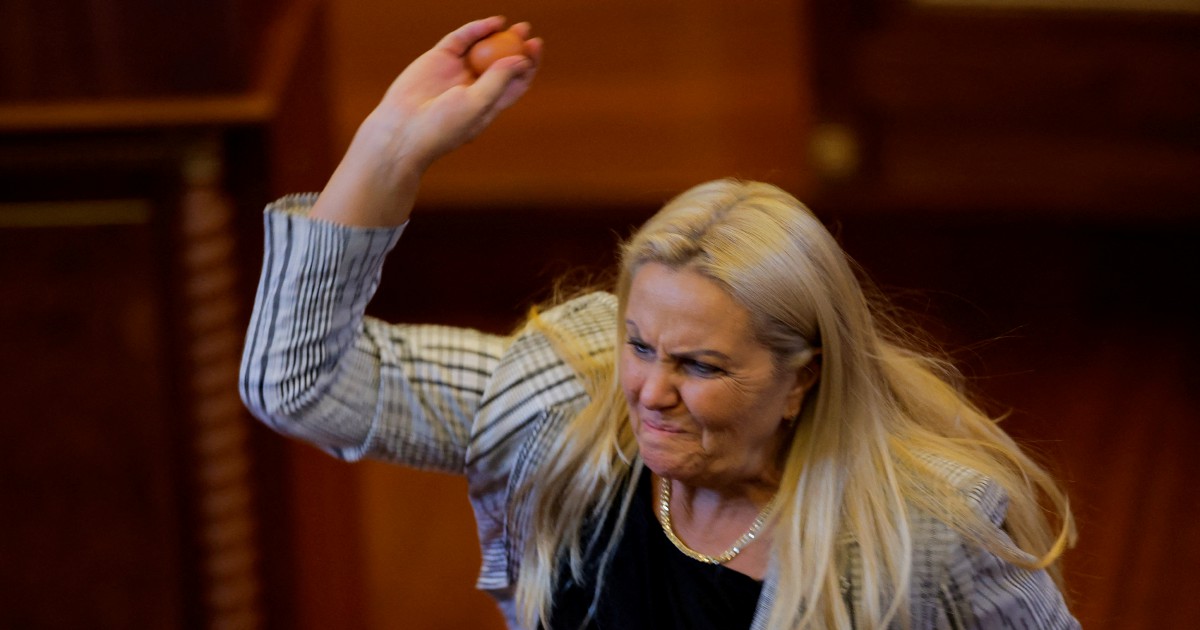
Kosovo's parliament was forced to halt proceedings on Saturday when an opposition deputy resorted to physical protest, hurling eggs at caretaker Prime Minister Albin Kurti in a dramatic moment that encapsulated the growing acrimony within the Balkan nation's fractious political establishment. The incident, captured during a heated parliamentary session in Pristina, represents a troubling descent into incivility and underscores how deeply fractured the country's political consensus has become after months of mounting tensions.
The egg-throwing incident itself serves as a visible manifestation of deeper institutional strains that have been building within Kosovo's government structure. What began as procedural disagreements has now evolved into open confrontation in the chamber itself, suggesting that established parliamentary norms—already fragile in this young democracy—are eroding rapidly. The suspension that followed was not merely a practical response to restore order; it reflected the parliament's inability to contain conflict through conventional debate, forcing lawmakers to acknowledge that the normal channels of political discourse had broken down entirely.
Albin Kurti, serving in a caretaker capacity, has found himself at the centre of a political maelstrom that extends far beyond individual parliamentary sessions. The opposition's willingness to resort to such provocative tactics indicates their frustration with what they perceive as an intractable governance situation. For countries observing from the region, including Malaysia and other Southeast Asian nations navigating their own coalition politics, Kosovo's dysfunction offers cautionary lessons about how quickly fragile power-sharing arrangements can deteriorate when trust erodes and compromise becomes impossible.
Underlying this latest parliamentary crisis is a prolonged standoff over fundamental governance questions that have remained unresolved for months. Kosovo's political factions have become increasingly polarized, unable to forge the agreements necessary for stable administration. Each side views the other with suspicion, making even routine legislative business contentious and opening the door to the kind of physical confrontation that occurred this weekend. This deterioration reflects not only personal rivalries between political leaders but also genuine disagreements about Kosovo's direction, particularly regarding relations with Serbia and the country's security outlook.
The threat of snap elections looms as a potential consequence if the political gridlock continues unchecked. While elections might seem like a logical democratic solution to break the impasse, they would likely inflict significant costs on Kosovo's already struggling economy and further delay urgent policy decisions. For a country still building state institutions and working toward greater regional stability, repeated electoral cycles represent a distraction from substantive governance challenges that demand sustained attention and resources.
The opposition's escalatory tactics reflect their limited leverage within parliament and their apparent belief that confrontational strategies might force concessions that reasoned argument has failed to achieve. However, such demonstrations of frustration risk delegitimizing parliament itself in the eyes of Kosovo's citizens, who may increasingly view their elected representatives as dysfunctional and unworthy of public trust. This erosion of institutional credibility carries consequences extending well beyond the current crisis, potentially weakening Kosovo's democratic foundations during a critical development period.
Regional observers have watched Kosovo's political trajectory with concern, particularly those invested in Balkan stability as a prerequisite for broader European security. The international community, including Western powers that have maintained significant strategic interests in Kosovo since the 1990s, faces the challenge of encouraging political compromise without appearing to dictate outcomes. This diplomatic balance becomes increasingly difficult as internal divisions harden and politicians prove unwilling to moderate their positions for the sake of stability.
The caretaker status of Kurti's government adds another layer of complexity to the crisis. Caretaker administrations typically lack the full mandate and legitimacy of elected governments, making them more vulnerable to opposition pressure and less capable of implementing controversial policies. This structural vulnerability can paradoxically encourage confrontation rather than cooperation, as opponents may calculate that they can hold out until elections produce a more favourable political configuration.
For Kosovo's business community and citizens dependent on stable governance for investment and economic activity, the continuing crisis represents lost opportunity and mounting uncertainty. Economic policy requires predictability and coherent decision-making, commodities in short supply during periods of intense political struggle. As parliamentary dysfunction persists, practical matters of budget allocation, regulatory reform, and development strategy remain frozen, creating cascading disadvantages that accumulate over time.
The international dimension of Kosovo's crisis cannot be overlooked. Unresolved tensions with Serbia, ongoing EU integration aspirations, and security considerations related to NATO presence all depend on Kosovo having a functioning government capable of representing national interests and delivering results. The current political stalemate undermines Kosovo's negotiating position on multiple fronts and potentially emboldened regional actors seeking to exploit instability.
Looking forward, Kosovo's political leaders face a choice between continuing toward escalation or seeking paths toward accommodation. The egg-throwing incident, while seemingly absurd, reflects genuine underlying grievances and strategic calculations about political survival. Resolving this crisis will require genuine compromise on substantive issues, not merely a return to procedural civility. Without such resolution, Kosovo risks tumbling into a cycle of electoral contests and governmental dysfunction that could endure for years, diverting resources and energy from the serious work of building a stable, prosperous state capable of serving its citizens and contributing positively to regional affairs.

