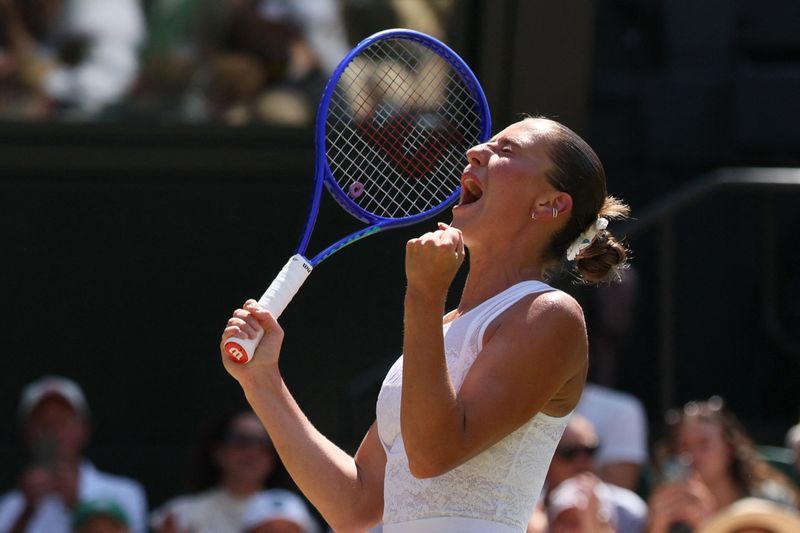
Marta Kostyuk's arrival at the Wimbledon semi-finals was announced with emphatic authority on Wednesday, as the Ukrainian 12th seed dismantled Italy's Jasmine Paolini in a quarter-final encounter that lasted just over an hour on Centre Court. Playing in sweltering conditions, Kostyuk delivered a commanding 6-3 6-2 victory that underlined her credentials as a serious contender for the title, despite having faced an opponent ranked slightly higher and harboring superior recent head-to-head records.
Kostyuk's intentions were evident from the opening moments, as she seized control with the aggression and precision that characterizes her playing style. She claimed the opening set in merely 36 minutes, an extraordinarily swift dispatch that left little room for Paolini to establish any rhythm or confidence. The Ukrainian broke serve twice—once to reach 3-2 and again to secure 5-3—before holding her own service game to close out the set. This wasn't merely a victory; it was a statement that suggested Kostyuk had come to London with clear objectives and the tactical clarity to execute them.
The significance of this performance extends beyond the scoreline. At 24 years old, Kostyuk was appearing in her first Wimbledon quarter-final and making her maiden appearance on Centre Court, the championship's most prestigious stage. For a player navigating the demanding schedule of professional tennis, particularly one representing a nation enduring prolonged conflict, such moments carry weight that transcends sport. Yet she played with the composure of a seasoned campaigner, refusing to be overawed by the occasion or the opponent.
Paolini, the Italian who reached the French Open final and the Australian Open final in recent years, entered the match as the 13th seed and held a slight advantage in their head-to-head record, having won their last two encounters. However, these credentials proved insufficient against Kostyuk's elevated performance. The Italian never truly threatened to break Kostyuk's serve in the second set, a troubling statistic that underscored her inability to generate pressure during the critical moments when matches are typically decided.
Kostyuk's powerful forehand was the defining weapon throughout, deployed with both accuracy and aggression to dictate play from the baseline. She showcased the kind of ball-striking that forces opponents into defensive postures, compelling them to construct points rather than dictate them. This aggressive approach paid dividends immediately in the second set, where Kostyuk broke for 3-1 and subsequently held serve to construct a commanding lead that proved impossible for Paolini to bridge.
The Centre Court crowd, despite their underdog sympathies toward Paolini, watched as Kostyuk methodically closed out the contest without deviation or sentiment. With Queen Camilla observing from the Royal Box, adding ceremonial gravitas to an already significant occasion, Kostyuk secured her place in the semi-finals after 69 minutes of play. The victory came on her second match point, delivered on Paolini's serve—a fitting conclusion to a performance where she consistently held the upper hand.
For Malaysian tennis enthusiasts and regional observers, this result carries particular relevance. Asian representation at Wimbledon has grown increasingly competitive, and while Kostyuk represents Eastern Europe, her journey reflects the broader globalization of elite tennis and the emergence of players from diverse backgrounds on the sport's biggest stages. Her advancement also provides a counterpoint to some of the tournament's traditional narratives, offering fresh storylines as the championship progresses toward its conclusion.
Kostyuk's path to the semi-finals represents a critical inflection point in her career trajectory. Success at Grand Slams, particularly against seeded opponents and in knockout stages, often signals a player's readiness for sustained competitiveness at tennis's highest level. This display, combining tactical discipline with technical excellence, suggests she possesses the ingredients necessary to progress even further, potentially challenging for titles on grass courts or other surfaces.
Looking ahead, Kostyuk's semi-final opponent will emerge from the remaining quarter-final clash, and the Ukrainian will carry substantial confidence into that encounter. Having demolished a player of Paolini's caliber with such clinical efficiency, she has effectively announced her presence among Wimbledon's serious contenders. The semi-final stage represents uncharted territory for her at this tournament, but her performance against Paolini suggests she arrives with the game and temperament to compete convincingly against whoever awaits.

