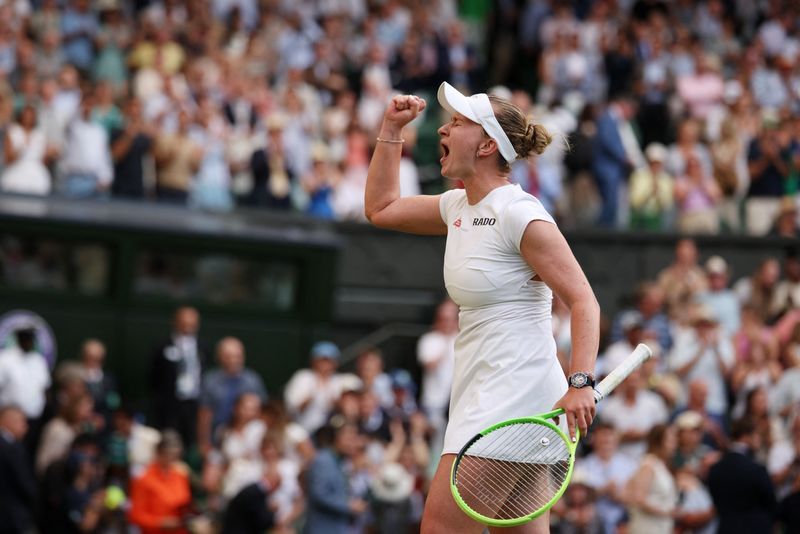
Barbora Krejcikova demonstrated the hallmarks of a seasoned champion on Wednesday when she rallied past fifth-seeded Mirra Andreeva to secure a third-round berth at Wimbledon, capturing a decisive 4-6 7-5 6-4 victory on Centre Court in London. The Czech star's comeback victory against the teenage Russian prodigy illustrated how veteran poise and tactical adjustments can overturn early setbacks in the sport's most demanding moments.
Krejcikova's path to this triumph revealed the complex dynamics at play in women's professional tennis. The Czech competitor opened aggressively, establishing a commanding 3-0 advantage in the opening set that suggested a straightforward passage through to the next round. However, her concentration wavered at precisely the moment when maintaining intensity proved most critical. Andreeva seized the opportunity presented by this lapse, capitalising on Krejcikova's dropping level to construct a comeback that culminated in claiming the first set 6-4 and putting psychological pressure on her opponent.
The encounter was particularly intriguing given the contrasting trajectories of both players entering Wimbledon. Krejcikova carries the credentials of multiple Grand Slam winner, her resume enriched by previous Wimbledon success in 2024 and a French Open title among her career achievements. Conversely, Andreeva, still only nineteen years old, had just announced herself to the tennis world weeks earlier by capturing her maiden major championship at Roland Garros, establishing herself as an emerging force capable of competing at the highest level.
This generational clash took on deeper significance as the match progressed into its critical phases. Rather than capitulating after losing the first set, Krejcikova regrouped and recalibrated her approach. The subsequent set became a test of both technical execution and mental fortitude, with the Czech player methodically elevating her performance to force the contest into a final deciding set. Her ability to shift momentum proved decisive in securing the second set at 7-5, demonstrating why experience matters when margins between victory and defeat become razor-thin.
The decider itself crystallised the tension characterising this particular encounter. Andreeva mounted a spirited resistance, particularly in the match's concluding moments when she managed to repel six separate match points. This feat underscored her growing maturity and refusal to accept defeat despite facing an opponent of considerable stature. Yet Krejcikova's composure ultimately prevailed, with the experienced campaigner finally breaking through to claim the set 6-4 and the overall victory.
Krejcikova's post-match reflections provided insight into how she approached this demanding assignment. In her comments, she acknowledged both the quality of her opponent and the demanding nature of their encounter, noting that this represented their fifth career meeting. The Czech player highlighted Andreeva's exceptional talent and potential, recognising that the Russian teenager possesses the full toolkit necessary for sustained success at professional tennis's pinnacle. Krejcikova's magnanimity in victory, coupled with her evident satisfaction at performing on Centre Court, suggested a player who remains deeply engaged with competing at Wimbledon's centre stage.
For Malaysian and Southeast Asian tennis enthusiasts, this match offered a compelling narrative about how professional athletes navigate pressure and adversity. Andreeva's emergence as a major champion at such a tender age carries implications for the sport's future hierarchy, while Krejcikova's successful comeback illustrated the enduring value of experience and tactical sophistication. The contrast between youth's fearless aggression and age's calculated wisdom provided a fascinating subplot to broader discussions about tennis's evolutionary trajectory.
Andreeva's reaction to her defeat, characterised by visible frustration and disappointment, reflected the emotional toll of coming so close to victory only to fall short in the final set. Her six saved match points represented extraordinary defensive capability, yet they ultimately proved insufficient against Krejcikova's relentless pursuit of victory. The Russian player faces the difficult prospect of recalibrating her approach following what represents a setback in her meteoric ascent through professional tennis.
Looking forward, Krejcikova will confront fellow Czech competitor Nikola Bartunkova in the third round, promising another matchup between players of shared nationality. This pairing adds another layer to Krejcikova's Wimbledon campaign, which continues to demonstrate that recent Grand Slam champions remain formidable opponents across all surfaces. The Czech champion's capacity to recover from adversity and execute under pressure validates her standing among the tournament's top contenders as the fortnight progresses deeper into its stages.

