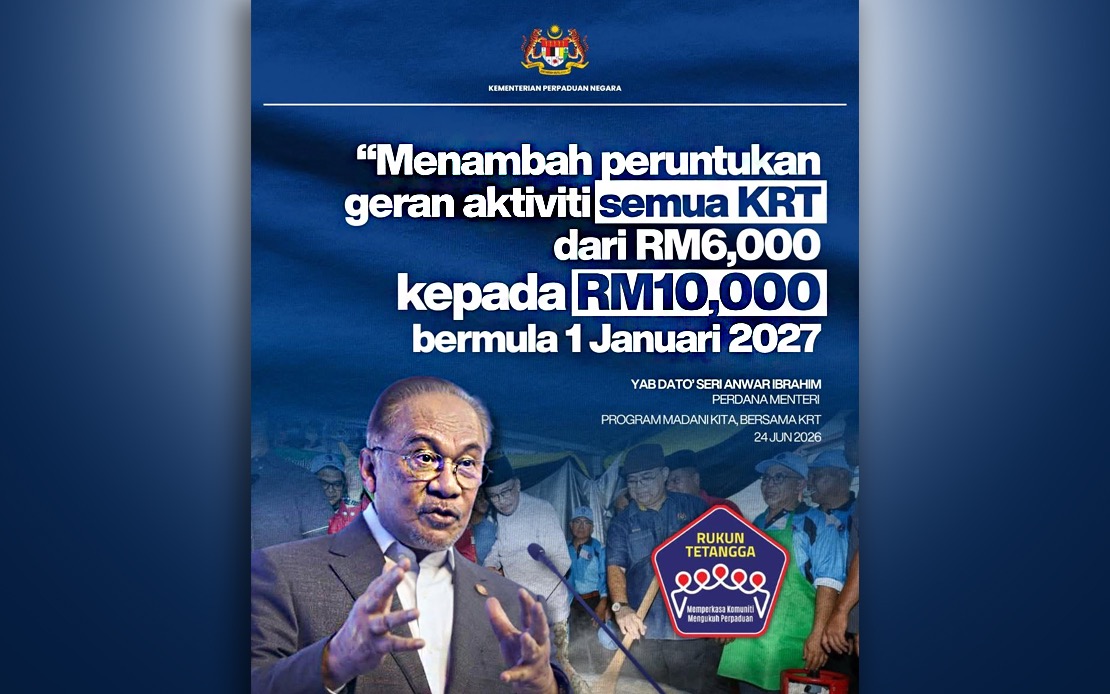
The Malaysian government has committed to substantially boosting support for neighbourhood watch organisations nationwide, with the annual grant per community group increasing to RM10,000 from the previous RM6,000 allocation. The decision affects all 8,615 registered KRT areas across the country and represents a tangible investment in grassroots community structures that have operated for more than fifty years. Prime Minister Datuk Seri Anwar Ibrahim unveiled the initiative during the MADANI KITA programme in Dataran Segamat, Johor, signalling the government's prioritisation of community-level interventions as part of its broader development agenda.
National Unity Minister Datuk Aaron Ago Dagang framed the funding increase as evidence of official recognition for the KRT's significance within Malaysia's social fabric. The grant enhancement specifically acknowledges the sector's historical contribution to fostering social cohesion, neighbourhood stability and collective well-being across diverse communities. According to Dagang, the decision aligns with the MADANI Government's wider philosophy of empowering grassroots institutions as essential components of national progress, rather than treating community engagement as peripheral to state objectives. This framing positions local neighbourhood associations as fundamental partners in achieving sustainable development outcomes.
The operational scope of KRT structures is considerably expansive when measured by membership and reach. The Ministry of National Unity oversees approximately 250,000 individual KRT members who collectively serve the interests of over 12 million Malaysians through regular engagement and programming. During the past year alone, these organisations coordinated more than 100,000 distinct community activities, demonstrating sustained capacity for mobilising residents around shared objectives. The scale of this network underscores why policymakers regard even modest per-group funding as having multiplied impact when aggregated across thousands of neighbourhood units.
The increased allocation is expected to enable KRT groups to expand and diversify their programming substantially. Designated priority areas for enhanced spending include unity-focused initiatives designed to strengthen inter-community relations, formal community development projects addressing local infrastructure and service gaps, targeted welfare support for vulnerable residents, educational programmes serving youth and families, neighbourhood security arrangements, volunteer recruitment and coordination, and micro-economic activities intended to generate local economic opportunities. This broad mandate reflects an understanding that neighbourhood associations function as multifaceted platforms addressing various dimensions of local well-being simultaneously.
Dagang emphasised that the funding increase should unlock greater capacity for implementing programmes with tangible public benefits at the grassroots level. Higher per-group allocations remove previous financial constraints that may have limited the ambition or frequency of community initiatives. By providing more discretionary resources to locally-elected leadership, the government enables KRT groups to respond more dynamically to neighbourhood priorities as identified by residents themselves rather than centralised directives. This devolved approach potentially improves programme relevance and community buy-in compared to top-down service delivery models.
The symbolic importance of neighbourhood relations within Malaysia's national unity framework received particular emphasis from the minister. He articulated that meaningful interpersonal connections among neighbours transcending ethnic, religious and cultural boundaries represent the authentic foundation of the nation's multi-communal identity and cohesion. Neighbourhood watch organisations are positioned as institutional mechanisms through which such everyday cosmopolitanism can be cultivated and sustained. Rather than treating unity as something imposed through national campaigns, this perspective locates it within daily neighbourhood interactions and the trust-building that occurs through collaborative community effort.
KRT has accumulated evidence of effectiveness in fulfilling this social bridging function across Malaysia's diverse urban and rural contexts. The organisations serve as platforms where residents encounter each other regularly, develop trust through shared problem-solving, and experience tangible solidarity when facing common challenges. Dagang contended that this demonstrated track record justifies increased public investment, as KRT provides proven institutional channels for translating government development objectives into community-rooted action that resonates with local contexts and priorities. The grant increase effectively represents confidence in these existing structures rather than an attempt to replace or substantially restructure them.
Implementation of the enhanced grant programme commences on January 1, 2027, providing KRT groups with a planning horizon to develop enhanced programming aligned with their newly expanded budgets. This staged rollout allows organisations time to prepare infrastructure and capacity improvements needed to absorb and effectively deploy additional resources. The timing also permits the Ministry of National Unity to establish monitoring frameworks ensuring funding translates into tangible community benefits rather than administrative accumulation. Staggered implementation reduces risks of sudden resource deployment without adequate planning or accountability mechanisms.
The ministry has signalled commitment to close oversight of how additional funding is deployed across the KRT ecosystem. Ensuring optimal utilisation of increased resources represents a stated priority, implying that evaluation mechanisms will be established to track programme outputs and outcomes. This commitment to stewardship reflects awareness that public funding decisions require corresponding accountability measures demonstrating value generated for communities. Effective monitoring also enables iterative refinement of funding mechanisms if certain KRT groups develop innovative approaches worthy of replication or scaling.
For Malaysia's regional position and development trajectory, the KRT initiative exemplifies an approach prioritising community-level stability and social integration as prerequisites for broader national progress. As Malaysia positions itself for advancement within increasingly competitive regional economic contexts, maintaining social cohesion and neighbourhood-level governance capacity represents strategic infrastructure investment rather than discretionary social spending. Well-resourced community organisations can address localised tensions before they escalate, coordinate emergency response efforts, facilitate knowledge-sharing about government programmes, and mobilise volunteer contributions reducing demands on state resources.
The grant increase also signals governmental recognition that national unity cannot be achieved through rhetorical campaigns alone but requires sustained investment in institutions where everyday Malaysians interact and build relationships. By enhancing resources available to KRT groups, the government acknowledges that neighbourhood-level social capital represents genuine competitive advantage for a multicultural democracy navigating contemporary social fragmentation pressures. This investment logic suggests that similar resource commitments to other grassroots institutions may follow as the government prioritises bottom-up approaches to national development objectives.