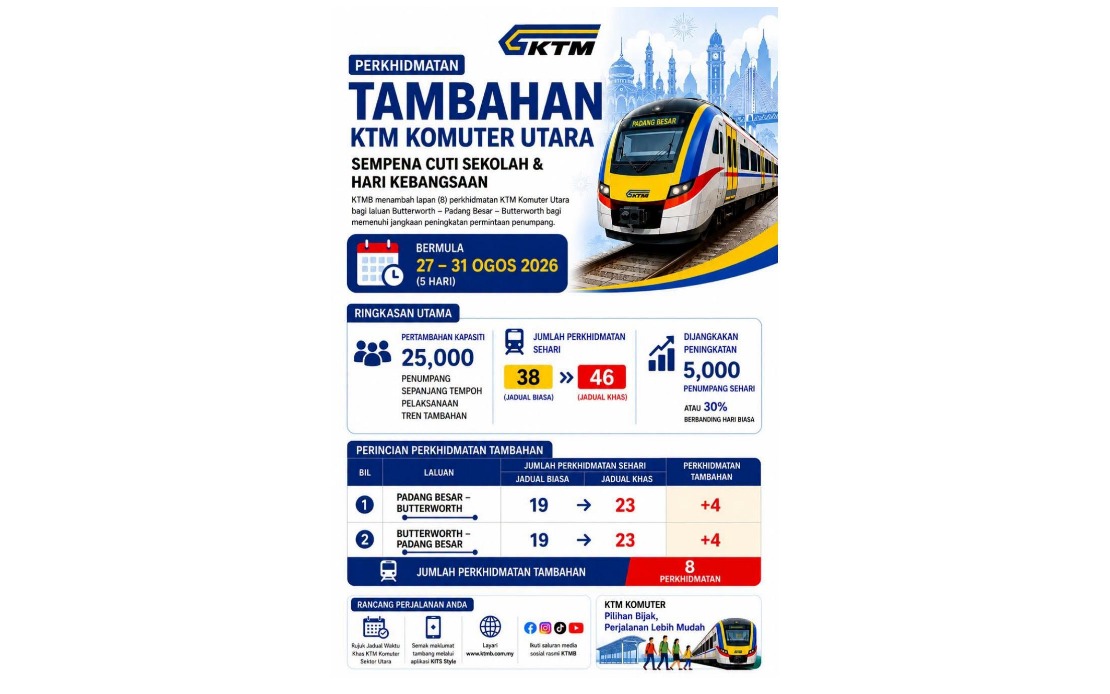
Keretapi Tanah Melayu Berhad has rolled out a temporary boost to rail capacity on its northern commuter line, introducing eight extra train services between Butterworth and Padang Besar to manage the predictable surge in passenger numbers during Malaysia's combined school holidays and National Day celebrations. The enhanced timetable takes effect from Thursday through the following Monday, spanning August 27 to 31, with the state-owned operator implementing what it terms the KTM Komuter Northern Sector Special Timetable to systematically address anticipated travel demand during this peak period.
The expansion represents a significant proportional increase in daily service frequency along this important corridor linking Penang, Kedah and Perlis. Under regular scheduling, the route operates 38 daily services across both directions combined, but the temporary arrangement swells that figure to 46 trains per day, a 21 per cent uplift that nonetheless falls short of the total passenger volume typically required during festive periods. This measured augmentation reflects careful balancing between deploying available rolling stock and maintaining operational efficiency across KTMB's broader network commitments during a season when multiple routes experience simultaneous demand spikes.
The carrier projects that introducing these supplementary services will translate into a 30 per cent increase in total passenger numbers compared to ordinary weekdays, a substantial jump that underscores how significantly holiday and national celebration periods alter travel patterns in Malaysia. The eight additional trains possess capacity to accommodate up to 5,000 extra passengers daily, which when aggregated across the five-day implementation window yields 25,000 additional passenger spaces. Such figures are crucial for understanding how Malaysia's state-owned transport operator approaches seasonal planning, using concrete mathematical projections rather than merely reacting to congestion after the fact.
Within this overall expansion, the bidirectional breakdown reveals deliberate symmetry. Four supplementary services are designated for the Padang Besar to Butterworth direction, increasing that leg from the standard 19 daily services to 23, whilst an identical four additional trains serve the return Butterworth to Padang Besar route, also raising it from 19 to 23 daily departures. This parity suggests that KTMB anticipates roughly balanced demand flows in both directions during the holiday window, likely reflecting families and holiday makers travelling northward toward Penang and the Malaysian-Thai border region, with corresponding return movements as vacation periods conclude. For commuters and leisure travellers in these northern states, such symmetrical scheduling enhances trip planning flexibility by ensuring comparable frequency regardless of travel direction.
The decision to implement supplementary services during this specific window reflects broader strategic thinking about Malaysia's seasonal transport dynamics. School holidays and National Day celebrations traditionally cluster during this period, creating a compound effect where educational institutions release students precisely when patriotic festivities encourage family visits and inter-state travel. Rather than treating these as separate demand events, KTMB has recognised them as a converging phenomenon requiring unified capacity response. The August 31 National Day particularly catalyses north-south population flows, with Malaysians across the peninsula travelling to celebrate, attend official ceremonies, or simply spend holiday time with distant relatives in less congested northern towns.
For residents of Penang, Kedah and Perlis, this temporary timetable expansion carries tangible implications for journey planning and accessibility during premium travel dates. Rather than facing the typical situation where peak-season school holidays generate overcrowded, infrequent services that frustrate leisure travellers and daily commuters alike, this region benefits from genuinely expanded frequency. The enhanced service frequency also translates into improved journey time options, allowing passengers to select departure slots that align with personal schedules rather than being compressed into fewer train windows. This flexibility particularly matters for families managing school-age children during holidays, where rigid timing constraints can hinder broader family activities.
From an operational perspective, KTMB's announcement reflects the reality that railway systems must actively manage seasonal fluctuations or risk reputational damage through overcrowding and service failures during culturally significant periods. Malaysian rail users increasingly expect improved service levels during recognisable peak periods, and state-owned operators face public scrutiny when capacity proves inadequate. The proactive deployment of eight additional services demonstrates KTMB's effort to meet rather than disappoint passenger expectations, positioning the organisation as responsive to legitimate seasonal demand patterns rather than indifferent to predictable congestion.
Information dissemination channels have also been carefully structured to ensure passenger awareness of the temporary timetable changes. KTMB directs users toward multiple access points—the KITS Style mobile application, the official corporate website, and official social media accounts—recognising that diverse demographic segments access travel information through different digital platforms. This multi-channel approach proves essential when conveying time-sensitive scheduling information to populations that may not regularly consult traditional announcements. Clear communication about special timetables reduces confusion and potential missed journeys, ultimately improving passenger satisfaction even beyond the supplementary capacity itself.
The implicit message within KTMB's announcement extends beyond mere operational adjustment. By demonstrating capacity to surge services during peak periods whilst maintaining broader network operations, the railway company signals organisational responsiveness to Malaysian travel patterns and national seasonal rhythms. This matters for policy discussions about public transport investment and modal choice, as it illustrates how existing rail infrastructure can be optimised through intelligent scheduling and strategic resource deployment. For Malaysian policymakers evaluating the returns on historical railway infrastructure investments, examples of successful seasonal optimisation provide evidence that intelligent management rather than merely capital expenditure drives public transport performance.
Looking beyond this specific five-day window, KTMB's seasonal service enhancement strategy raises longer-term questions about permanent capacity expansion on northern routes. If projections of 30 per cent increased usage during holiday periods prove accurate and consistent across multiple years, this empirical evidence might justify arguments for additional trains and infrastructure investment beyond temporary measures. The data generated from this implementation period could inform future capital budgeting decisions and determine whether Penang-Kedah-Perlis rail connectivity receives prioritisation in KTMB's medium-term expansion plans. Passengers and local governments in these states would find compelling such demonstration that temporary capacity increases successfully prevent congestion, as evidence supporting permanent service enhancements.

