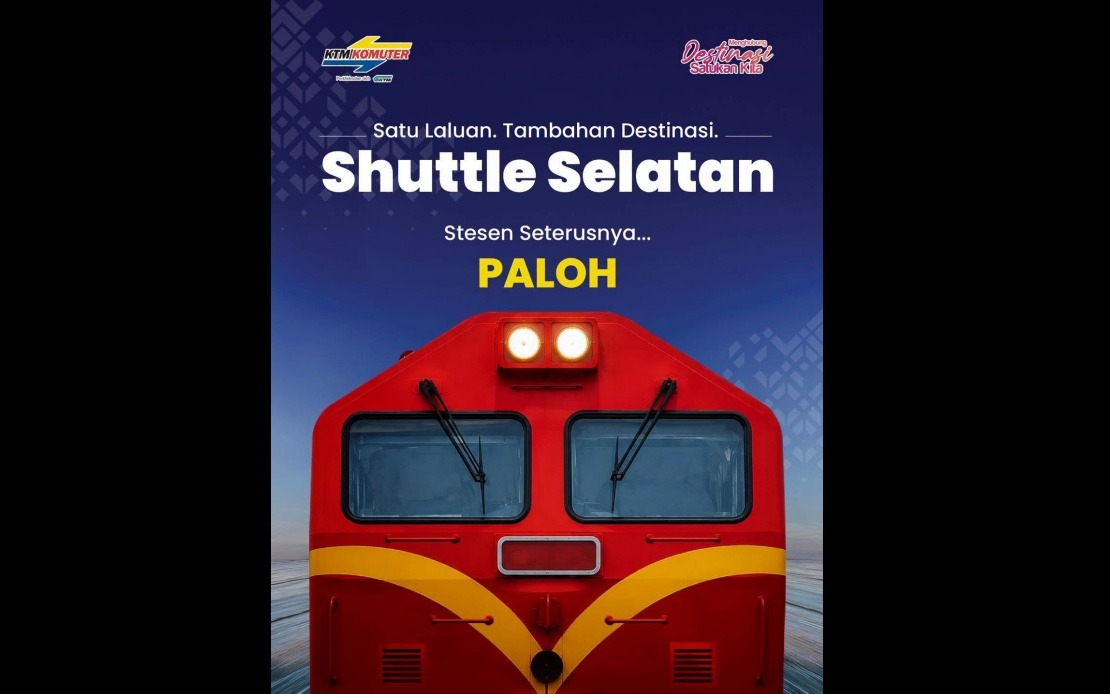
Malaysia's national railway operator Keretapi Tanah Melayu Berhad (KTMB) is rolling out an expanded version of its Southern Shuttle service beginning August 8, extending connectivity along the critical Paloh-Johor Bahru Sentral corridor. The initiative marks the second phase of expansion for the shuttle service, launched less than three months after its initial introduction, signalling strong confidence in the region's demand for modern rail connectivity. The service will now incorporate seven stations — Paloh, Kluang, Renggam, Layang-Layang, Kulai, Kempas Baru, and JB Sentral — providing commuters with a 120-minute transit time between the terminus points.
The Transport Ministry has positioned this extension as a strategic lever to enhance public mobility across Johor's densely populated suburban zones and link them to significant economic centres. By tapping into existing infrastructure from the Gemas-Johor Bahru Electrified Double-Track Project (PLBEGJB), KTMB has minimised additional capital expenditure while maximising the utility of completed rail assets. This approach underscores a broader government objective: reducing vehicular congestion and air pollution by shifting commuters from road networks to rail, a recurring challenge in Malaysia's rapidly urbanising corridor areas.
The operational structure reflects careful attention to commuter patterns, particularly those working across state lines. KTMB will deploy ten trains daily, split evenly between Paloh-to-JB Sentral and return journeys, with each unit holding 400 passengers. The earliest departure from Paloh at 3.55 am—arriving at JB Sentral at 5.52 am—addresses the needs of workers bound for Singapore via the Johor Bahru border checkpoint, a substantial cross-border commuting demographic often overlooked in transport planning. Similarly, the final evening service from JB Sentral at 8.30 pm reaches Paloh at 10.27 pm, accommodating those returning from the financial and commercial hub after business hours.
Promotional pricing has emerged as a key driver of adoption. KTMB has reduced the full Paloh-JB Sentral single fare from RM15.30 to RM7.70, effectively cutting the cost in half during an introductory period that extends until new electric train sets arrive. This aggressive pricing strategy aims to build ridership volume and establish the service as the preferred commute option before normalising tariffs. The move demonstrates KTMB's recognition that price sensitivity remains substantial among Malaysia's commuting workforce, particularly among daily travellers from peripheral towns to urban employment centres.
Integration with the broader regional rail network strengthens the service's value proposition considerably. At Kempas Baru Station, passengers gain transfer capability to the Kempas Baru-Pasir Gudang-Kempas Baru route, effectively creating a hub that connects the Paloh-Kluang-Kulai-Johor Bahru corridor with the Pasir Gudang industrial zone. This connectivity is particularly significant for workers in petrochemical, manufacturing, and logistics sectors concentrated in the Pasir Gudang area, allowing them to access employment from towns previously dependent on lengthy private vehicle journeys. The hub approach mirrors best practices in integrated regional transport networks, enhancing system-wide utility.
Concessions for vulnerable and student populations form an important equity component of KTMB's expansion strategy. The MyRailLife Pass, extended to cover Southern Shuttle services from August 8 through December 31, provides free travel for children aged four to six, primary and secondary students from Year One to Form Six, and persons with disabilities (PwDs), subject to applicable terms and conditions. Such provisions recognise that affordable transport access directly correlates with educational attendance, economic opportunity, and social inclusion—particularly in regions where family income constraints might otherwise restrict mobility.
The initial phase of Southern Shuttle operations provides encouraging baseline metrics for projecting the extended service's uptake. Since launch, the service recorded 3,209 passengers across its two original routes, suggesting organic demand exists among target demographics. While modest in absolute terms, this figure represents validated interest in a transport mode that competes against established automobile commuting patterns and intercity bus services. The expansion to Paloh, a town of approximately 25,000 residents with limited economic alternatives, likely represents a significant departure opportunity for the service.
Broader economic rationales underpin this infrastructure investment. The Transport Ministry and KTMB explicitly cite support for workforce mobility, commercial activity acceleration, and development of the Johor-Singapore Special Economic Zone (JS-SEZ) as policy objectives. The JS-SEZ, a bilateral initiative aimed at deepening cross-border economic integration, depends substantially on seamless human and goods movement between Malaysian and Singaporean territories. Efficient rail connectivity reduces transaction costs for businesses operating within or servicing the zone, potentially attracting manufacturing relocation and supporting regional competitiveness against alternative Southeast Asian locations.
The sustainability argument—reducing private vehicle dependency and associated environmental costs—has assumed greater prominence in Malaysian transport discourse, particularly following urban air quality challenges in the Klang Valley and other metropolitan zones. By offering a reliable, cost-competitive rail alternative, KTMB directly addresses a documented market failure where private vehicle use remains the default despite negative externalities. However, success depends on service reliability, frequency adequacy, and schedule consistency—operational dimensions where Malaysian public transport has historically faced credibility challenges. Consumer perception often lags actual performance improvements, requiring sustained communication and service excellence to convert promotional riders into committed patrons.
The phased approach to deployment—launching initially with two routes in May 2024, then expanding to seven stations by August—suggests KTMB is testing operational readiness before full-scale rollout. This iterative methodology allows identification and resolution of scheduling inefficiencies, maintenance requirements, and staffing challenges on smaller scales before scaling. Given Malaysian infrastructure projects' historical susceptibility to delays and technical complications, this cautious expansion likely reflects lessons learned from past rail service launches.
Regional implications extend beyond Johor's borders. The Southern Shuttle represents a model for addressing last-mile connectivity and suburban rail provision in other Malaysian states contemplating rapid urbanisation. Perak, Selangor's periphery, and parts of Pahang face similar mobility pressures, and KTMB's Johor pilot may offer replicable lessons regarding subsidy requirements, operational efficiency, and demand stimulation techniques. If the expansion demonstrates financial sustainability or acceptable subsidy ratios, similar services could emerge elsewhere, gradually building a regionally integrated rail network that contrasts with Malaysia's current fragmentation across multiple operators.
Looking forward, the service's trajectory hinges on whether KTMB successfully transitions from promotional pricing to sustainable tariff structures once new electric trains enter service. Consumer behaviour literature suggests that price increases, even modest ones, generate significant ridership resistance when alternative transport remains available. KTMB must therefore emphasise reliability, comfort, and time savings alongside cost advantages to retain riders through the critical pricing transition phase. The August 8 launch represents not merely an extension, but a crucial test of whether Malaysia can construct modern commuter rail networks capable of competing with private vehicle convenience and meeting sustainable transport aspirations.

