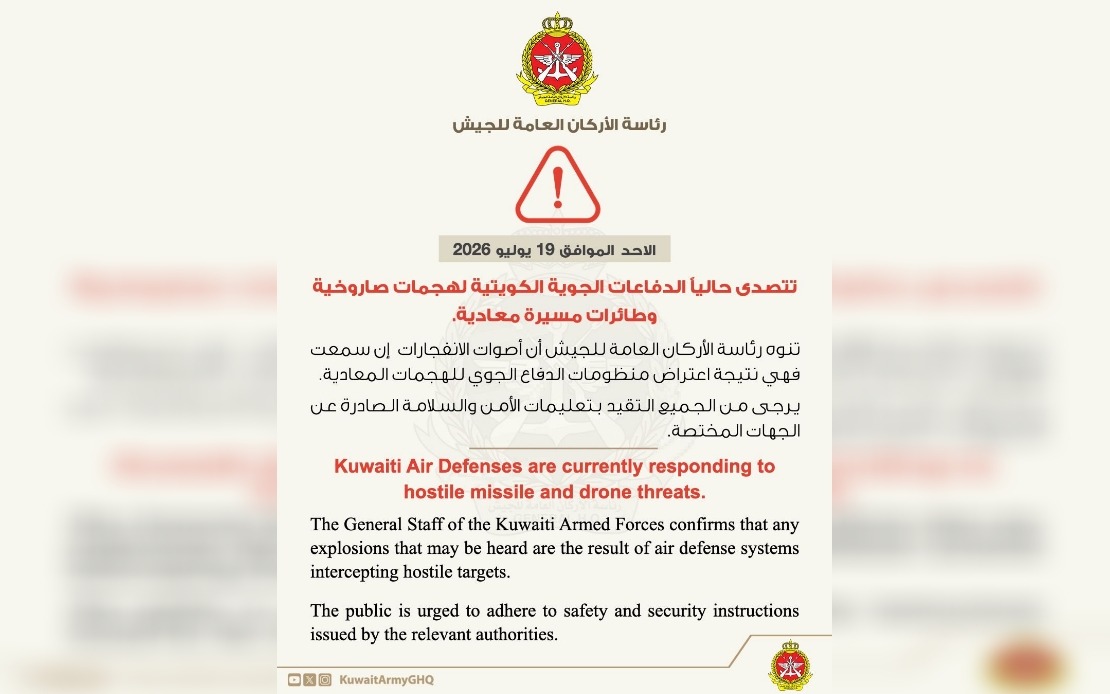
Kuwait's military establishment confirmed on Sunday that defensive operations were underway to counter incoming hostile aerial threats, marking a significant escalation in regional tensions that now directly affects civilian populations in the Gulf state. The Kuwaiti armed forces disclosed through social media that explosions audible to residents resulted from active interception efforts by their air defence infrastructure, while simultaneously instructing the public to remain vigilant and comply with security protocols issued by government authorities. This move brings the simmering conflict between Washington and Tehran to a fresh crescendo, with Kuwait caught in the crossfire as a key strategic location hosting substantial American military infrastructure.
The immediate backdrop to Kuwait's defensive measures stems from a week-long cycle of retaliatory strikes between the United States and Iran. American forces have conducted successive bombing campaigns targeting locations within Iranian territory, while Tehran has responded by launching attacks against what it characterizes as American military installations and allied facilities scattered across several regional nations. Kuwait figures prominently in this geostrategic equation, serving as a staging ground for substantial United States military operations throughout the broader Middle East, making it an obvious target for Iranian retaliation and consequently a flashpoint for escalating tensions.
The deterioration in security conditions underscores the fragility of diplomatic efforts undertaken just months earlier. In June, Pakistani officials facilitated negotiations that produced a memorandum of understanding between Washington and Tehran, ostensibly designed to establish a framework for de-escalation and achieving a comprehensive peace settlement. Yet despite this agreement, both sides have continued their military posturing and retaliatory operations, suggesting either fundamental disagreements persist over implementation or one or both parties view the accord as sufficiently ambiguous to permit continued military action. The breakdown of this nascent diplomatic architecture raises troubling questions about the trajectory of Gulf security in the coming months.
For Malaysia and broader Southeast Asian observers, the escalating Iran-US confrontation carries significant implications. Malaysia maintains diplomatic and economic ties with both nations, and any widening conflict threatens regional shipping lanes through which substantial Malaysian trade flows. The Strait of Hormuz, through which approximately one-third of seaborne petroleum passes globally, faces potential disruption if hostilities expand beyond targeted strikes into more systematic naval or commercial interference. Malaysian energy security, heavily dependent on Middle Eastern oil supplies, faces indirect pressure from such uncertainties.
The involvement of Kuwait as a direct target zone demonstrates how regional conflicts have metastasized beyond bilateral disputes into proxy confrontations affecting multiple nations. Kuwait's position as a wealthy Gulf Cooperation Council member with strong American security ties makes it vulnerable to Iranian strategic calculations, while its geographic proximity to Iraq and Iran ensures it remains unavoidably enmeshed in broader regional power competitions. The civilian population's exposure to air defence operations underscores how modern interstate competition increasingly imposes costs on non-combatant populations.
The pattern of American strikes followed by Iranian retaliation creates a dangerous dynamic whereby each side justifies subsequent escalation as defensive rather than aggressive. This rhetorical framing complicates international diplomatic interventions, as both Washington and Tehran present their actions as responsive measures rather than initiating provocations. Pakistan's role in June's memorandum suggests that regional powers retain interest in conflict management, yet the manifest failure of that agreement to curb military operations raises questions about enforcement mechanisms and whether fundamental interests of both parties actually align toward genuine settlement.
Kuwait's security situation also reflects vulnerabilities common among smaller regional states lacking the military capacity to withstand sustained great-power confrontation. While the country possesses modern air defence systems, their effectiveness against coordinated attacks from a technologically sophisticated adversary like Iran remains uncertain. Kuwait's reliance on external security guarantees, principally from the United States, creates dependencies that themselves become sources of danger when those guarantor nations engage in serious conflicts with other regional actors.
The broader implications extend beyond immediate military considerations into economic and financial realms. Global oil markets react nervously to any disruption in the Gulf, and sustained military operations risk triggering energy price spikes that reverberate throughout developing Asian economies including Malaysia. Insurance and shipping costs for vessels transiting regional waters increase during periods of elevated hostilities, ultimately raising consumer prices for imported goods throughout the region. Southeast Asian importers of Gulf energy face particularly acute exposure to these secondary effects of Iran-US tensions.
Diplomatically, the escalation poses challenges for nations attempting to maintain balanced relationships with both Washington and Tehran. Malaysia's historical non-alignment preferences complicate clear positioning, yet the physical reality of intensifying military operations forces all regional actors toward implicit alignment with either side. The potential for accidental escalation increases dramatically during sustained military operations, as evidenced by previous incidents where miscalculation nearly triggered broader conflicts. International mechanisms for preventing such accidents remain underdeveloped despite decades of diplomatic practice.
Looking forward, Kuwait's mobilization of air defences signals that regional actors have abandoned hope for rapid diplomatic resolution and are preparing for sustained confrontation. The failure of Pakistan's June memorandum suggests that addressing underlying strategic grievances between Washington and Tehran requires deeper structural accommodations than currently on the table. Until those fundamental issues receive serious negotiation, peripheral states like Kuwait will continue absorbing the costs of great-power competition through disrupted security, damaged infrastructure, and civilian anxiety about their country's viability as a safe place to live and work.

