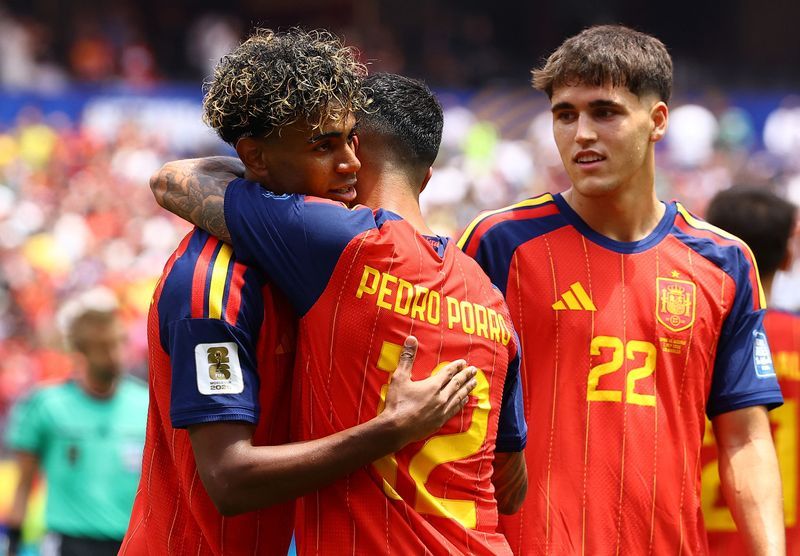
Spain's dominant 3-0 triumph against Austria marks a pivotal moment in their tournament, one that illustrates how a single player operating at peak fitness can fundamentally alter a team's trajectory. For an institution accustomed to celebrating the collective over the individual, the emergence of 18-year-old Lamine Yamal presents an intriguing paradox—his personal brilliance has become inseparable from Spain's team philosophy, making individual excellence feel like an expression of their established principles rather than a departure from them.
When Spain arrived at the competition, Yamal carried a nagging hamstring injury that forced him onto the bench during their opening fixture. That match against Cape Verde exposed the vulnerability of a side without their key creative spark. Playing with Gavi and Ferran Torres deployed across the wings, Spain generated little fluency in their passing exchanges and lacked the penetrative quality that defined their European Championship victory just months earlier. The goalless stalemate proved emblematic of a team searching for rhythm and purpose under manager Luis de la Fuente's guidance.
The contrast between that flat performance and the Austria display reveals how substantially Yamal's availability reshapes Spain's tactical options. As he has gathered consecutive minutes and rebuilt his match fitness, Spain's entire system has clicked into place with remarkable synchronicity. The fundamental infrastructure—the midfield dominance and possession-based approach that serves as their foundation—remains unchanged, yet it now operates with a new dimension of incisiveness provided by a teenager whose speed and technical security repeatedly destabilize opposing defenses.
Yamal's pathway from Barcelona's La Masia academy to international prominence speaks to his exceptional maturity. Since emerging at merely sixteen years old, he has demonstrated an unusual capacity to make structured, systematic football feel fluid and unpredictable. His contributions to Spain's European Championship triumph in Germany were substantial, coming at an age when most players are still completing their development away from elite stages. In that tournament, Spain's complete record—winning every match while setting scoring records—showcased how seamlessly Yamal integrated into their system.
However, the North American phase of this competition initially appeared less straightforward. Beyond Yamal's fitness concerns, Spain faced complications with Nico Williams, whose speed on the opposite flank had functioned as a crucial balancing element in their attacking structure. When both players operated below their optimal conditions simultaneously, the team struggled to generate sufficient width and penetration. The introduction of Alex Baena as a solution on the left flank, paired with Yamal's growing involvement on the right, has gradually restored the balance Spain requires.
Against Austria, Spain's tactical setup exploited their widemen to maximum effect. Baena operated as a constant irritant to Austria's defensive organization, stretching their lines and creating secondary attacking pathways that complemented Spain's primary approach through the center. Meanwhile, Yamal functioned like a magnet pulling opposing defenders toward him, creating passing lanes and spatial advantages for his teammates. Spain constructed sequences where they deliberately isolated Yamal in wide positions, trusting his one-on-one capabilities to generate attacking momentum.
Yet the most revealing aspect of Spain's performance involved how Yamal's positioning evolved throughout matches. When drifting inward from the wing, he created congestion that actually benefited Spain's midfield orchestrators. This inward movement allowed Rodri and Pedri—Spain's controlling midfield forces—to operate with greater influence and tempo, restoring the possession-based rhythm for which Spain have become renowned across multiple generations of players.
The defensive solidity Spain demonstrated against Austria provided equally compelling evidence of their tournament-stage potential. Austria managed zero shots on target throughout the match, an achievement unmatched in World Cup knockout football since Germany similarly suffocated Argentina in the 2014 final. Beyond this performance, Spain have not conceded any goal since their defeat by Japan in 2022, maintaining an unbeaten sequence spanning thirty-four consecutive matches. Such defensive consistency, combined with their rekindled attacking potency, suggests they are assembling the ingredients required for deep tournament runs.
What elevated Yamal's contribution against Austria beyond mere statistical categories was his designation as player of the match despite neither scoring nor providing an assist. This recognition underscores how Spain's system has evolved to extract value from players in ways traditional attacking statistics cannot measure. Rather than relying exclusively on their leading attackers to generate goals, Spain instead leverage Yamal's presence to restructure opposing defenses, attract pressure, and create conditions where supporting players flourish. Mikel Oyarzabal and the fullback pairing of Marc Cucurella and Pedro Porro exemplified how effectively Spain's teammates capitalized on the opportunities Yamal's involvement generated.
For the wider Southeast Asian context, Spain's revitalization offers instructive lessons regarding tournament football philosophy. The capacity to maintain systematic, possession-dominant principles while simultaneously accommodating individual brilliance remains a defining characteristic of elite teams. Young talents like Yamal succeed not by abandoning collective structures but by operating within them so effectively that personal excellence amplifies group coherence rather than destabilizing it.
Spain's early tournament doubts have substantially diminished as Yamal has regained his physical and technical sharpness. The performance against Austria suggests that European champions from the summer campaign are now operating across multiple tactical registers simultaneously. Should this upward trajectory continue, Spain's combination of midfield control, defensive discipline, and now-unleashed attacking fluidity positions them as increasingly formidable opposition for any remaining competitors. The awkwardness that momentarily emerged when individual brilliance appeared at odds with collective philosophy has resolved into something more powerful—confirmation that both elements can coexist and amplify one another under proper conditions.

