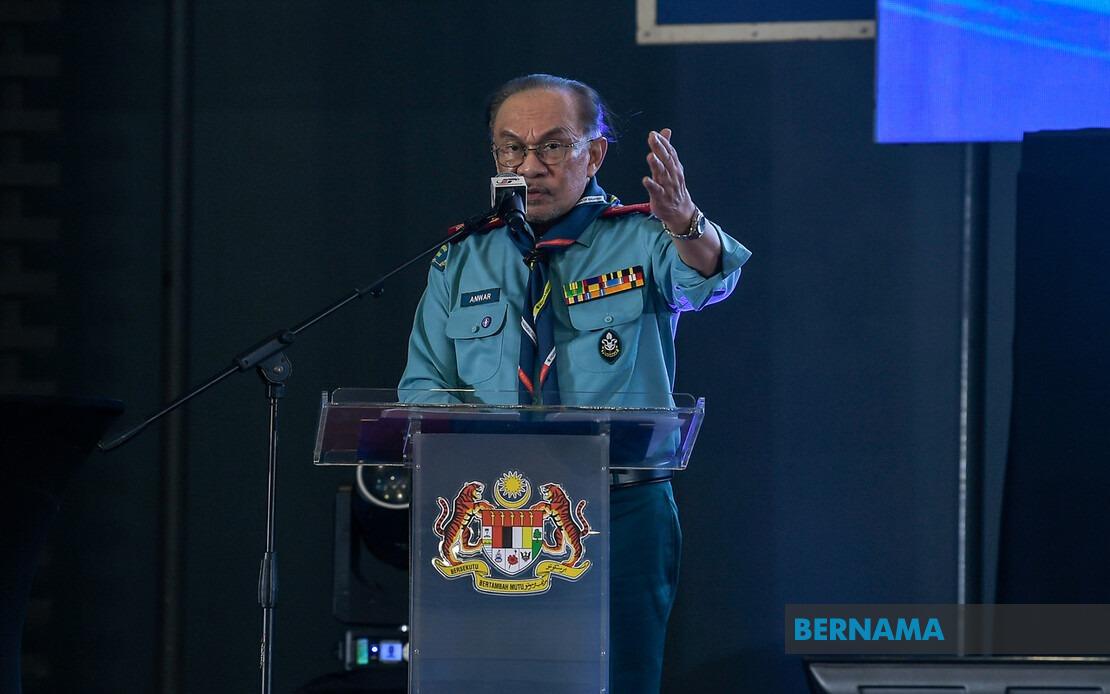
Prime Minister Datuk Seri Anwar Ibrahim has moved to reframe the national conversation around language policy, insisting that efforts to strengthen Malay should be understood as distinct from any attempt to weaken multilingual capabilities across the population. Speaking at the Ambang Merdeka Sahabat MADANI 2026 programme held at Universiti Teknologi MARA (UiTM) Permatang Pauh on August 29, Anwar articulated a vision of linguistic pluralism that positions Malaysia's official language as foundational while remaining open to the practical value of regional and global tongues.
The Prime Minister's remarks appear designed to address concerns that have periodically surfaced in Malaysian public discourse regarding tensions between language preservation and international competitiveness. By characterising the challenge as fundamentally non-competitive, Anwar suggested that citizens need not sacrifice proficiency in Malay to gain advantage in English, Mandarin, or Tamil. This framing carries particular significance for a nation where debates over language medium in education and public administration have occasionally become flashpoints for deeper anxieties about cultural identity and economic positioning.
Anwar emphasised that all Malaysians, irrespective of ethnic origin, should achieve strong command of the national language. This framing treats Malay competency as a unifying civic requirement rather than a marker of ethnic preference, a distinction that allows him to argue for universal language standards without appearing to advance majoritarian cultural dominance. The approach acknowledges Malaysia's constitutional commitment to Malay while implicitly rejecting the notion that such commitment must come at the expense of other linguistic communities' interests.
The Prime Minister specifically highlighted English as a language that has transcended regional boundaries to become essential for global economic participation. Rather than positioning English as threatening to Malay, he proposed that educational and governmental systems should view the two languages as complementary, with English serving to expand opportunities rather than to displace the national language. This perspective reflects growing recognition across Southeast Asia that monolingualism may constrain rather than protect national development prospects.
Mandarin received particular attention in Anwar's remarks, reflecting Malaysia's awareness of China's economic prominence and the linguistic implications of regional trade patterns. The Prime Minister acknowledged that Mandarin proficiency has become increasingly valuable within Southeast Asian commerce and investment contexts. By framing Mandarin competency as economically rational rather than culturally threatening, Anwar sought to position linguistic diversity as a strategic asset for Malaysian workers and entrepreneurs navigating regional markets.
Tamil occupied a distinct category in his discussion, reflecting Malaysia's Tamil-speaking minority and their historical linguistic heritage. Anwar's mention of Malaysians' interest in improving Tamil proficiency acknowledged the language's significance within specific communities while suggesting that such development could occur alongside broader linguistic competencies. This inclusive framing extended his core argument: that language acquisition operates along multiple simultaneous tracks rather than forcing citizens into binary choices.
The Prime Minister explicitly rejected the concept of language development as a zero-sum proposition, using economic language to frame linguistic competency as an investment in individual and national potential. This rhetorical choice grounds the discussion in pragmatism rather than cultural nationalism, appealing to parents and students concerned with career prospects and regional mobility. For Malaysian families, particularly those in middle-income brackets, the argument that multilingualism creates rather than diminishes opportunity addresses genuine concerns about their children's competitiveness in regional labour markets.
Beyond linguistic policy proper, Anwar's address touched on the deeper challenge of maintaining national cohesion across Malaysia's diverse population. He cautioned against allowing divisive rhetoric to undermine the conditions necessary for continued harmony, warning that social stability cannot be assumed to persist without deliberate protective efforts. This connection between language policy and communal relations reflects an understanding that debates over linguistic supremacy frequently serve as proxies for broader concerns about resource distribution, representation, and cultural recognition.
The Prime Minister called for cultivation of shared values emphasising mutual support and concern across racial boundaries, framing inclusion as requiring active maintenance rather than emerging naturally from demographic diversity. His emphasis on ensuring all citizens benefit from national development regardless of background situated language policy within a broader equity agenda. This positioning suggests that decisions about which languages receive institutional support carry implications for which communities experience themselves as fully integrated into the national project.
Anwar's remarks at UiTM Permatang Pauh represent an attempt to depoliticise language questions by reframing them through an economic-opportunity lens rather than a cultural-preservation framework. For Malaysian policymakers, such framing may offer a path toward language decisions that satisfy constitutional requirements while accommodating legitimate multilingual aspirations. The approach tacitly acknowledges that in an interconnected region where talent and capital flow across borders, language policy increasingly intersects with questions of economic resilience and regional standing.
The practical implications of this perspective extend to educational institutions across Malaysia, particularly universities and technical colleges that shape graduate competencies. If linguistic pluralism becomes embedded as official policy rationale rather than viewed as potential threat to national cohesion, curriculum decisions about language instruction may shift toward additive rather than substitutive models. For students from all backgrounds, such an approach theoretically expands rather than constrains their communicative repertoires and professional options.

