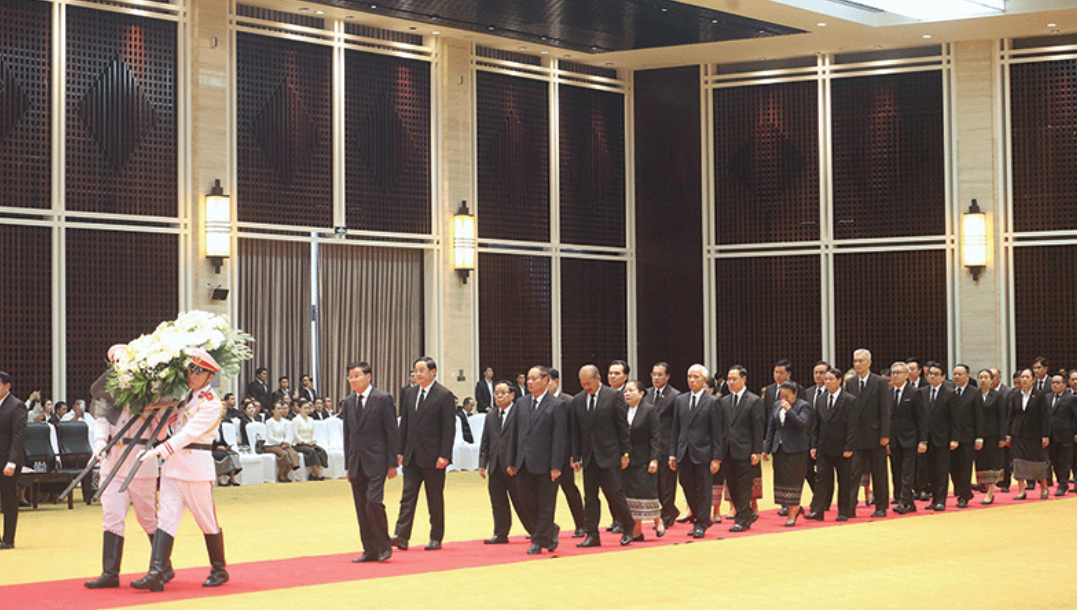
Senior Lao political figures led by Party Secretary General and President Thongloun Sisoulith assembled at the National Convention Hall on Sunday to pay their last respects to National Assembly President Xaysomphone Phomvihane, who died on Saturday. The solemn ceremony marked the beginning of a series of tributes to one of Laos's most prominent institutional leaders, drawing top party officials, government ministers, members of the National Assembly, and representatives from across the country's political and business sectors. The gathering underscored the scale of Xaysomphone's influence within Lao governance and his standing as a central figure in the nation's political establishment.
Xaysomphone's death represents a significant loss for Laos at an institutional level. As a member of the Politburo of the Lao People's Revolutionary Party Central Committee and President of the National Assembly, he occupied one of the state's highest positions. Throughout a career spanning decades, he worked to strengthen the legislative body's capacity and contributed substantially to discussions on national defence, economic development, and the country's political trajectory. His role placed him at the intersection of party ideology and state governance, making him instrumental in how Laos navigated policy decisions affecting both the nation's trajectory and its relationship with the international community.
The formal wreath-laying ceremony proceeded in a carefully ordered sequence that reflected the hierarchy of Lao power structures. Party Secretary General and President Thongloun Sisoulith led the initial delegation from the Central Committee of the Lao People's Revolutionary Party, setting the tone for subsequent tributes. This was followed by delegations representing the Sisoulith family, the Standing Committee of the National Assembly led by Vice President Sounthone Xayachack, and the Government delegation headed by Prime Minister Dr Sonexay Siphandone. The deliberate choreography of these presentations conveyed not only respect for the deceased but also reinforced the interconnected nature of Lao political leadership, where family ties and institutional positions often overlap.
The ceremony reflected Laos's closest regional relationship through prominent Vietnamese participation. A delegation from the National Assembly of Vietnam, led by Politburo member and National Assembly Chairman Tran Thanh Man, attended to lay wreaths in Xaysomphone's honour. This was accompanied by representatives from Vietnam's Ministry of Public Security and Ministry of National Defence, signalling the depth of the bilateral relationship and the respect afforded to senior Lao figures within Vietnam's political circles. The Vietnamese government subsequently declared two days of national mourning on August 10 and 11, an unusual gesture that underscored the significance both countries attached to Xaysomphone's passing and the strength of Laos-Vietnam ties.
The scale of domestic recognition extended across Laos's entire institutional framework. Delegations from the Lao Front for National Development, the Ministry of Justice, the Commission for Information and Education, the Prime Minister's Office, line ministries, and various government agencies all sent representatives to pay respects. Business community leaders also participated, indicating that Xaysomphone's influence extended beyond purely political circles into economic governance. This broad representation suggested that his role touched multiple aspects of Lao state function and that his loss was felt across different sectors of the establishment.
Foreign diplomats stationed in Vientiane attended the National Convention Hall to express condolences, adding an international dimension to the tributes. This diplomatic turnout reflected both professional courtesy and genuine recognition of Xaysomphone's significance in Laos's external relations. The presence of foreign representatives underscored how senior Lao officials serve as key interlocutors for international engagement and how transitions in their leadership can affect bilateral relationships and regional dynamics in Southeast Asia.
The state's official response highlighted the magnitude of the loss. Laos declared five days of national mourning from August 8 to 12, with wreath-laying ceremonies at the National Convention Hall continuing through August 11. This extended period allowed not only party and state officials but also organisations and members of the general public to pay respects. The decision to extend the mourning period and maintain the ceremony venue underscored the inclusive nature of the tributes and the importance placed on allowing broad sectors of society to participate in honouring the deceased leader.
Xaysomphone's family background connected him directly to Laos's revolutionary history. Born on December 12, 1956, he was the son of President Kaysone Phomvihane, one of the founding figures of the Lao People's Revolutionary Party and the architect of modern Laos. Having five brothers, including current Deputy Prime Minister and Minister of Finance Santiphab Phomvihane, placed Xaysomphone within a family network that remained deeply embedded in the country's highest institutions. This familial connection to the revolutionary generation gave him both historical weight and access to the inner circles of power, shaping his career trajectory and institutional influence throughout his life.
The ceremonial cremation scheduled for August 12 at the That Luang esplanade, to be conducted with full honours and commencing at 1 p.m., represented the final formal recognition of Xaysomphone's service. That Luang is Laos's most sacred Buddhist site, and conducting a state funeral there demonstrated the highest level of official recognition. The timing and location were deliberate choices that connected Xaysomphone's legacy to both the spiritual and national identity of Laos, ensuring his passing would be remembered as a moment of significance in the nation's history.
Xaysomphone's departure leaves a vacancy in one of the National Assembly's most senior and influential positions. The Legislative body, which he helped strengthen and guide, now faces the task of identifying his successor and adapting to his absence. For Malaysia and other Southeast Asian nations, the succession process in a neighbouring state's key institution warrants attention. Leadership transitions in regional governments can signal shifts in policy orientation, particularly regarding economic partnerships, trade relationships, and broader regional alignment. The manner in which Laos manages this transition and selects Xaysomphone's replacement may offer insights into the stability and future direction of one of ASEAN's member states.

