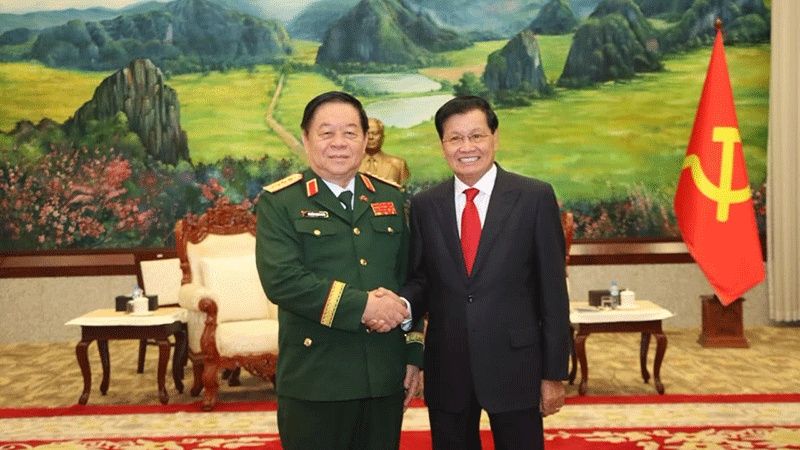
President Thongloun Sisoulith of Laos has praised the productive outcomes of military discussions between his country and Vietnam, following an official visit by General Nguyen Trong Nghia, Chairman of the General Department of Politics of the Vietnam People's Army. The three-day engagement from August 5–7 signals renewed momentum in defence cooperation between the two neighbouring countries, reflecting the enduring strategic importance of their bilateral relationship in Southeast Asian geopolitics.
During a courtesy call on Thursday, August 6, President Thongloun conveyed his strong appreciation for the Vietnamese delegation's presence, characterizing the talks as a meaningful progression in the deepening of ties that bind the two nations at multiple levels. The Lao leader emphasized that the visit represented another chapter in an ongoing narrative of friendship, solidarity, and coordinated action between the parties, governments, armed forces, and populations of both Laos and Vietnam. Such diplomatic language underscores the personal investment Lao leadership places in maintaining the relationship, particularly given Vietnam's regional influence and historical role in Laos's political development.
The substantive military discussions that formed the core of General Nghia's itinerary produced concrete agreements aimed at broadening defence cooperation. Lao and Vietnamese military officials, through their respective General Departments of Politics, identified several priority areas for expansion, including political education initiatives, military-to-military exchanges, border management frameworks, and joint personnel training programmes. These functional areas reveal how both countries are seeking to operationalize their strategic partnership beyond ceremonial gestures, addressing practical security concerns and institutional capacity-building that benefit their shared interests.
Border management cooperation holds particular significance for both nations, given their shared 2,130-kilometre frontier and the complexity of maintaining security across terrain that includes remote and challenging terrain. Enhanced coordination in this domain reflects mutual recognition that effective cross-border administration requires sustained dialogue, information-sharing, and joint operational protocols. For Malaysia and other ASEAN members observing regional dynamics, such cooperation models demonstrate how neighbouring countries with historical ties can institutionalize security coordination while respecting sovereignty.
General Khamlieng Outhakaisone, Laos's Deputy Prime Minister and Minister of National Defence, also received General Nghia, further testament to the high-profile nature of the visit within Laotian government circles. The participation of multiple senior figures across defence and political portfolios signals that both capitals view the relationship as requiring attention at the most senior levels. This multi-layered engagement structure ensures that agreements reached are integrated across bureaucratic and military hierarchies, increasing the likelihood of effective implementation.
Lieutenant General Vongsone Inpanphim, who holds the dual role of Deputy Minister of National Defence and Director General of the General Department of Politics of the Lao People's Army, engaged directly with General Nghia on substantive military cooperation matters. These discussions prioritized Party and political work collaboration, suggesting that ideological alignment and organizational synchronization remain important dimensions of the Laos-Vietnam relationship, reflecting their shared communist party heritage and governance frameworks.
Vietnam's renewed emphasis on the Laos partnership arrives at a moment when Hanoi is navigating complex regional relationships, particularly as it balances strategic ties with major powers while deepening economic integration with neighbours. For Laos, the relationship with Vietnam remains foundational to its security architecture and development trajectory. By strengthening defence cooperation and military exchanges, both nations are investing in institutional relationships that transcend individual leadership transitions and provide stable frameworks for managing shared challenges.
Education of younger generations about the historical basis and contemporary value of Laos-Vietnam friendship featured prominently in the stated objectives of the military talks. This emphasis on generational continuity reveals strategic thinking beyond immediate defence concerns, recognizing that sustaining long-term partnership requires cultivating understanding and commitment among populations and officials who did not experience the formative historical periods that bound the countries together. Such initiatives help insulate the relationship from short-term political fluctuations.
The comprehensive strategic partnership framework that officials referenced encompasses political, economic, defence, and cultural dimensions, presenting an integrated approach to bilateral relations that moves beyond single-issue engagement. For Malaysia and other ASEAN nations, such comprehensive partnerships highlight the depth of integration possible between neighbouring states while maintaining ASEAN principles of non-interference and respect for sovereignty. The Laos-Vietnam model demonstrates how countries can pursue enhanced cooperation without compromising fundamental independence.
General Nguyen Trong Nghia's visit and the ensuing agreements reflect Vietnam's strategic interest in maintaining influence and coordination across Indochina, while Laos seeks to strengthen security partnerships with its most important neighbour. The timing and substance of these discussions suggest both countries remain committed to evolving their relationship in response to contemporary regional security dynamics, including transnational challenges such as irregular migration, narcotics trafficking, and emerging security threats.
The emphasis on defence cooperation as a central pillar of the comprehensive strategic partnership indicates that both governments view military and security matters as foundational to their broader relationship. Rather than viewing defence cooperation narrowly as military alliance-building, Lao and Vietnamese officials are framing it as integral to maintaining political stability, managing shared borders effectively, and advancing mutual development interests. This integrated approach reflects mature statecraft that recognizes security and prosperity as interconnected rather than competing objectives.

